
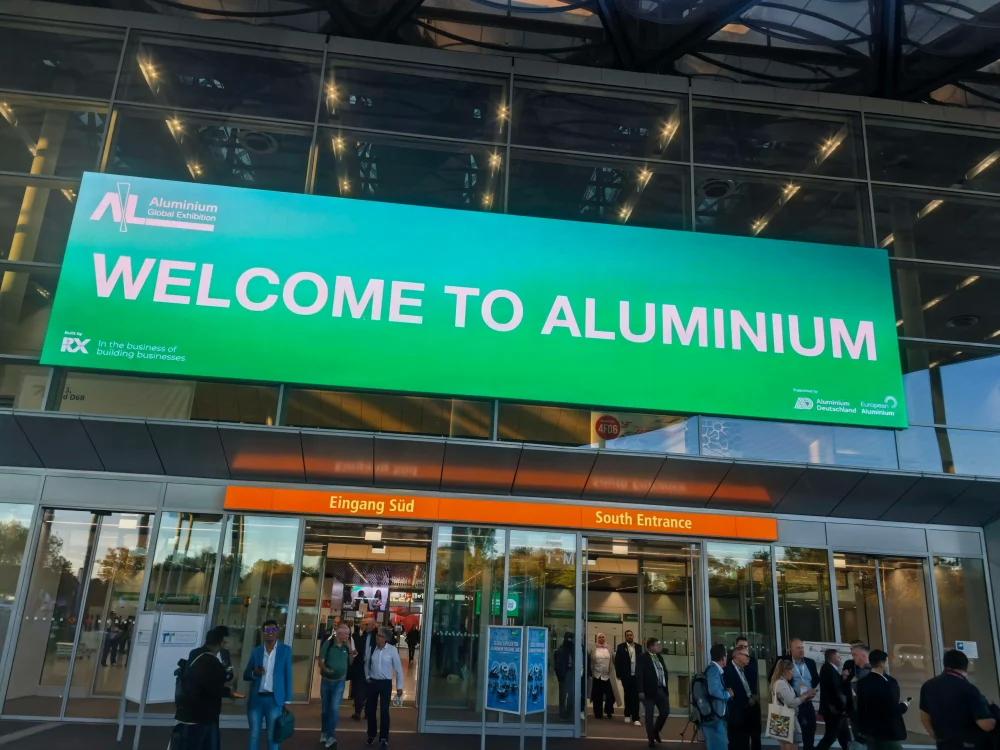
From October 6 to 8, 2026, AdTech Metallurgical Materials Co., Ltd. is exhibiting at ALUMINIUM 2026 in Düsseldorf, Germany, at Booth 6M18.
For AdTech, this exhibition is a good opportunity to meet aluminum producers, casting engineers, equipment companies, and distributors face to face. More importantly, it gives us the chance to discuss the problems that occur in an actual casting line—not just the products listed in a catalogue.
Our work is mainly around one section of the aluminum production process: molten aluminum treatment, filtration, and transfer.
What AdTech Brought to Düsseldorf
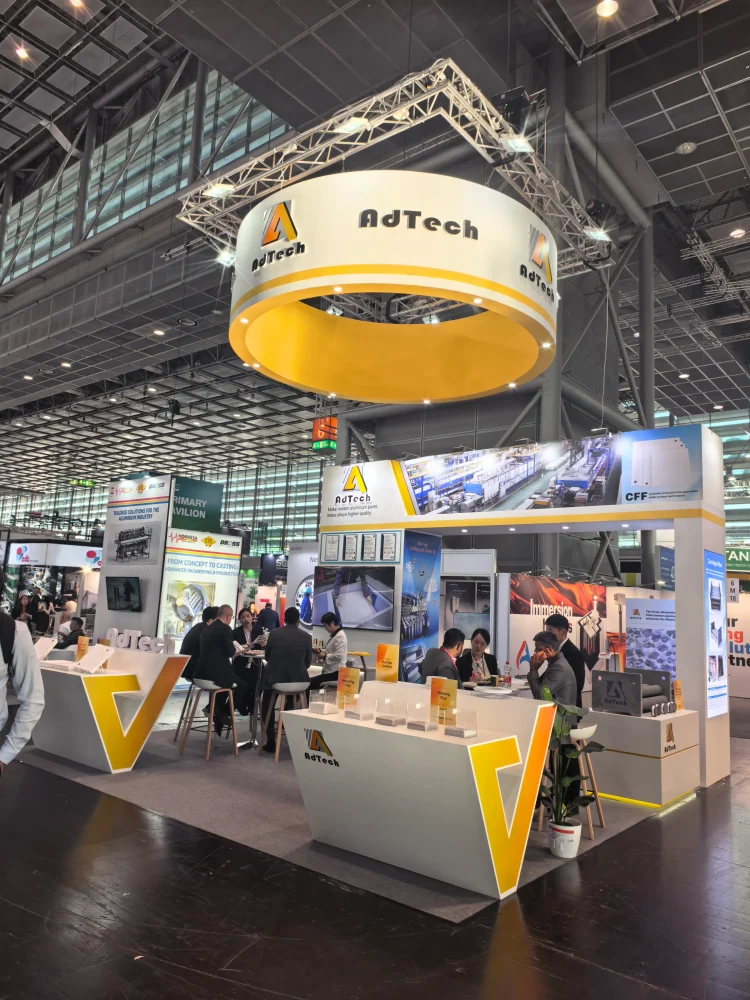
The products and systems we are presenting at ALUMINIUM 2026 cover several common applications in aluminum casting.
These include:
- Filtros de espuma cerâmica
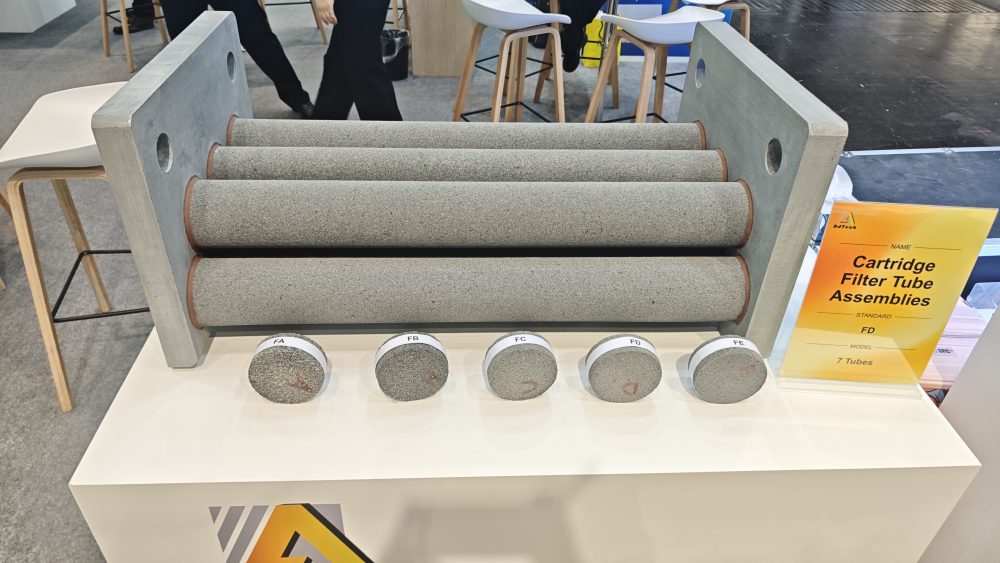
- Tubular and cartridge filters
- Refractory and ceramic materials used in aluminum casting
Some of these products are individual consumables, while others are complete systems or supporting equipment.
For example, a ceramic foam filter cannot be considered separately from the filter box in which it is installed. The filter size, PPI, sealing method, metal flow rate, operating temperature, and filter box design all affect how the filtration system works.
The same applies to molten aluminum launders. The launder is not simply a channel for moving metal from one point to another. Its refractory structure, heating method, insulation, dimensions, and flow-control design can all affect the condition of the metal before it reaches the casting machine.
These details are where many of the technical discussions at the exhibition begin.
Talking About the Part Between the Furnace and the Caster
In aluminum production, the main equipment often receives the most attention: the melting furnace, casting machine, rolling mill, extrusion press, and so on.
But between the furnace and the caster, there is another important section.
Molten aluminum needs to be treated, cleaned, filtered, and transferred before entering the casting process.
A typical process may look simple on paper:
Melting → Degassing → Filtration → Launder Transfer → Casting
In an operating plant, however, each step involves a number of practical considerations.
For degassing, the required treatment capacity and installation conditions need to match the casting line.
For filtration, the filter needs to be selected according to the alloy, metal flow, casting conditions, and required cleanliness.
For launders, heat loss and metal flow need to be considered together with the existing plant layout.
This is why customers do not always come to us with a simple question such as “How much is this filter?”
Quite often, the first question is about the production line.
What is the casting machine?
What is the metal flow rate?
What alloy is being produced?
Where is the existing filter installed?
What is the current launder length?
Is the customer replacing an existing system or building a new one?
These details can make a significant difference to the final recommendation.
Ceramic Foam Filters: The Details Matter
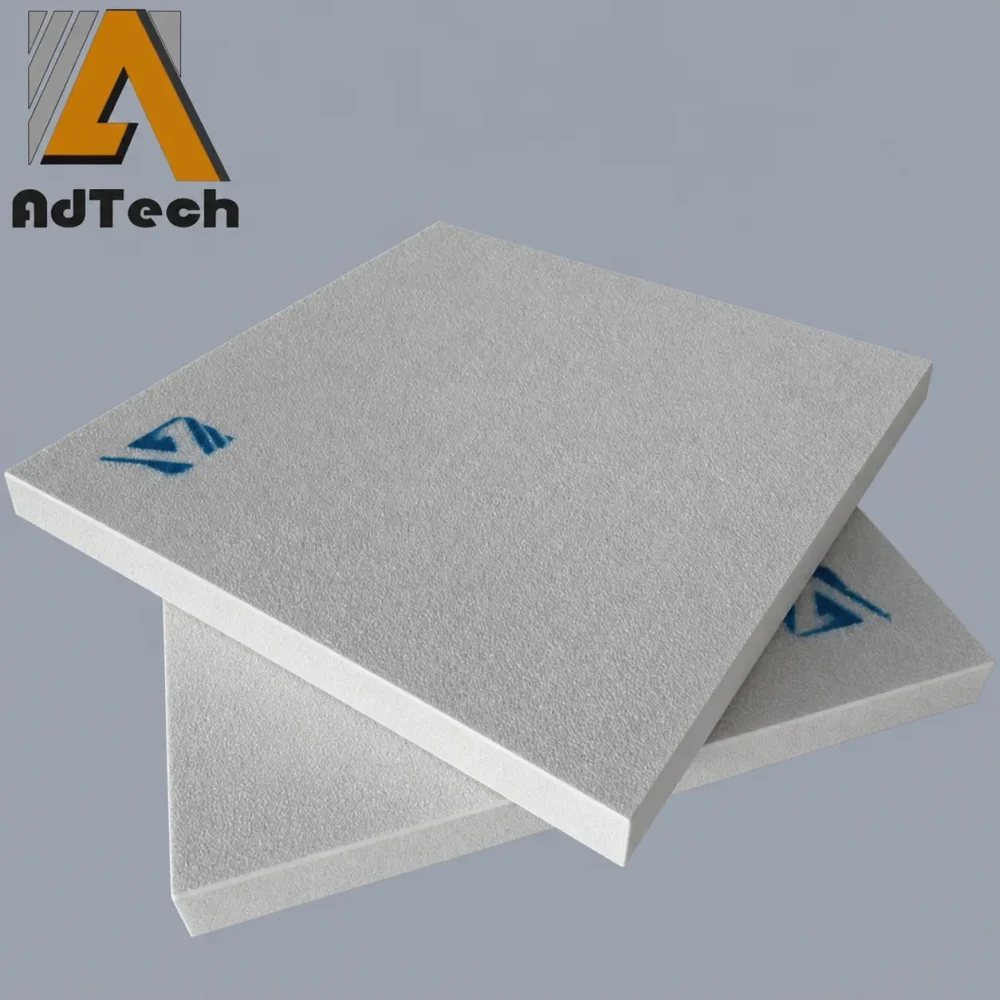
Ceramic foam filters are one of the products AdTech is showcasing at the exhibition.
For aluminum casting, the purpose of a ceramic foam filter is straightforward: to remove non-metallic inclusions from molten aluminum before casting.
But selecting a filter is not simply a matter of choosing a PPI number.
Filter dimensions, thickness, material, sealing, operating temperature, metal flow rate, and installation conditions all need to be considered.
A AdTech fabrica alumina ceramic foam filters for aluminum filtration, with customizable dimensions and PPI according to different applications.
Our commonly used filter thickness is 50 mm, while other dimensions can be produced according to the customer’s requirements.
The filter can also be supplied with an expandable sealing cotton edge, which helps with installation and sealing inside the filter box.
For customers who already have a filter box, providing the existing filter dimensions and installation details is often the fastest way for our engineers to determine a suitable filter specification.
Filtration Is Only One Part of Melt Treatment
Another important area of AdTech’s business is on-line degassing.
Hydrogen dissolved in molten aluminum can contribute to porosity during solidification. At the same time, oxide films and other non-metallic inclusions can affect the quality of the cast product.
Degassing and filtration therefore address different parts of the melt-quality problem.
A degassing unit is used to reduce dissolved hydrogen and assist melt treatment, while filtration removes solid non-metallic inclusions from the molten metal.
In an actual casting line, these processes are often used together rather than treated as two unrelated pieces of equipment.
This is also why AdTech provides both on-line degassing systems and filtration equipment.
The objective is not to sell a customer two separate products. It is to make sure that the treatment section works properly as part of the complete casting process.
From Standard Products to Customized Equipment
Not every aluminum plant has the same layout.
Some customers need a standard ceramic foam filter.
Others need a filter box designed around an existing casting line.
Some need a complete launder system with heating and insulation.
Others are looking to replace an existing launder while keeping the rest of the production line unchanged.
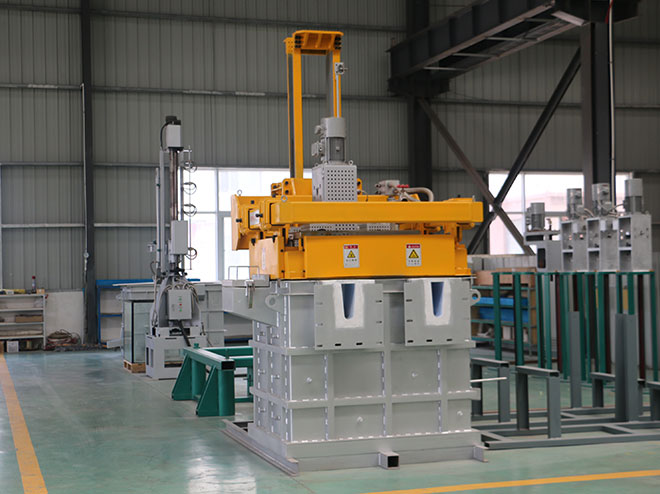
AdTech can manufacture and configure equipment according to these different requirements.
Our launder solutions, for example, can be supplied with different heating arrangements, including gas/flame heating, electric heating, and hot-air heating, depending on the application.
Other components, such as launder dams, integrated launders, front boxes, removable launders, and flow-control parts, can also be configured according to the customer’s installation conditions.
This type of customization is particularly important when working with an existing production line.
A new system has to fit the space available, connect with the existing equipment, and work with the customer’s operating conditions. A technically good product is not necessarily a good solution if it cannot be installed properly.
AdTech’s Approach to Aluminum Melt Treatment
AdTech has been working in the field of metallurgical materials and aluminum melt treatment for years, with its factory production beginning in 2013.
Our product range has expanded from individual refractory and ceramic products to equipment and systems used across the melt treatment section.
Today, our work covers several connected areas:
Melt treatment.
Degassing.
Filtration.
Molten aluminum transfer.
Flow control.
Casting support materials.
The common point between them is the molten aluminum itself.
The equipment may be different, but the final requirement is the same: the metal needs to reach the casting process in a stable and controlled condition.
Meet AdTech at ALUMINIUM 2026
ALUMINIUM 2026 is taking place in Düsseldorf from October 6–8, 2026.
AdTech Metallurgical Materials Co., Ltd. is exhibiting at Booth 6M18.
If you are visiting the exhibition and are working on aluminum melt treatment, filtration, degassing, or molten aluminum transfer, we welcome you to visit our booth and discuss your application with our team.
And if you are not attending ALUMINIUM 2026, you can also contact AdTech directly with your filter dimensions, casting capacity, alloy, existing equipment, drawings, or project requirements.
The more we know about the actual process, the more accurately we can recommend the right solution.