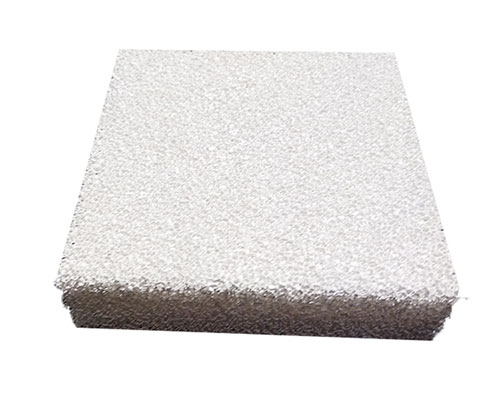
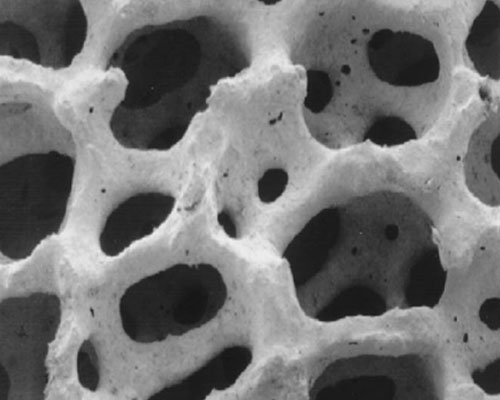
Porous ceramics are used in applications that require a combination of high-temperature stability, controlled porosity, low density, thermal insulation, corrosion resistance, or filtration. Their applications range from catalyst supports and thermal insulation to high-temperature gas and molten-metal filtration. In aluminum processing, open-cell porous ceramic filters are widely used to remove non-metallic inclusions from molten aluminum before casting.
What Makes Porous Ceramics Useful?
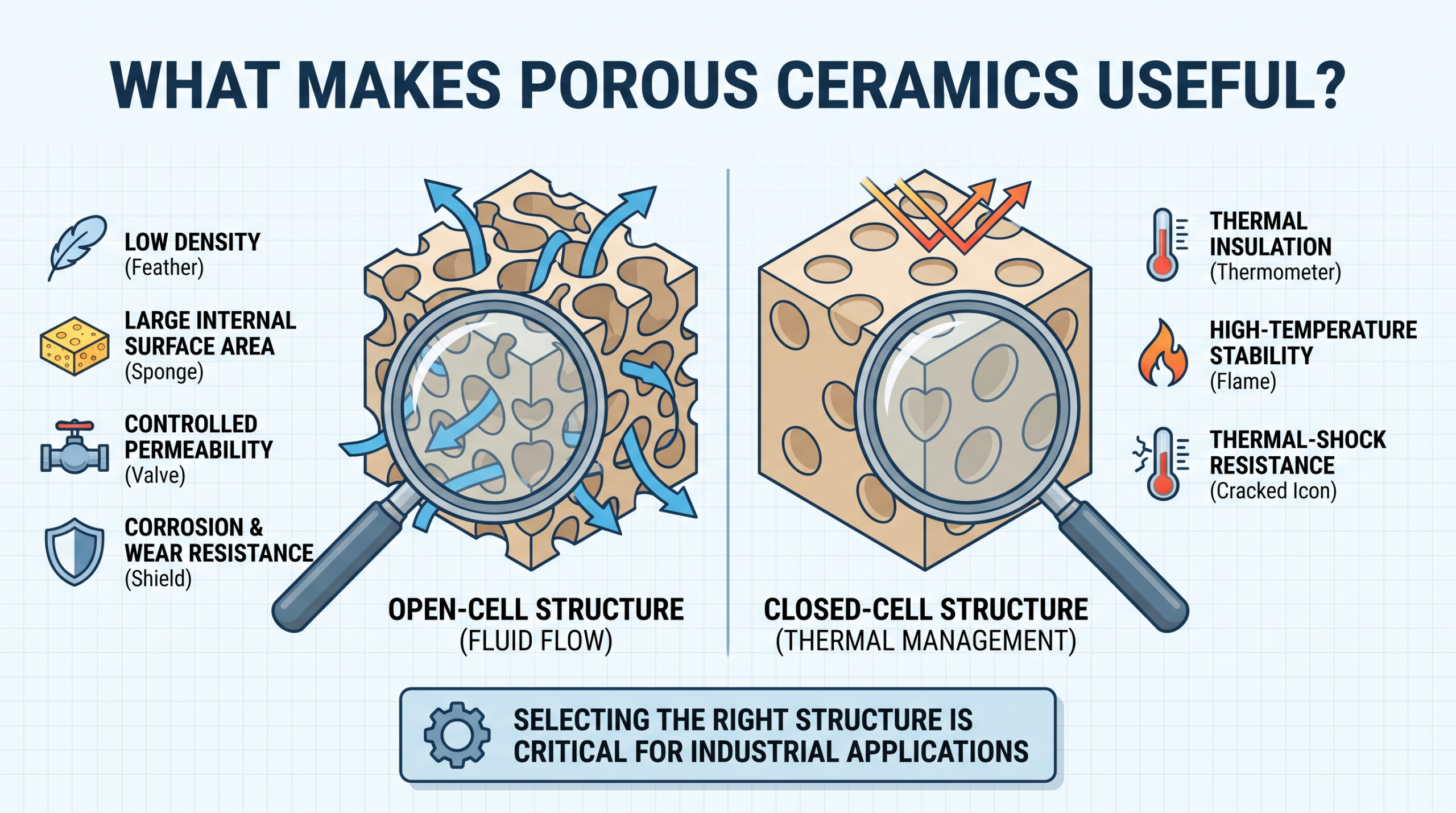
The performance of a porous ceramic is determined not only by its ceramic material, but also by its pore structure.
Depending on how the pores are formed and connected, porous ceramics can provide:
- Low density
- Large internal surface area
- Controlled permeability
- Thermal insulation
- High-temperature stability
- Thermal-shock resistance
- Corrosion and wear resistance
Open-cell structures are particularly useful when a fluid needs to pass through the material. Closed or highly insulating pore structures are more suitable for thermal-management applications.
This difference is important when selecting a porous ceramic for an industrial process.
What Are the Main Applications of Porous Ceramics?
Porous ceramics are used across several industries, but the required structure varies considerably by application.
| Başvuru | Ana İşlev | Important Properties |
|---|---|---|
| Molten-metal filtration | Remove suspended inclusions | Open porosity, permeability, thermal shock resistance |
| Gas filtration | Capture particles from hot gases | High-temperature stability, controlled pore structure |
| Catalyst support | Provide a large active surface | High surface area, chemical stability |
| Thermal insulation | Reduce heat transfer | Low thermal conductivity, low density |
| Separation and membranes | Control fluid or particle transport | Pore size and connectivity |
| High-temperature equipment | Protect or manage heat | Corrosion resistance, thermal stability |
Porous ceramics are therefore not one specific product. Their design changes according to whether the material needs to filter, support, insulate, separate, or transport.
How Are Porous Ceramics Used for Filtration?
Filtration is one of the most established industrial applications of open-cell porous ceramics.
A porous ceramic filter contains interconnected passages through which the molten metal or gas can flow. Particles are retained through a combination of mechanisms such as physical interception, tortuous flow, inertial effects, and interaction with the internal ceramic surfaces.
The result is different from a simple straight-hole screen. A three-dimensional porous structure provides a much longer and more complex flow path.
This is why open-cell ceramic foam is widely used for molten-metal purification.
What Is a Porous Ceramic Filter for Molten Aluminum?
A porous ceramic filter for aluminum casting is an open-cell ceramic filtration element installed in the molten-metal flow path.
As molten aluminum passes through the interconnected pores, suspended non-metallic inclusions are captured within the filter structure.
Common sources of these inclusions include:
- Oxide films and bifilms
- Slag or dross particles
- Refrakter parçacıklar
- Flux residues
- Other suspended non-metallic material
The filter does not simply block every particle at the first pore opening. Smaller inclusions can also be retained deeper inside the filter through the complex flow path and surface interactions.
Why Is Porosity Important in Ceramic Filters?
Porosity determines how much open space is available for molten metal to pass through the filter.
Commercial ceramic foam filters commonly have high open porosity, often around 80–90%, although the actual specification depends on the filter material and manufacturer.
Higher porosity can support permeability and flow, but filtration performance cannot be judged from porosity alone.
Other factors include:
- Pore size and PPI
- Filter thickness
- Filter area
- Ceramic composition
- Surface characteristics
- Kapsayıcı yükleme
- Metal akış hızı
- Filter-box design
A filter therefore needs to provide a practical balance between inclusion capture and molten-metal flow.
What Does PPI Mean in a Porous Ceramic Filter?
For ceramic foam filters, PPI means pores per inch and is used to describe the nominal pore structure.
A higher PPI generally indicates a finer pore structure, but PPI should not be treated as a direct measurement of filtration efficiency.
For example, choosing a finer filter can improve the capture of smaller inclusions under suitable conditions, but it may also increase flow resistance and the risk of blockage.
The appropriate PPI depends on the aluminum alloy, metal flow rate, casting duration, expected inclusion load, required cleanliness, and filter dimensions.
Where Are Porous Ceramic Filters Used in Aluminum Casting?
Porous ceramic filters can be used at different points in aluminum casting systems.
Tipik uygulama alanları şunlardır:
Furnace or holding furnace → Melt treatment → Ceramic filter → Launder → Casting machine
They are used in applications such as:
- Kütük döküm
- Slab casting
- Sürekli döküm
- Alüminyum alaşımlı döküm
- Wheel and automotive casting
- Rod casting
- Other processes requiring cleaner molten aluminum
The filter should be selected together with the filter box or filtration system rather than as an isolated component.
How Are Porous Ceramics Different From Ceramic Foam Filters?
The terms are related but are not interchangeable.
Gözenekli seramik is a broad material category covering different pore structures and applications.
Ceramic foam filter (CFF) is a specific type of open-cell porous ceramic designed for filtration.
| Dönem | Meaning |
|---|---|
| Gözenekli seramik | Broad class of ceramic materials containing pores |
| Open-cell porous ceramic | Interconnected pores allow fluid flow |
| Ceramic foam | Three-dimensional porous ceramic structure |
| Seramik köpük filtre | Open-cell ceramic specifically designed for filtration |
This distinction matters because a porous ceramic developed for thermal insulation may not have the permeability, strength, or chemical compatibility required for molten aluminum filtration.
What Materials Are Used for Porous Ceramic Filters?
The ceramic composition depends on the application temperature and molten material.
For aluminum filtration, alumina-based ceramic foam filters are widely used. Other ceramic materials, including silicon carbide and zirconia-based systems, are used for different high-temperature filtration applications.
Material selection should consider:
- Working temperature
- Molten-metal compatibility
- Termal şok direnci
- Mekanik mukavemet
- Kimyasal kararlılık
- Required filtration performance
The filter material must remain stable during heating, contact with molten metal, and the complete casting cycle.
Why Is Thermal Shock Resistance Important?
A ceramic filter can experience a significant temperature change when it is heated and brought into contact with molten metal.
Because ceramics are brittle materials, poor thermal-shock resistance can lead to cracking or failure.
This is particularly important in molten aluminum filtration, where the filter must withstand the transition from its storage or preheating condition to the operating temperature.
For this reason, material composition, pore structure, manufacturing quality, and preheating practice all matter.
Can Porous Ceramics Be Used as Catalyst Supports?
Yes. High internal surface area is one reason porous ceramics are used as catalyst supports.
The interconnected structure provides a large internal surface on which catalytic materials can be deposited. Porous ceramics can also provide chemical and thermal stability in demanding environments.
However, the ideal structure for a catalyst support is not necessarily the ideal structure for a molten-metal filter.
For catalyst applications, surface area, pore connectivity, permeability, and chemical compatibility may be prioritized differently from the requirements of metal filtration.
Can Porous Ceramics Be Used for Thermal Insulation?
Yes. Porosity can reduce thermal conductivity, making suitable porous ceramic structures useful for thermal insulation and other heat-management applications. Thermal behavior depends on ceramic composition as well as pore size, connectivity, and overall porosity.
This makes porous ceramics useful in selected high-temperature insulation systems where low weight and thermal stability are required.
However, a filter designed for high permeability should not be assumed to provide the same insulation performance as a purpose-built porous insulating ceramic.
How Should a Porous Ceramic Filter Be Selected for Aluminum?
The correct filter cannot be selected only by looking at the PPI number.
An aluminum producer should consider:
| Seçim Faktörü | Neden Önemli? |
|---|---|
| Alüminyum alaşımı | Determines melt condition and application requirements |
| Metal akış hızı | Determines required filter capacity |
| Casting time | Affects total inclusion loading |
| Inclusion level | Determines filtration demand |
| Filter PPI | Influences pore structure and flow resistance |
| Filter thickness | Affects filtration path |
| Filter area | Affects flow velocity and pressure drop |
| Çalışma sıcaklığı | Determines thermal requirements |
| Filter material | Determines chemical and thermal compatibility |
| Filter box | Ensures correct installation and metal sealing |
A common mistake is to choose a finer pore structure simply because it appears to offer finer filtration. In practice, the filter must provide the required cleanliness without restricting the metal flow excessively or blocking prematurely.
What Problems Can Occur With a Porous Ceramic Filter?
A filter can perform poorly even when the ceramic material itself is suitable.
Common problems include:
Filter blockage: excessive inclusion loading, insufficient filter area, or overly fine filtration.
Cracking: thermal shock, handling damage, or unsuitable installation.
Metal bypass: poor sealing between the filter and filter box.
Unstable flow: inappropriate filter dimensions, excessive pressure drop, or changing casting conditions.
Insufficient filtration: unsuitable PPI, filter area, filter type, or excessive upstream inclusion load.
This is why ceramic foam filtration should be evaluated as a complete filtration system, not simply as a consumable filter plate.
Why Are Porous Ceramics Important in Aluminum Melt Treatment?
For aluminum producers, porous ceramic filters are one part of a broader melt-cleanliness strategy.
A typical treatment sequence may be:
Melting → Alloy Adjustment → Degassing → Porous Ceramic Filtration → Launder → Casting
Each stage has a different role.
Gaz Giderme primarily reduces dissolved hydrogen.
Filtreleme primarily removes suspended non-metallic inclusions.
Keeping these functions separate helps engineers determine which process needs improvement when a casting-quality problem occurs.
Porous Ceramic Filter for Aluminum Casting
AdTech supplies ceramic foam filtration solutions for aluminum processing, including filter media and filtration components used in molten aluminum casting systems.
The appropriate filter specification depends on the customer’s alloy, casting method, metal flow rate, casting duration, filter dimensions, and required melt cleanliness.
For an aluminum filtration project, these parameters should be reviewed together rather than selecting a filter from PPI alone.
Frequently Asked Questions
What are porous ceramics used for?
Porous ceramics are used for filtration, catalyst supports, thermal insulation, gas treatment, separation, and other high-temperature applications.
What is a porous ceramic filter?
A porous ceramic filter is a ceramic material with interconnected pores that allow fluid to pass through while retaining suspended particles.
What is a ceramic foam filter?
A ceramic foam filter is an open-cell porous ceramic filtration element with a three-dimensional interconnected pore structure.
What are porous ceramic filters used for in aluminum casting?
They are mainly used to remove suspended non-metallic inclusions from molten aluminum before casting.
What does PPI mean in a ceramic foam filter?
PPI means pores per inch and describes the nominal pore structure of a ceramic foam filter.
Does higher PPI always mean better filtration?
No. A higher PPI generally represents a finer pore structure, but the suitable PPI depends on flow rate, inclusion loading, casting time, filter area, and required cleanliness.
What is the typical porosity of a ceramic foam filter?
Many commercial ceramic foam filters have open porosity in the range of about 80–90%, although specifications vary by material and manufacturer.
Do porous ceramic filters remove hydrogen from aluminum?
No. Ceramic filtration primarily removes suspended non-metallic inclusions. Dissolved hydrogen is primarily controlled through melt degassing.
Why does a ceramic filter need thermal shock resistance?
The filter experiences rapid heating when exposed to molten aluminum. Adequate thermal-shock resistance reduces the risk of cracking during operation.
How do I choose a porous ceramic filter for aluminum?
Consider the alloy, metal flow rate, casting duration, inclusion load, PPI, filter size and thickness, operating temperature, filter material, and filter-box configuration.