
Seramik elyaf kağıdı nedir ve neyden yapılır?
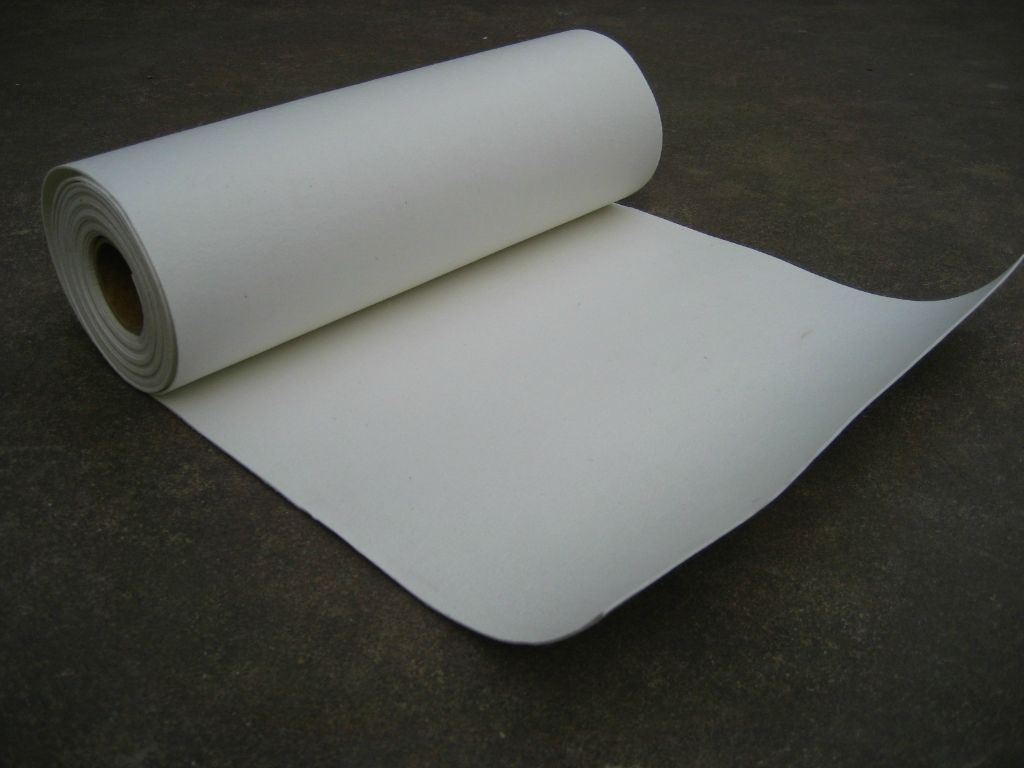
Seramik elyaf kağıdı, refrakter seramik elyaflardan üretilen ince ve esnek bir tabaka malzemesidir — seramik elyaf battaniye ve levhaların temelini oluşturan alümina-silika bileşimi ile aynıdır, ancak ıslak serim kağıt üretim süreciyle kağıt benzeri bir forma işlenmiştir. Ellerinizde ne kadar hafif hissedilse de şaşırtıcı derecede dayanıklı olan bu pürüzsüz ve tutarlı ürün elde etmek için, lifler suda dağıtılır, hareketli bir tel örgü üzerinde homojen bir tabaka haline getirilir, ardından kurutulur ve kalenderlenir.
Standart sınıflar için lif bileşimi tipik olarak –47% alümina (Al₂O₃) ve –54% silika (SiO₂) aralığındadır; alümina içeriği daha yüksek ve zirkonyumla zenginleştirilmiş varyantlar ise performansı sıcaklık ölçeğinde daha da yukarıya taşır. Kağıda işlenebilirlik ve ham mukavemet kazandırmak amacıyla, şekillendirme aşamasında genellikle nişasta veya lateks gibi organik bağlayıcılar eklenir. Bu bağlayıcılar ilk ısıtma döngüsü sırasında yanarak yok olur ve çalışma sıcaklığında kimyasal olarak kararlı, tamamen inorganik bir yapı bırakır.
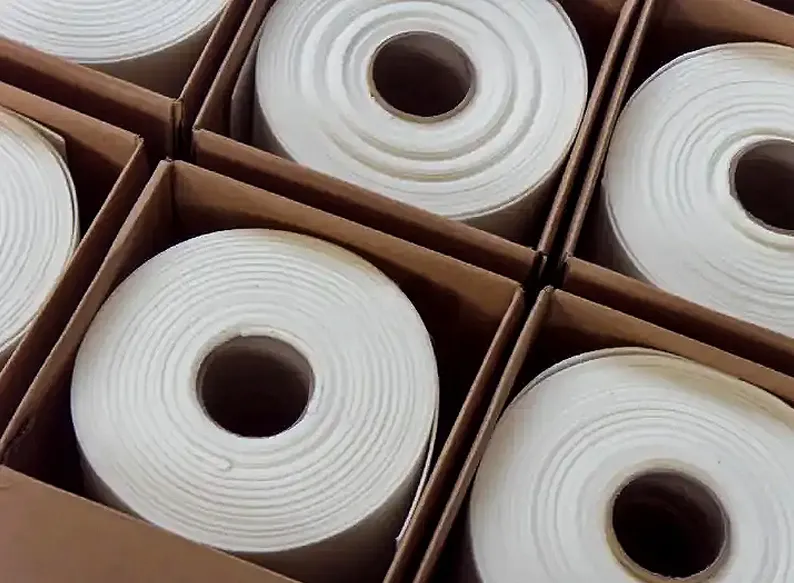
Sonuçta elde ettiğiniz ürün, metrekare başına 80 ila 200 gram arasında bir ağırlığa sahip, 1 mm ile 6 mm arasında kalınlıklarda üretilen ve ısınana kadar kalın karton gibi işlenebilen bir malzemedir. Tipik rulo genişlikleri 300 mm ile 1220 mm arasında değişir; rulo uzunlukları ise kalınlığa bağlı olarak 10 ila 30 metre arasındadır. Bu ürünü makasla kesebilir, kalıpla delebilir veya standart kağıt üretim ekipmanlarında contalar halinde damgalayabilirsiniz — işte bu yüzden, battaniye veya kartonun aşırı kalın olacağı hassas uygulamalar için son derece kullanışlıdır.
AdTech’te seramik elyaf kağıdı, standart 1260 °C ve yüksek alümina içeren 1430 °C sınıflarında üretilmekte olup, hem standart yoğunluklu (128–160 kg/m³) hem de yüksek yoğunluklu çeşitleri mevcuttur.
Seramik Elyaf Kağıdı, Seramik Elyaf Battaniyesinden ve Levhadan Nasıl Farklıdır?
Bu soru sürekli gündeme geliyor ve bu konudaki kafa karışıklığı anlaşılabilir bir durum — zira hepsi aynı temel elyaf kimyasından üretiliyor. Aradaki fark, üretim sürecinde, ortaya çıkan fiziksel formda ve dolayısıyla her bir ürünün uygun olduğu kullanım alanlarında yatıyor.
Seramik elyaf battaniye iğne ile delme işlemine tabi tutulmuştur; bu da malzemeye kalınlık, hacim ve sıkıştırılabilirlik kazandırır. Düzensiz şekilleri sarmak, geniş yalıtım hacimlerini doldurmak ve önemli ölçüde yalıtım kalınlığı gerektiren uygulamalar için doğru seçimdir. Ancak bu battaniye hacimlidir — pratik minimum kalınlığı yaklaşık 25 mm’dir — ve kenarlarının sökülmeden hassas şekillerde kalıpla kesilmesi gerçekten zordur.
Seramik elyaf levha vakumla sıkıştırılarak sert panellere dönüştürülür. Yapısal mukavemete sahiptir ve kendi ağırlığı altında sarkmaz veya deforme olmaz. Bunun karşılığında esnek değildir ve özel bir şekillendirme işlemi yapılmadıkça kavisli yüzeylere uyum sağlamaz.
Seramik elyaf kağıdı Ne battaniyenin ne de levhanın ulaşamadığı alanları kaplar. 1–6 mm kalınlığıyla, yerin çok kısıtlı olduğu uygulamalarda kullanılabilir. Kavisli yüzeylere uyum sağlayacak ve silindirik bileşenlerin etrafını saracak kadar esnektir. Contalar, sızdırmazlık elemanları ve karmaşık şekiller için temiz bir şekilde kalıp kesimi yapılabilir. Ayrıca, ıslak serme işlemi iğne delme yöntemine göre daha homojen bir elyaf dağılımı sağladığından, levha genelinde termal özellikleri daha tutarlıdır.
Şöyle düşünün: Battaniye geniş hacimleri yalıtır, levha sert yapısal yalıtım sağlar ve kağıt ise hassas işleri üstlenir — ince kesitli contalar, katmanlı refrakter sistemlerdeki katman arası yalıtım, ev aletleri üretimi için kalıpla kesilmiş bileşenler ve dar bir alanda yüksek sıcaklık yalıtımına ihtiyaç duyulan her türlü durum.
Seramik elyaf kağıdı hangi sıcaklığa dayanabilir?
Burada kalite seçimi, halat veya levhalarda olduğu kadar önemlidir. Seramik elyaf kağıdının sınıflandırma sıcaklığı, diğer refrakter seramik elyaf ürünleri için kullanılan ASTM C892 / EN 1094-1 standardına uygundur; ancak kesitinin daha ince olması nedeniyle kağıt, daha kalın ürünlere kıyasla termal dengeye daha hızlı ulaşır — hızla ısınır, dolayısıyla neredeyse anında tam çalışma sıcaklığına maruz kalır.
| Sınıf | Lif Kimyası | Sınıflandırma Sıcaklığı | Önerilen Sürekli Kullanım | Ateşleme Kaybı (LOI) |
|---|---|---|---|---|
| Standart (STD) | Al₂O₃ ~45%, SiO₂ ~53% | 1050 °C (1920 °F) | 900 °C | 8–12% |
| Yüksek Saflık (HP) | Al₂O₃ ~47%, SiO₂ ~52%, düşük Fe₂O₃ | 1260 °C (2300 °F) | 1100 °C | 6–10% |
| Yüksek Alüminalı (HA) | Al₂O₃ ~52–55%, SiO₂ ~43–46% | 1400 °C (2550 °F) | 1200 °C | 5–8% |
| Zirkonya Zenginleştirilmiş (HZ) | Al₂O₃ ~36%, SiO₂ ~49%, ZrO₂ ~15% | 1430 °C (2600 °F) | 1250 °C | 4–7% |
ASTM C892 ve ASTM C871 (Refrakter Malzemelerin Kimyasal Analizi için Standart Test Yöntemleri) uyarınca sınıflandırma sıcaklıkları ve LOI değerleri. LOI, ilk ısıtma döngüsü sırasında yanarak buharlaşan organik bağlayıcı içeriğini yansıtır.
Ateşleme kaybı değerine dikkat etmek önemlidir. İlk kullanım sırasında organik bağlayıcılar yandığında, kağıt kütle kaybına uğrar ve küçük boyut değişiklikleri gösterir — tipik olarak 1000°C’de HP sınıfı kağıt için 1%’den az doğrusal büzülme. İlk döngü boyunca boyutsal kararlılığın önemli olduğu uygulamalarda (örneğin hassas contalar), tasarım aşamasında bu durum dikkate alınmalıdır. AdTech’in HP sınıfı kağıdı, LOI değerini en aza indirirken, elleçleme ve kalıp kesimi için yeterli ham mukavemeti koruyacak şekilde formüle edilmiştir.
Seramik elyaf kağıdı endüstride gerçekte nerede kullanılır?
Seramik elyaf kağıdının kullanım alanları, çoğu kişinin sandığından daha geniş ve çeşitlidir. Bu malzemeyi, ilk bakışta hiç beklemeyeceğiniz yerlerde bile gördüm.
Conta üretimi. Bu, hacim açısından muhtemelen en büyük tekil uygulama alanıdır. Kalıpla kesilmiş seramik elyaf kağıt contalar, endüstriyel fırınlarda, laboratuvar fırınlarında, fırın gözetleme deliklerinde ve ısıl işlem ekipmanlarında kullanılır. Malzeme, standart kalıp kesme preslerinde çelik kalıplarla temiz bir şekilde kesilir; bu da aynı özellikteki contaların yüksek hacimlerde üretilmesini ekonomik hale getirir. ±0,5 mm'lik toleranslar rutin olarak elde edilebilir ve bu da fırın flanşlarının ve kapı çerçevelerinin büyük çoğunluğu için yeterlidir.
Çok katmanlı refrakter sistemlerde katmanlar arası yalıtım. Kompozit bir refrakter kaplama oluştururken — örneğin, mikro gözenekli bir panelin arkasında seramik elyaf levha bulunan, sıcak yüzeyli bir döküm malzeme — seramik elyaf kağıdı genellikle sert bileşenler arasında bir kayma tabakası olarak kullanılır. Bu kağıt, yüzeydeki düzensizlikleri doldurur, mütevazı bir ek yalıtım katkısı sağlar ve termal döngü sırasında katmanların birbirine göre hareket etmesine çatlama olmadan izin verir.
Seramik ve fırın donanımlarında genleşme boşluklarının doldurulması. Seramik fırın rafları ve direkleri ısıtıldığında genleşir. Bu genleşmeye yönelik önlem alınmazsa, çatlar veya eğrilir. Üst üste yerleştirilmiş fırın donanımı parçalarının arasına yerleştirilen ince seramik elyaf kağıt şeritleri, farklı genleşme oranlarını dengeler ve soğuma sırasında parçaların birbirine sıkışmasını ve çatlamasını önler.
Alüminyum döküm ekipmanlarında yedek yalıtım. Fırın ile kalıp arasında erimiş alüminyumu ileten kanallarda, oluklarda ve geçiş parçalarında, seramik elyaf kağıdı, önceden kalıplanmış refrakter şekillerin altında esnek bir destek tabakası olarak kullanılır. Bu malzeme, aksi takdirde ısının birincil yalıtımı atlamasına neden olacak boşlukları doldurur. Bu, AdTech’in alüminyum döküm ve erimiş metal taşıma sistemleri alanındaki daha geniş kapsamlı çalışmalarıyla doğrudan bağlantılıdır.
Beyaz eşya ve ısıtma, havalandırma ve iklimlendirme (HVAC) üretimi. Ev tipi ve ticari fırınlar, kurutucular ve endüstriyel ısıtma ekipmanlarında, kapı contaları ve iç yalıtım levhaları olarak seramik elyaf kağıdı kullanılır. Bu malzemenin standart üretim ekipmanlarında preslenip şekillendirilebilme özelliği, onu yüksek hacimli ev aletleri üretimi için cazip kılmaktadır.
Isıtma elemanları ve termokupllar için koruyucu kılıf. Endüstriyel fırınlardaki dirençli ısıtma elemanları, hemen arkalarındaki fırın astarına doğrudan radyasyon hasarını önlemek amacıyla bazen bir kat seramik elyaf kağıdıyla sarılır. Termokupl kılıfları da fırın duvarından geçtiği yerlerde benzer bir işlemden geçirilir.
Elektronik ve yarı iletken üretimi. Yüksek saflıkta, düşük demir içerikli seramik elyaf kağıtlar, demir veya alkali metallerden kaynaklanan kirlenmenin en aza indirilmesi gereken yarı iletken difüzyon fırınlarında ayırıcı tabaka olarak kullanılır.
Seramik elyaf kağıdının başlıca fiziksel özellikleri nelerdir?
Bu malzemeyi bir mühendislik uygulaması için belirlerken, rakamlar konusunda net olmak önemlidir. İşte HP sınıfı seramik elyaf kağıdının temel özellikleri açısından genellikle sergilediği değerler:
| Mülk | 1 mm kalınlık | 3mm Thickness | 6mm Thickness | Test Standard |
|---|---|---|---|---|
| Yığın Yoğunluğu | 128–160 kg/m³ | 128–160 kg/m³ | 128–160 kg/m³ | ASTM C167 |
| Tensile Strength (MD) | 0.15–0.25 MPa | 0.18–0.28 MPa | 0.20–0.30 MPa | ASTM D828 |
| Thermal Conductivity @ 400°C | 0.10–0.12 W/m·K | 0.10–0.12 W/m·K | 0.10–0.12 W/m·K | ASTM C177 |
| Thermal Conductivity @ 800°C | 0.18–0.22 W/m·K | 0.18–0.22 W/m·K | 0.18–0.22 W/m·K | ASTM C177 |
| Max. Linear Shrinkage @ 1000°C | <1.0% | <1.0% | <1.0% | ASTM C356 |
| Temperature Classification | 1260 °C | 1260 °C | 1260 °C | ASTM C892 |
Physical property data represents typical values for AdTech HP-grade ceramic fiber paper. Actual values may vary by ±10% depending on batch. Independent verification available upon request for quality-critical procurement.
A few things jump out from that table. The thermal conductivity values — 0.10–0.12 W/m·K at 400°C — are competitive with much thicker insulation products. That’s the nature of the material: even a 3mm sheet provides meaningful thermal resistance. The tensile strength numbers look modest in absolute terms, but for a 3mm paper-form product, they’re actually quite good — enough to handle without tearing during normal installation.
Can Ceramic Fiber Paper Be Cut, Formed, and Fabricated?
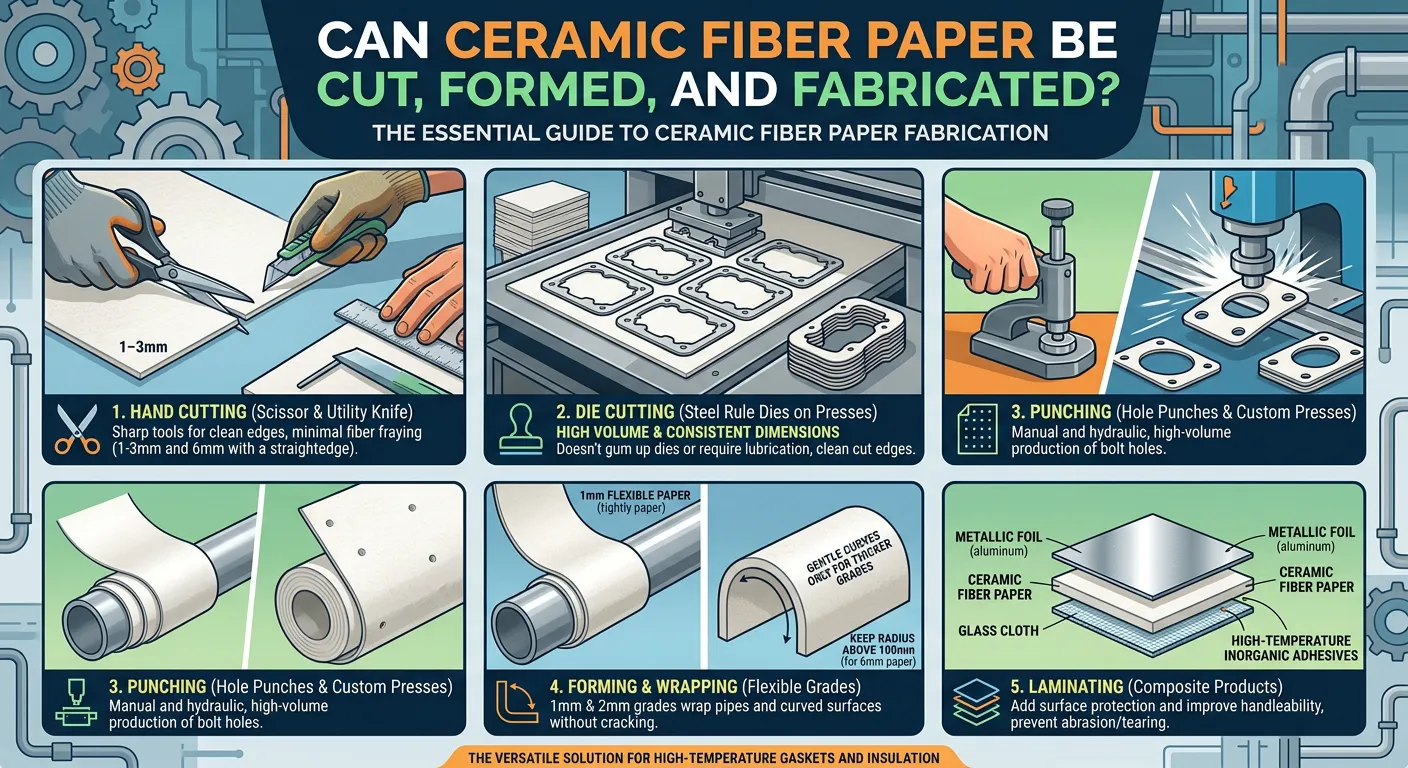
Yes, and this fabricability is genuinely one of its best selling points. Unlike ceramic fiber board, which requires power tools to cut, and unlike ceramic fiber blanket, which frays and sheds fibers if you try to cut it with anything less than a sharp knife, ceramic fiber paper behaves like — well, like paper. Within reason.
Hand cutting. Sharp scissors or a utility knife cut 1–3mm paper cleanly. For 6mm paper, a straightedge and a fresh utility knife blade gives clean edges without tearing.
Die cutting. This is where ceramic fiber paper really shines. Standard steel-rule dies on flatbed cutting presses stamp out gaskets and seals in high volumes with consistent dimensions. The material doesn’t gum up dies, doesn’t require lubrication, and produces clean cut edges with minimal fiber fraying. Most gasket manufacturers who work with high-temperature materials have die-cutting operations set up for ceramic fiber paper.
Punching. Hole punches, both manual and hydraulic, work well for producing bolt holes in gaskets. For high-volume production, custom punch presses turn out hundreds of identical gaskets per hour.
Forming and wrapping. The 1mm and 2mm grades are flexible enough to wrap around cylinders, pipes, and curved surfaces without cracking. Thicker grades can be bent around gentle curves but will crack on tight radii — try to keep the bend radius above 100mm for 6mm paper.
Laminating. Ceramic fiber paper can be laminated to metallic foil, glass cloth, or other facing materials using high-temperature inorganic adhesives. These composite products add surface protection and improve handleability in applications where the bare paper might abrade or tear during installation.
How Does Ceramic Fiber Paper Perform as a Gasket Material?
Gasket performance comes down to three things: sealing effectiveness under compression, resistance to blowout at operating pressure, and long-term stability so the gasket doesn’t require constant re-torquing. Here’s how ceramic fiber paper stacks up on each count.
Compression sealing. Ceramic fiber paper compresses readily under bolt load, flowing into surface irregularities and microscopic imperfections on flange faces. It doesn’t require high bolt loads to achieve an effective seal — important when you’re working with thin cast iron or ceramic flanges that can crack under excessive torque.
Blowout resistance. Paper-form ceramic fiber isn’t designed for high-pressure service. In furnace and kiln applications — which typically operate at slightly negative pressure (draft) or very low positive pressures — blowout isn’t a concern. If your application involves gauge pressures above about 0.5 bar, you’d want to look at reinforced ceramic fiber sheet or a metal-jacketed gasket instead.
Long-term stability. This is where ceramic fiber paper outperforms organic-binder-based gasketing materials like compressed fiber sheet (CFG). Above 300°C, CFG oxidizes and hardens, eventually losing its compressibility and allowing flange joint leakage. Ceramic fiber paper, once its organic binder has burned out in the first heat cycle, is purely inorganic and maintains its properties indefinitely at operating temperature — no oxidation, no carbonization, no hardening.
Şu U.S. Department of Energy’s Better Plants program has identified high-temperature gasket performance as a meaningful factor in industrial energy efficiency, noting that leaking furnace joints can increase energy consumption by 5–15% in susceptible equipment types.
AdTech Real Case: Upgrading a Japanese Ceramic Kiln Manufacturer’s Production Line
In mid-2024, a specialty ceramics manufacturer based in Aichi Prefecture, Japan, approached AdTech with a specific and somewhat unusual problem. The company produced fine technical ceramics — alumina substrates, zirconia components, and silicon carbide structural parts — in a line of continuous pusher kilns running at peak temperatures of 1400°C.
Their existing interlayer insulation between kiln furniture components was a domestic fiberglass paper product rated to 700°C. During a routine process audit, their quality engineer noticed that the fiberglass paper was completely disintegrating above the transition zone in their kilns, where temperatures exceeded 800°C. Fragments of degraded fiberglass were contaminating the kiln atmosphere and, in some cases, adhering to the surfaces of sintered ceramic components — which caused rejection rates in their high-purity alumina substrate line to spike from a baseline of 2.3% to over 7% during certain production runs.
The contamination source wasn’t immediately obvious — the failed fiberglass paper fragments were small and only showed up under microscopic surface inspection. It took their quality team three months to trace the rejects back to the kiln furniture insulation.
AdTech recommended our HA-grade ceramic fiber paper (1400°C classification, 3mm thickness, 160 kg/m³ density). The high-alumina grade was specified — rather than standard HP-grade — because the kiln peak temperature of 1400°C left very little safety margin for the HP grade. The low iron content of our HA paper (Fe₂O₃ under 0.3%) was also critical, since iron contamination is particularly damaging in alumina substrate sintering.
The customer ordered an initial trial quantity of 2,400 square meters in 300mm × 600mm pre-cut sheets, sized to match their kiln furniture dimensions and minimize on-site waste. AdTech also supplied a small quantity of 1mm HA-grade paper for use as slip sheets between stacked components in their shuttle kilns.
Results after 90 days:
- Surface rejection rate on alumina substrates returned to 2.1% — actually slightly below the pre-problem baseline, likely because the ceramic fiber paper provided better dimensional separation between kiln furniture pieces than the original material
- Zero paper fragment contamination incidents detected in the 90-day monitoring period
- Maintenance team reported that the AdTech paper was easier to cut and handle than the previous product, reducing preparation time per kiln load
- Kiln furniture longevity improved because the ceramic fiber paper cushioned thermal expansion differentials that had previously caused stress cracking in silicon carbide setter plates
Within six months of the initial trial, the customer had transitioned their entire ceramic fiber paper supply to AdTech, placing quarterly orders covering four kiln lines. We subsequently supplied high-purity ceramic fiber board for their kiln car top insulation, and discussions are ongoing about additional insulation solutions for a planned kiln expansion in 2025.
The lesson from this case isn’t complicated: using the wrong temperature-rated material in a precision manufacturing environment costs far more in scrap and quality failures than the price difference between grades ever would. Getting the spec right from the start is always cheaper than fixing it after the damage is done.
How Do You Select the Right Ceramic Fiber Paper Thickness?
Thickness selection is partly thermal engineering and partly practical constraint — you’re often limited by the physical space available in the application.
For gasket applications, the general rule is to use the thinnest sheet that provides adequate compression and sealing under your bolt load. Thinner gaskets compress more uniformly and are less likely to extrude under clamping force. For most furnace door and inspection port applications, 1–3mm is the right range.
For interlayer insulation in composite refractory systems, the thermal contribution of the paper needs to be weighed against space constraints. A 3mm HP-grade paper contributes roughly 0.015 m²·K/W of thermal resistance at 600°C mean temperature — modest but meaningful in a tightly designed composite lining.
For protective wrapping around heating elements or thermocouple sheaths, 1–2mm provides adequate mechanical protection without adding significant thermal mass that would slow system response time.
| Başvuru | Recommended Thickness | Sınıf | Key Reason for Selection |
|---|---|---|---|
| Furnace door gaskets (≤1000°C) | 1–3mm | HP (1260°C) | Adequate compression sealing, clean die-cut edges |
| Kiln furniture interlayer | 3mm | HA (1400°C) | Temperature margin, low contamination risk |
| Heating element wrap | 1–2mm | HP (1260°C) | Flexibility for wrapping, minimal thermal mass |
| Composite lining slip layer | 3–6mm | HP or HA | Fills surface voids, accommodates expansion |
| Appliance oven door insulation | 3–6mm | STD (1050°C) | Cost-effective for lower temperature service |
Application recommendations based on AdTech field installation experience and customer feedback across aluminum processing, ceramics manufacturing, and industrial heating equipment sectors.
If you’re unsure about thickness for a specific application, the practical approach is to order a small quantity of two adjacent thicknesses and test both. Ceramic fiber paper is inexpensive enough that a test quantity costs very little relative to the engineering time spent trying to calculate the optimum from first principles. Talk to our technical applications team if you want guidance before placing a test order — we’ve seen enough installations to give you a well-informed starting recommendation.
What Should You Know About Handling and Storage?
Ceramic fiber paper is more robust than it looks, but it has a few quirks worth knowing about.
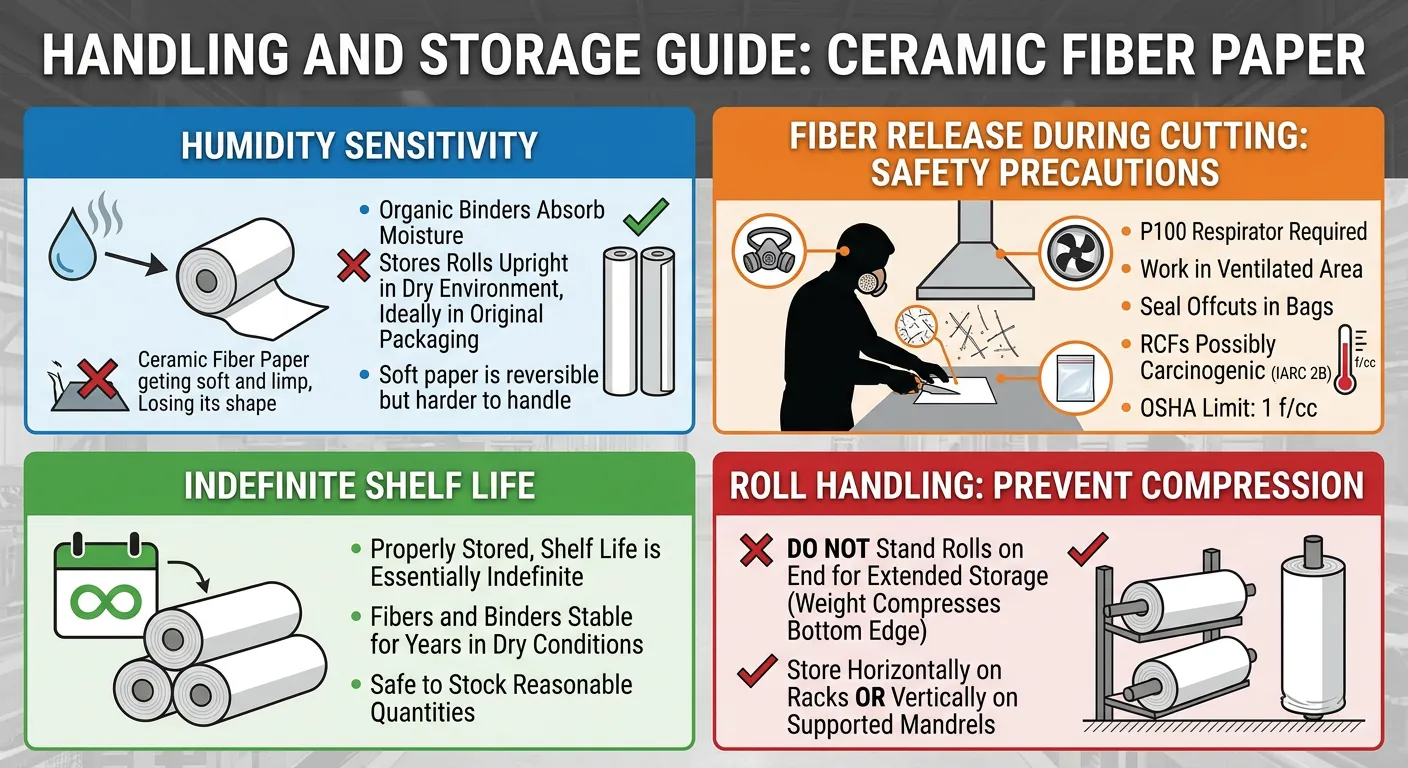
Humidity sensitivity. The organic binders used in green (unfired) ceramic fiber paper absorb moisture from the air. In humid climates, rolls stored in open conditions can become limp and lose some of their handleability. Store rolls upright in a dry environment, ideally in original packaging until needed. This isn’t a product-damaging problem — the paper recovers its properties once dried — but it makes on-site handling messier.
Fiber release during cutting. Cutting ceramic fiber paper releases airborne respirable fibers. Follow the same precautions as for other refractory ceramic fiber products: P100 respirator, work in ventilated conditions, and dispose of offcuts in sealed bags. The IARC classifies refractory ceramic fibers as Group 2B (possibly carcinogenic), and workplace exposure limits apply — typically 1 fiber per cubic centimeter in the US under OSHA guidance.
Shelf life. Properly stored, ceramic fiber paper has essentially indefinite shelf life. The fibers don’t degrade at ambient temperature, and the binders remain stable for years in dry conditions. There’s no meaningful expiry date to worry about, which makes it practical to stock in reasonable quantities.
Roll handling. Don’t stand rolls on end for extended storage — the weight of the roll can permanently compress the bottom edge. Store horizontally on racks, or vertically on purpose-built mandrels that support the inner diameter.
Why Ceramic Fiber Paper Is Worth Specifying Correctly
It’s easy to treat ceramic fiber paper as a commodity — a thin sheet of thermal insulation that gets stuck between flanges or wrapped around things. But getting the grade, thickness, and density right actually matters, especially in precision manufacturing environments where contamination risk and dimensional stability affect product quality.
The cost difference between a standard 1050°C paper and an HA-grade 1400°C paper is maybe 40–60% per square meter. In most applications, that price difference represents a tiny fraction of the total operating cost — and it’s completely insignificant compared to the cost of a quality failure traced back to insulation contamination, or the labor cost of emergency maintenance when an undersized gasket blows through.
AdTech manufactures ceramic fiber paper with tight controls on fiber chemistry, binder content, and dimensional tolerances. Every batch comes with a material test report. If you have an application that needs something outside our standard range — custom widths, pre-cut shapes, special fiber chemistry — our product team at AdTech is the right place to start. Or head straight to the ceramic fiber paper specifications page to pull the technical data you need.
Sık Sorulan Sorular
1. What is ceramic fiber paper used for?
The most common applications are high-temperature gaskets, interlayer insulation between refractory components, kiln furniture separators, heating element wraps, and appliance insulation. It’s also used as a die-cut seal material in laboratory furnaces, industrial ovens, and heat treatment equipment where thin-profile insulation is needed.
2. What temperature can ceramic fiber paper withstand?
Standard grade handles up to 1050°C, HP grade reaches 1260°C, and high-alumina grades go to 1400°C or higher. Always choose a grade that gives you at least 150°C of headroom above your actual operating temperature — especially for gasket applications where the paper reaches thermal equilibrium almost instantly due to its thin cross-section.
3. How thin can ceramic fiber paper be?
AdTech produces ceramic fiber paper as thin as 1mm. Thinner products exist on the market — some manufacturers offer 0.5mm grades — but handling becomes difficult below 1mm and the insulation contribution is minimal. For most practical applications, 1–3mm strikes the right balance between thermal performance, mechanical strength, and ease of handling.
4. Can I cut ceramic fiber paper with scissors?
Yes, for 1–3mm thicknesses, sharp scissors or a utility knife work perfectly. For 6mm paper, use a fresh utility blade against a straightedge. For high-volume production, steel-rule dies on flatbed cutting presses produce clean, repeatable cuts. Always wear a P100 respirator when cutting — the process releases airborne fibers regardless of the cutting method.
5. Does ceramic fiber paper shrink when heated?
Slightly. Expect less than 1% linear shrinkage at 1000°C for HP-grade paper, plus a 6–10% mass loss from organic binder burnout during the first heat cycle. Both effects stabilize after the initial firing. For precision gasket applications, factor the burnout shrinkage into your design dimensions, or pre-fire the gaskets before installation if tight tolerances matter.
6. Is ceramic fiber paper the same as kaowool paper?
Kaowool is a brand name that’s become a generic term in some markets, similar to how people say “Kleenex” when they mean tissue paper. Ceramic fiber paper from any reputable manufacturer — including AdTech — uses essentially the same alumina-silica fiber chemistry. The real differences between brands come down to fiber quality, binder content, density consistency, and iron oxide levels — not the product name.
7. Can ceramic fiber paper replace asbestos gaskets?
Yes, and it has been doing exactly that across industry for decades. Ceramic fiber paper handles higher temperatures than chrysotile asbestos sheet (which was typically rated to around 500°C for gasket applications) and poses none of the same long-term health risks associated with asbestos fiber inhalation. Most industrial gasket replacement programs in the US and EU have specified ceramic fiber paper or seramik elyaf halat as direct asbestos substitutes.
8. What’s the difference between ceramic fiber paper and fiberglass paper?
Temperature capability. Fiberglass paper maxes out at around 550–600°C before the glass fibers soften and lose structural integrity. Ceramic fiber paper operates comfortably to 1260°C and beyond. For any application above 500°C, fiberglass paper simply isn’t an option. Below 500°C, fiberglass is cheaper and works fine — but it won’t survive a temperature excursion that ceramic fiber paper would shrug off.
9. How should I store ceramic fiber paper?
Keep rolls in their original packaging in a dry, indoor environment. The organic binders absorb humidity, which makes the paper limp and harder to handle. Store rolls horizontally on racks rather than standing them upright — standing storage compresses the bottom edge over time. In proper conditions, ceramic fiber paper has no practical shelf life limit.
10. What certifications should ceramic fiber paper carry?
Look for compliance with ASTM C892 for temperature classification, ASTM C167 for density measurement, and ASTM C871 for chemical analysis. A manufacturer certificate of conformity showing batch-specific test results for density, thickness, LOI, and fiber chemistry should accompany every shipment. AdTech provides complete material test documentation with all ceramic fiber paper orders — request it at the time of purchase from our technical sales team.