
Qu'est-ce que le papier en fibre céramique et de quoi est-il composé ?
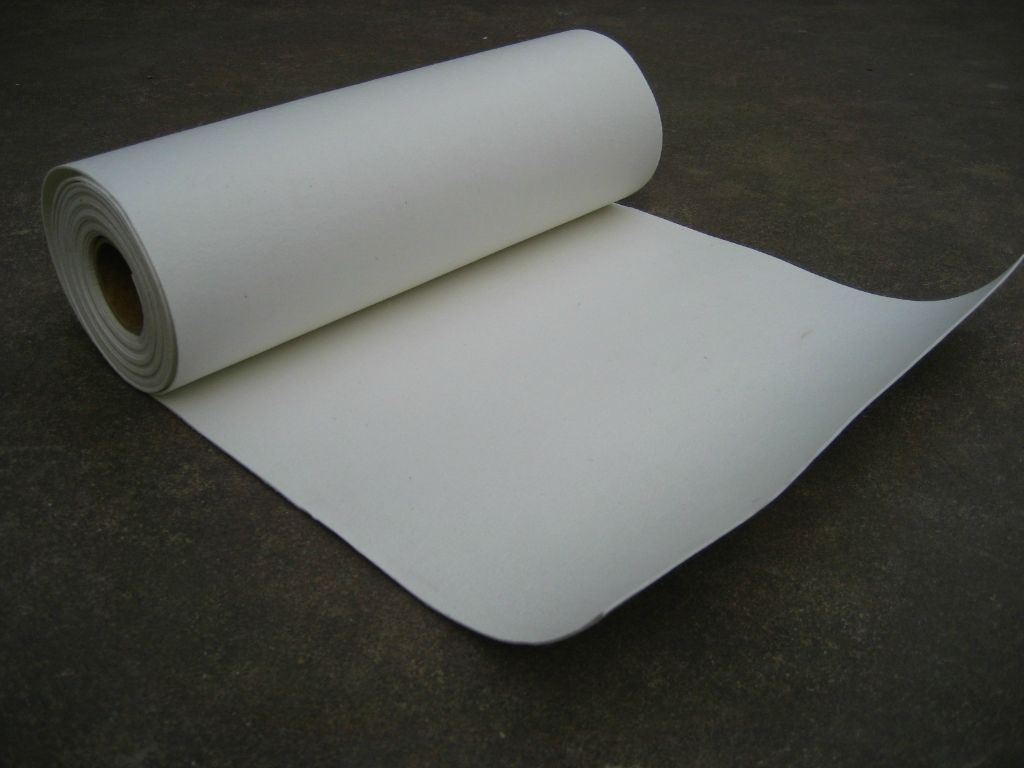
Le papier en fibres céramiques est un matériau en feuille mince et souple, fabriqué à partir de fibres céramiques réfractaires — la même composition chimique à base d’alumine et de silice qui constitue la base des couvertures et des panneaux en fibres céramiques, mais transformée en une forme semblable à du papier grâce à un procédé de fabrication par dépôt humide. Les fibres sont dispersées dans l'eau, puis mises en forme pour former une feuille uniforme sur un treillis métallique mobile ; elles sont ensuite séchées et calandrées afin d'obtenir un produit lisse et homogène, étonnamment résistant compte tenu de sa légèreté au toucher.
La composition des fibres se situe généralement entre 44 et 47% d’alumine (Al₂O₃) et entre 51 et 54% de silice (SiO₂) pour les qualités standard, tandis que des variantes à teneur plus élevée en alumine et enrichies en zircone permettent d’améliorer encore les performances à des températures plus élevées. Des liants organiques — généralement de l’amidon ou du latex — sont ajoutés lors de la mise en forme afin de conférer au papier une bonne maniabilité et une résistance à l’état cru. Ceux-ci se consumment lors du premier cycle thermique, laissant place à une structure purement inorganique chimiquement stable à la température de fonctionnement.
On obtient ainsi un produit dont le poids varie entre 80 et 200 grammes par mètre carré, dont l'épaisseur va de 1 mm à 6 mm, et qui se manipule comme du carton épais jusqu'à ce qu'il soit chauffé. Les largeurs de rouleaux varient généralement de 300 mm à 1 220 mm, pour des longueurs comprises entre 10 et 30 mètres selon l’épaisseur. Il est possible de le découper aux ciseaux, de le perforer à l'aide d'une matrice ou de le transformer en joints d'étanchéité sur des équipements standard de fabrication de papier — ce qui explique précisément pourquoi il est si utile pour les applications de précision où l'utilisation d'un blanchet ou d'un carton serait excessive.
Chez AdTech, le papier en fibre céramique est produit dans des qualités standard à 1 260 °C et à haute teneur en alumine à 1 430 °C, avec des variantes disponibles aussi bien en densité standard (128–160 kg/m³) qu’en haute densité.
En quoi le papier en fibre céramique diffère-t-il de la couverture et du panneau en fibre céramique ?
Cette question revient sans cesse, et cette confusion est compréhensible : ces produits sont tous fabriqués à partir de la même composition chimique de base. La différence réside dans le processus de fabrication, la forme physique obtenue et, par conséquent, les applications auxquelles chaque produit est adapté.
Couverture en fibre céramique est aiguilleté, ce qui lui confère épaisseur, gonflant et compressibilité. C'est le choix idéal pour envelopper des formes irrégulières, combler de grands volumes à isoler et pour les applications nécessitant une épaisseur d'isolation importante. Cependant, cette couverture est volumineuse — son épaisseur minimale pratique est d'environ 25 mm — et il est véritablement difficile de la découper à l'emporte-pièce en formes précises sans qu'elle s'effiloche.
Panneau en fibre céramique est pressé sous vide pour former des panneaux rigides. Il présente une bonne résistance structurelle et ne s'affaisse ni ne se déforme sous son propre poids. En contrepartie, il n'est pas souple et ne s'adapte pas aux surfaces courbes sans un formage spécial.
Papier en fibre céramique Il occupe un créneau que ni les nappes ni les panneaux ne peuvent couvrir. Avec une épaisseur comprise entre 1 et 6 mm, il convient aux applications où l’espace est limité. Il est suffisamment souple pour épouser les surfaces courbes et envelopper des composants cylindriques. Il se découpe proprement à l’emporte-pièce pour former des joints d’étanchéité, des garnitures et des formes complexes. Et comme le procédé de fabrication par voie humide permet une répartition plus uniforme des fibres que le aiguilletage, ses propriétés thermiques sont plus homogènes sur l’ensemble de la feuille.
Voyez les choses ainsi : la couverture isole les grands volumes, les panneaux assurent une isolation structurelle rigide, tandis que le papier est utilisé pour les travaux de précision — joints de section fine, isolation intercouche dans les systèmes réfractaires stratifiés, composants découpés à l'emporte-pièce pour la fabrication d'appareils électroménagers, et toute situation nécessitant une isolation résistante aux hautes températures dans un espace restreint.
À quelle température le papier en fibre de céramique peut-il résister ?
Le choix de la qualité est ici tout aussi important que pour une corde ou une planche. La température de classification du papier en fibre céramique suit le même référentiel ASTM C892 / EN 1094-1 que celui utilisé pour les autres produits réfractaires en fibre céramique, mais sa section plus fine fait que le papier atteint l'équilibre thermique plus rapidement que les produits plus épais : il se réchauffe rapidement et est donc exposé à la température de fonctionnement maximale presque immédiatement.
| Niveau | Chimie des fibres | Température de classification | Utilisation continue recommandée | Perte au feu (LOI) |
|---|---|---|---|---|
| Standard (STD) | Al₂O₃ ~45%, SiO₂ ~53% | 1 050 °C (1 920 °F) | 900 °C | 8–12% |
| Haute pureté (HP) | Al₂O₃ ~47%, SiO₂ ~52%, faible teneur en Fe₂O₃ | 1 260 °C (2 300 °F) | 1 100 °C | 6–10% |
| À haute teneur en alumine (HA) | Al₂O₃ ~52–55%, SiO₂ ~43–46% | 1 400 °C (2 550 °F) | 1 200 °C | 5–8% |
| Enrichi en zircone (HZ) | Al₂O₃ ~36%, SiO₂ ~49%, ZrO₂ ~15% | 1 430 °C (2 600 °F) | 1 250 °C | 4–7% |
Températures de classification et valeurs LOI conformément aux normes ASTM C892 et ASTM C871 (Méthodes d'essai standard pour l'analyse chimique des matériaux réfractaires). La valeur LOI reflète la teneur en liant organique éliminée par combustion au cours du premier cycle thermique.
La valeur de la perte au feu mérite une attention particulière. Lorsque les liants organiques se consument lors de la première utilisation, le papier perd de la masse et subit un léger changement dimensionnel — généralement un retrait linéaire inférieur à 1% pour le papier de qualité HP à 1 000 °C. Les applications pour lesquelles la stabilité dimensionnelle tout au long du premier cycle est importante (les joints de précision, par exemple) doivent en tenir compte lors de la conception. Le papier de qualité HP d’AdTech est formulé pour minimiser la perte au feu tout en conservant une résistance à l’état humide suffisante pour la manipulation et la découpe à l’emporte-pièce.
Où utilise-t-on concrètement le papier en fibre céramique dans l'industrie ?
La liste des applications du papier en fibre céramique est plus longue et plus variée que la plupart des gens ne le pensent. Je l'ai déjà vu dans des endroits où on ne s'y attendrait pas spontanément.
Fabrication de joints. Il s'agit probablement de la plus grande application en termes de volume. Les joints en papier de fibre céramique découpés à l'emporte-pièce sont utilisés dans les fours industriels, les fours de laboratoire, les hublots d'inspection des fours et les équipements de traitement thermique. Ce matériau se découpe proprement à l'aide de matrices en acier sur des presses de découpe standard, ce qui rend économique la production de grands volumes de joints identiques. Des tolérances de ±0,5 mm sont couramment atteignables, ce qui est suffisant pour la grande majorité des brides de four et des cadres de porte.
Isolation intercouche dans les systèmes réfractaires multicouches. Lors de la mise en place d'un revêtement réfractaire composite — par exemple, un béton réfractaire de face chaude soutenu par un panneau en fibre céramique lui-même soutenu par un panneau microporeux —, on utilise souvent du papier en fibre céramique comme couche de glissement entre les composants rigides. Il comble les irrégularités de surface, apporte un léger gain d'isolation et permet aux couches de se déplacer les unes par rapport aux autres lors des cycles thermiques sans se fissurer.
Remplissage des joints de dilatation dans la céramique et les accessoires de four. Les étagères et les montants des fours à céramique se dilatent lorsqu'ils sont chauffés. Si cette dilatation n'est pas prise en compte, ils se fissurent ou se déforment. De fines bandes de papier en fibre céramique placées entre les éléments empilés du mobilier de four absorbent les différences de dilatation et empêchent les pièces de se bloquer les unes contre les autres et de se fissurer lors du refroidissement.
Isolation de secours dans les équipements de moulage d'aluminium. Dans les goulottes, les canaux et les pièces de transition qui acheminent l'aluminium en fusion entre le four et le moule, le papier en fibre céramique est utilisé comme couche de support malléable sous les éléments réfractaires préfabriqués. Il comble les interstices qui, sans cela, permettraient à la chaleur de contourner l'isolation primaire. Cela s'inscrit directement dans le cadre des activités plus larges d'AdTech dans le domaine de la coulée d'aluminium et des systèmes de manutention des métaux en fusion.
Fabrication d'appareils électroménagers et de systèmes de chauffage, de ventilation et de climatisation. Les fours ménagers et professionnels, les sèche-linge et les équipements de chauffage industriels utilisent du papier en fibre céramique comme joints de porte et comme feuilles d'isolation internes. La capacité de ce matériau à être estampé et formé sur des équipements de production standard en fait un choix intéressant pour la fabrication en grande série d'appareils électroménagers.
Protective wrapping for heating elements and thermocouples. Resistance heating elements in industrial furnaces are sometimes wrapped with a layer of ceramic fiber paper to prevent direct radiation damage to the furnace lining immediately behind them. Thermocouple sheaths get similar treatment where they pass through the furnace wall.
Electronics and semiconductor manufacturing. High-purity, low-iron grades of ceramic fiber paper serve as separator sheets in semiconductor diffusion furnaces where contamination from iron or alkali metals must be minimized.
What Are the Key Physical Properties of Ceramic Fiber Paper?
Getting specific about the numbers is important when you’re actually specifying this material for an engineering application. Here’s where HP-grade ceramic fiber paper typically lands across its key properties:
| Propriété | 1mm Thickness | 3mm Thickness | 6mm Thickness | Test Standard |
|---|---|---|---|---|
| Densité apparente | 128–160 kg/m³ | 128–160 kg/m³ | 128–160 kg/m³ | ASTM C167 |
| Tensile Strength (MD) | 0.15–0.25 MPa | 0.18–0.28 MPa | 0.20–0.30 MPa | ASTM D828 |
| Thermal Conductivity @ 400°C | 0,10–0,12 W/m·K | 0,10–0,12 W/m·K | 0,10–0,12 W/m·K | ASTM C177 |
| Thermal Conductivity @ 800°C | 0.18–0.22 W/m·K | 0.18–0.22 W/m·K | 0.18–0.22 W/m·K | ASTM C177 |
| Max. Linear Shrinkage @ 1000°C | <1.0% | <1.0% | <1.0% | ASTM C356 |
| Temperature Classification | 1 260 °C | 1 260 °C | 1 260 °C | ASTM C892 |
Physical property data represents typical values for AdTech HP-grade ceramic fiber paper. Actual values may vary by ±10% depending on batch. Independent verification available upon request for quality-critical procurement.
A few things jump out from that table. The thermal conductivity values — 0.10–0.12 W/m·K at 400°C — are competitive with much thicker insulation products. That’s the nature of the material: even a 3mm sheet provides meaningful thermal resistance. The tensile strength numbers look modest in absolute terms, but for a 3mm paper-form product, they’re actually quite good — enough to handle without tearing during normal installation.
Can Ceramic Fiber Paper Be Cut, Formed, and Fabricated?
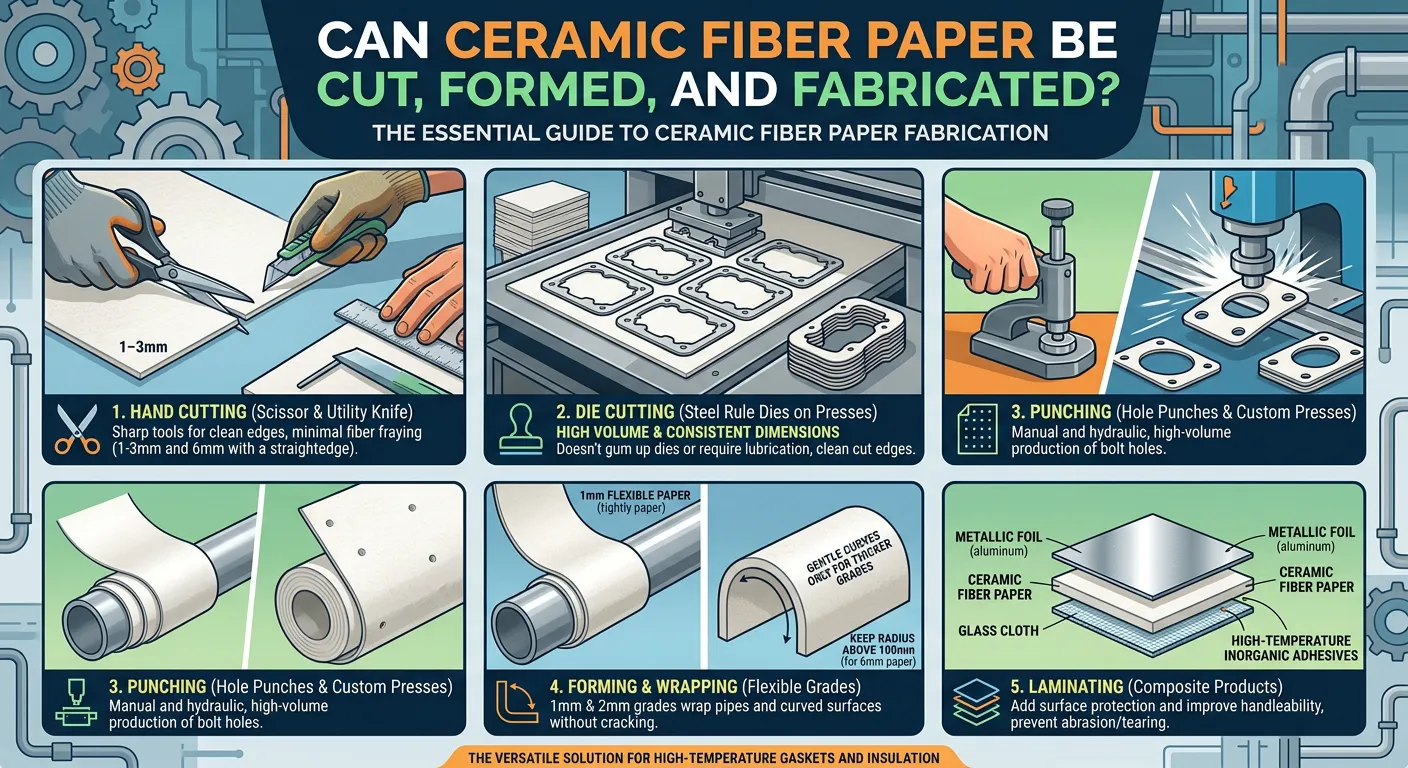
Yes, and this fabricability is genuinely one of its best selling points. Unlike ceramic fiber board, which requires power tools to cut, and unlike ceramic fiber blanket, which frays and sheds fibers if you try to cut it with anything less than a sharp knife, ceramic fiber paper behaves like — well, like paper. Within reason.
Hand cutting. Sharp scissors or a utility knife cut 1–3mm paper cleanly. For 6mm paper, a straightedge and a fresh utility knife blade gives clean edges without tearing.
Die cutting. This is where ceramic fiber paper really shines. Standard steel-rule dies on flatbed cutting presses stamp out gaskets and seals in high volumes with consistent dimensions. The material doesn’t gum up dies, doesn’t require lubrication, and produces clean cut edges with minimal fiber fraying. Most gasket manufacturers who work with high-temperature materials have die-cutting operations set up for ceramic fiber paper.
Punching. Hole punches, both manual and hydraulic, work well for producing bolt holes in gaskets. For high-volume production, custom punch presses turn out hundreds of identical gaskets per hour.
Forming and wrapping. The 1mm and 2mm grades are flexible enough to wrap around cylinders, pipes, and curved surfaces without cracking. Thicker grades can be bent around gentle curves but will crack on tight radii — try to keep the bend radius above 100mm for 6mm paper.
Laminating. Ceramic fiber paper can be laminated to metallic foil, glass cloth, or other facing materials using high-temperature inorganic adhesives. These composite products add surface protection and improve handleability in applications where the bare paper might abrade or tear during installation.
How Does Ceramic Fiber Paper Perform as a Gasket Material?
Gasket performance comes down to three things: sealing effectiveness under compression, resistance to blowout at operating pressure, and long-term stability so the gasket doesn’t require constant re-torquing. Here’s how ceramic fiber paper stacks up on each count.
Compression sealing. Ceramic fiber paper compresses readily under bolt load, flowing into surface irregularities and microscopic imperfections on flange faces. It doesn’t require high bolt loads to achieve an effective seal — important when you’re working with thin cast iron or ceramic flanges that can crack under excessive torque.
Blowout resistance. Paper-form ceramic fiber isn’t designed for high-pressure service. In furnace and kiln applications — which typically operate at slightly negative pressure (draft) or very low positive pressures — blowout isn’t a concern. If your application involves gauge pressures above about 0.5 bar, you’d want to look at reinforced ceramic fiber sheet or a metal-jacketed gasket instead.
Long-term stability. This is where ceramic fiber paper outperforms organic-binder-based gasketing materials like compressed fiber sheet (CFG). Above 300°C, CFG oxidizes and hardens, eventually losing its compressibility and allowing flange joint leakage. Ceramic fiber paper, once its organic binder has burned out in the first heat cycle, is purely inorganic and maintains its properties indefinitely at operating temperature — no oxidation, no carbonization, no hardening.
Le U.S. Department of Energy’s Better Plants program has identified high-temperature gasket performance as a meaningful factor in industrial energy efficiency, noting that leaking furnace joints can increase energy consumption by 5–15% in susceptible equipment types.
AdTech Real Case: Upgrading a Japanese Ceramic Kiln Manufacturer’s Production Line
In mid-2024, a specialty ceramics manufacturer based in Aichi Prefecture, Japan, approached AdTech with a specific and somewhat unusual problem. The company produced fine technical ceramics — alumina substrates, zirconia components, and silicon carbide structural parts — in a line of continuous pusher kilns running at peak temperatures of 1400°C.
Their existing interlayer insulation between kiln furniture components was a domestic fiberglass paper product rated to 700°C. During a routine process audit, their quality engineer noticed that the fiberglass paper was completely disintegrating above the transition zone in their kilns, where temperatures exceeded 800°C. Fragments of degraded fiberglass were contaminating the kiln atmosphere and, in some cases, adhering to the surfaces of sintered ceramic components — which caused rejection rates in their high-purity alumina substrate line to spike from a baseline of 2.3% to over 7% during certain production runs.
The contamination source wasn’t immediately obvious — the failed fiberglass paper fragments were small and only showed up under microscopic surface inspection. It took their quality team three months to trace the rejects back to the kiln furniture insulation.
AdTech recommended our HA-grade ceramic fiber paper (1400°C classification, 3mm thickness, 160 kg/m³ density). The high-alumina grade was specified — rather than standard HP-grade — because the kiln peak temperature of 1400°C left very little safety margin for the HP grade. The low iron content of our HA paper (Fe₂O₃ under 0.3%) was also critical, since iron contamination is particularly damaging in alumina substrate sintering.
The customer ordered an initial trial quantity of 2,400 square meters in 300mm × 600mm pre-cut sheets, sized to match their kiln furniture dimensions and minimize on-site waste. AdTech also supplied a small quantity of 1mm HA-grade paper for use as slip sheets between stacked components in their shuttle kilns.
Results after 90 days:
- Surface rejection rate on alumina substrates returned to 2.1% — actually slightly below the pre-problem baseline, likely because the ceramic fiber paper provided better dimensional separation between kiln furniture pieces than the original material
- Zero paper fragment contamination incidents detected in the 90-day monitoring period
- Maintenance team reported that the AdTech paper was easier to cut and handle than the previous product, reducing preparation time per kiln load
- Kiln furniture longevity improved because the ceramic fiber paper cushioned thermal expansion differentials that had previously caused stress cracking in silicon carbide setter plates
Within six months of the initial trial, the customer had transitioned their entire ceramic fiber paper supply to AdTech, placing quarterly orders covering four kiln lines. We subsequently supplied high-purity ceramic fiber board for their kiln car top insulation, and discussions are ongoing about additional insulation solutions for a planned kiln expansion in 2025.
The lesson from this case isn’t complicated: using the wrong temperature-rated material in a precision manufacturing environment costs far more in scrap and quality failures than the price difference between grades ever would. Getting the spec right from the start is always cheaper than fixing it after the damage is done.
How Do You Select the Right Ceramic Fiber Paper Thickness?
Thickness selection is partly thermal engineering and partly practical constraint — you’re often limited by the physical space available in the application.
For gasket applications, the general rule is to use the thinnest sheet that provides adequate compression and sealing under your bolt load. Thinner gaskets compress more uniformly and are less likely to extrude under clamping force. For most furnace door and inspection port applications, 1–3mm is the right range.
For interlayer insulation in composite refractory systems, the thermal contribution of the paper needs to be weighed against space constraints. A 3mm HP-grade paper contributes roughly 0.015 m²·K/W of thermal resistance at 600°C mean temperature — modest but meaningful in a tightly designed composite lining.
For protective wrapping around heating elements or thermocouple sheaths, 1–2mm provides adequate mechanical protection without adding significant thermal mass that would slow system response time.
| Demande | Épaisseur recommandée | Niveau | Key Reason for Selection |
|---|---|---|---|
| Furnace door gaskets (≤1000°C) | 1–3mm | HP (1260°C) | Adequate compression sealing, clean die-cut edges |
| Kiln furniture interlayer | 3mm | HA (1400°C) | Temperature margin, low contamination risk |
| Heating element wrap | 1–2mm | HP (1260°C) | Flexibility for wrapping, minimal thermal mass |
| Composite lining slip layer | 3–6mm | HP or HA | Fills surface voids, accommodates expansion |
| Appliance oven door insulation | 3–6mm | STD (1050°C) | Cost-effective for lower temperature service |
Application recommendations based on AdTech field installation experience and customer feedback across aluminum processing, ceramics manufacturing, and industrial heating equipment sectors.
If you’re unsure about thickness for a specific application, the practical approach is to order a small quantity of two adjacent thicknesses and test both. Ceramic fiber paper is inexpensive enough that a test quantity costs very little relative to the engineering time spent trying to calculate the optimum from first principles. Talk to our technical applications team if you want guidance before placing a test order — we’ve seen enough installations to give you a well-informed starting recommendation.
What Should You Know About Handling and Storage?
Ceramic fiber paper is more robust than it looks, but it has a few quirks worth knowing about.
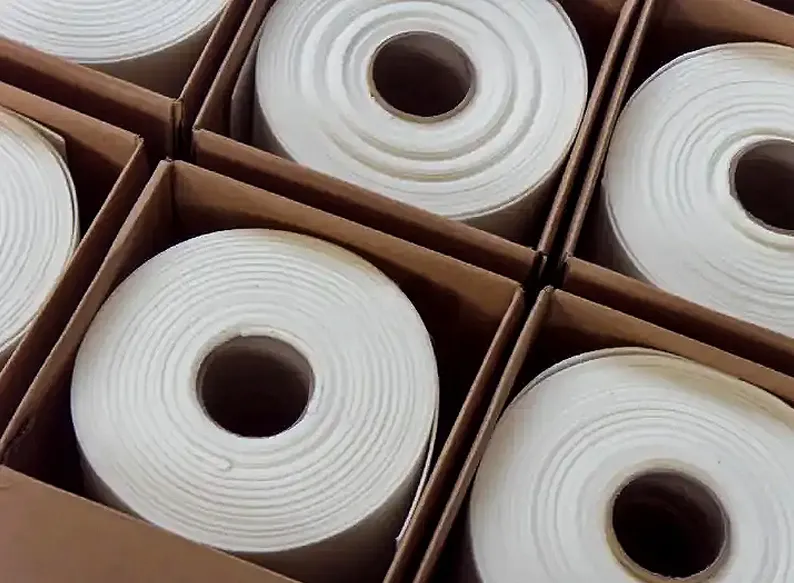
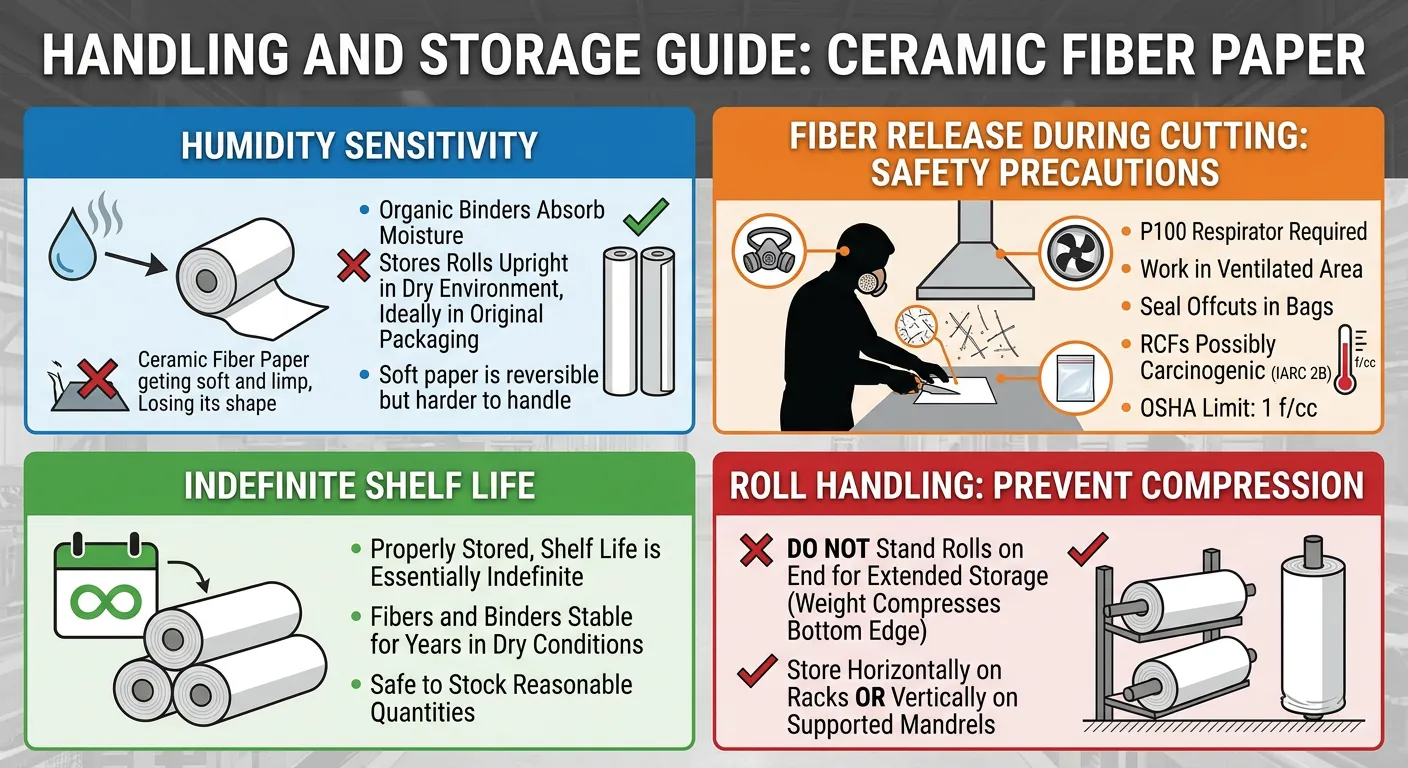
Humidity sensitivity. The organic binders used in green (unfired) ceramic fiber paper absorb moisture from the air. In humid climates, rolls stored in open conditions can become limp and lose some of their handleability. Store rolls upright in a dry environment, ideally in original packaging until needed. This isn’t a product-damaging problem — the paper recovers its properties once dried — but it makes on-site handling messier.
Fiber release during cutting. Cutting ceramic fiber paper releases airborne respirable fibers. Follow the same precautions as for other refractory ceramic fiber products: P100 respirator, work in ventilated conditions, and dispose of offcuts in sealed bags. The IARC classifies refractory ceramic fibers as Group 2B (possibly carcinogenic), and workplace exposure limits apply — typically 1 fiber per cubic centimeter in the US under OSHA guidance.
Shelf life. Properly stored, ceramic fiber paper has essentially indefinite shelf life. The fibers don’t degrade at ambient temperature, and the binders remain stable for years in dry conditions. There’s no meaningful expiry date to worry about, which makes it practical to stock in reasonable quantities.
Roll handling. Don’t stand rolls on end for extended storage — the weight of the roll can permanently compress the bottom edge. Store horizontally on racks, or vertically on purpose-built mandrels that support the inner diameter.
Why Ceramic Fiber Paper Is Worth Specifying Correctly
It’s easy to treat ceramic fiber paper as a commodity — a thin sheet of thermal insulation that gets stuck between flanges or wrapped around things. But getting the grade, thickness, and density right actually matters, especially in precision manufacturing environments where contamination risk and dimensional stability affect product quality.
The cost difference between a standard 1050°C paper and an HA-grade 1400°C paper is maybe 40–60% per square meter. In most applications, that price difference represents a tiny fraction of the total operating cost — and it’s completely insignificant compared to the cost of a quality failure traced back to insulation contamination, or the labor cost of emergency maintenance when an undersized gasket blows through.
AdTech manufactures ceramic fiber paper with tight controls on fiber chemistry, binder content, and dimensional tolerances. Every batch comes with a material test report. If you have an application that needs something outside our standard range — custom widths, pre-cut shapes, special fiber chemistry — our product team at AdTech is the right place to start. Or head straight to the ceramic fiber paper specifications page to pull the technical data you need.
FAQ
1. À quoi sert le papier en fibre céramique ?
The most common applications are high-temperature gaskets, interlayer insulation between refractory components, kiln furniture separators, heating element wraps, and appliance insulation. It’s also used as a die-cut seal material in laboratory furnaces, industrial ovens, and heat treatment equipment where thin-profile insulation is needed.
2. À quelle température le papier en fibre céramique peut-il résister ?
Standard grade handles up to 1050°C, HP grade reaches 1260°C, and high-alumina grades go to 1400°C or higher. Always choose a grade that gives you at least 150°C of headroom above your actual operating temperature — especially for gasket applications where the paper reaches thermal equilibrium almost instantly due to its thin cross-section.
3. How thin can ceramic fiber paper be?
AdTech produces ceramic fiber paper as thin as 1mm. Thinner products exist on the market — some manufacturers offer 0.5mm grades — but handling becomes difficult below 1mm and the insulation contribution is minimal. For most practical applications, 1–3mm strikes the right balance between thermal performance, mechanical strength, and ease of handling.
4. Can I cut ceramic fiber paper with scissors?
Yes, for 1–3mm thicknesses, sharp scissors or a utility knife work perfectly. For 6mm paper, use a fresh utility blade against a straightedge. For high-volume production, steel-rule dies on flatbed cutting presses produce clean, repeatable cuts. Always wear a P100 respirator when cutting — the process releases airborne fibers regardless of the cutting method.
5. Does ceramic fiber paper shrink when heated?
Slightly. Expect less than 1% linear shrinkage at 1000°C for HP-grade paper, plus a 6–10% mass loss from organic binder burnout during the first heat cycle. Both effects stabilize after the initial firing. For precision gasket applications, factor the burnout shrinkage into your design dimensions, or pre-fire the gaskets before installation if tight tolerances matter.
6. Is ceramic fiber paper the same as kaowool paper?
Kaowool is a brand name that’s become a generic term in some markets, similar to how people say “Kleenex” when they mean tissue paper. Ceramic fiber paper from any reputable manufacturer — including AdTech — uses essentially the same alumina-silica fiber chemistry. The real differences between brands come down to fiber quality, binder content, density consistency, and iron oxide levels — not the product name.
7. Can ceramic fiber paper replace asbestos gaskets?
Yes, and it has been doing exactly that across industry for decades. Ceramic fiber paper handles higher temperatures than chrysotile asbestos sheet (which was typically rated to around 500°C for gasket applications) and poses none of the same long-term health risks associated with asbestos fiber inhalation. Most industrial gasket replacement programs in the US and EU have specified ceramic fiber paper or corde en fibre céramique as direct asbestos substitutes.
8. What’s the difference between ceramic fiber paper and fiberglass paper?
Temperature capability. Fiberglass paper maxes out at around 550–600°C before the glass fibers soften and lose structural integrity. Ceramic fiber paper operates comfortably to 1260°C and beyond. For any application above 500°C, fiberglass paper simply isn’t an option. Below 500°C, fiberglass is cheaper and works fine — but it won’t survive a temperature excursion that ceramic fiber paper would shrug off.
9. How should I store ceramic fiber paper?
Keep rolls in their original packaging in a dry, indoor environment. The organic binders absorb humidity, which makes the paper limp and harder to handle. Store rolls horizontally on racks rather than standing them upright — standing storage compresses the bottom edge over time. In proper conditions, ceramic fiber paper has no practical shelf life limit.
10. What certifications should ceramic fiber paper carry?
Look for compliance with ASTM C892 for temperature classification, ASTM C167 for density measurement, and ASTM C871 for chemical analysis. A manufacturer certificate of conformity showing batch-specific test results for density, thickness, LOI, and fiber chemistry should accompany every shipment. AdTech provides complete material test documentation with all ceramic fiber paper orders — request it at the time of purchase from our technical sales team.