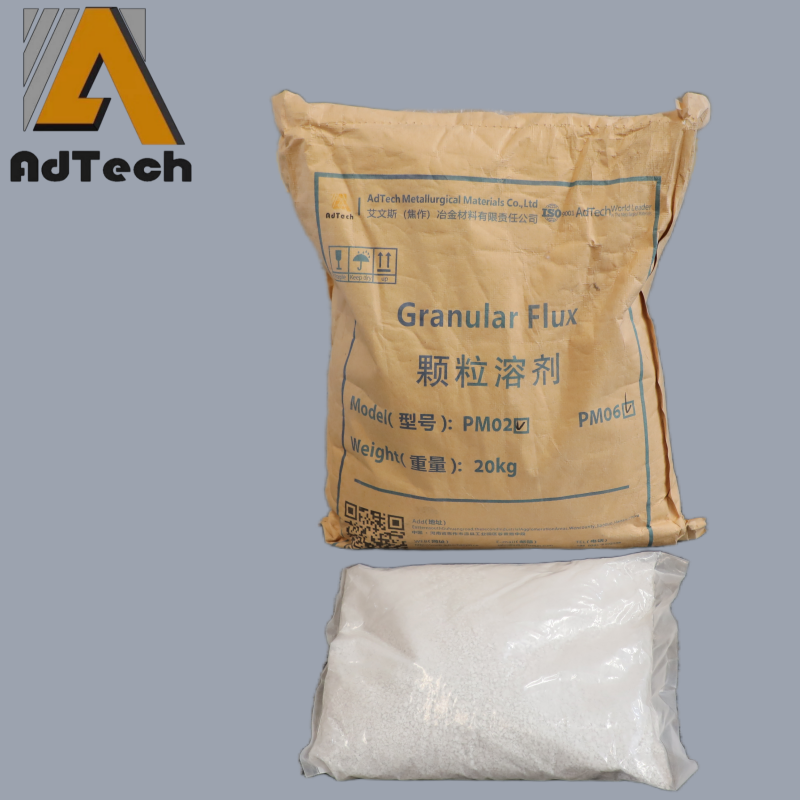
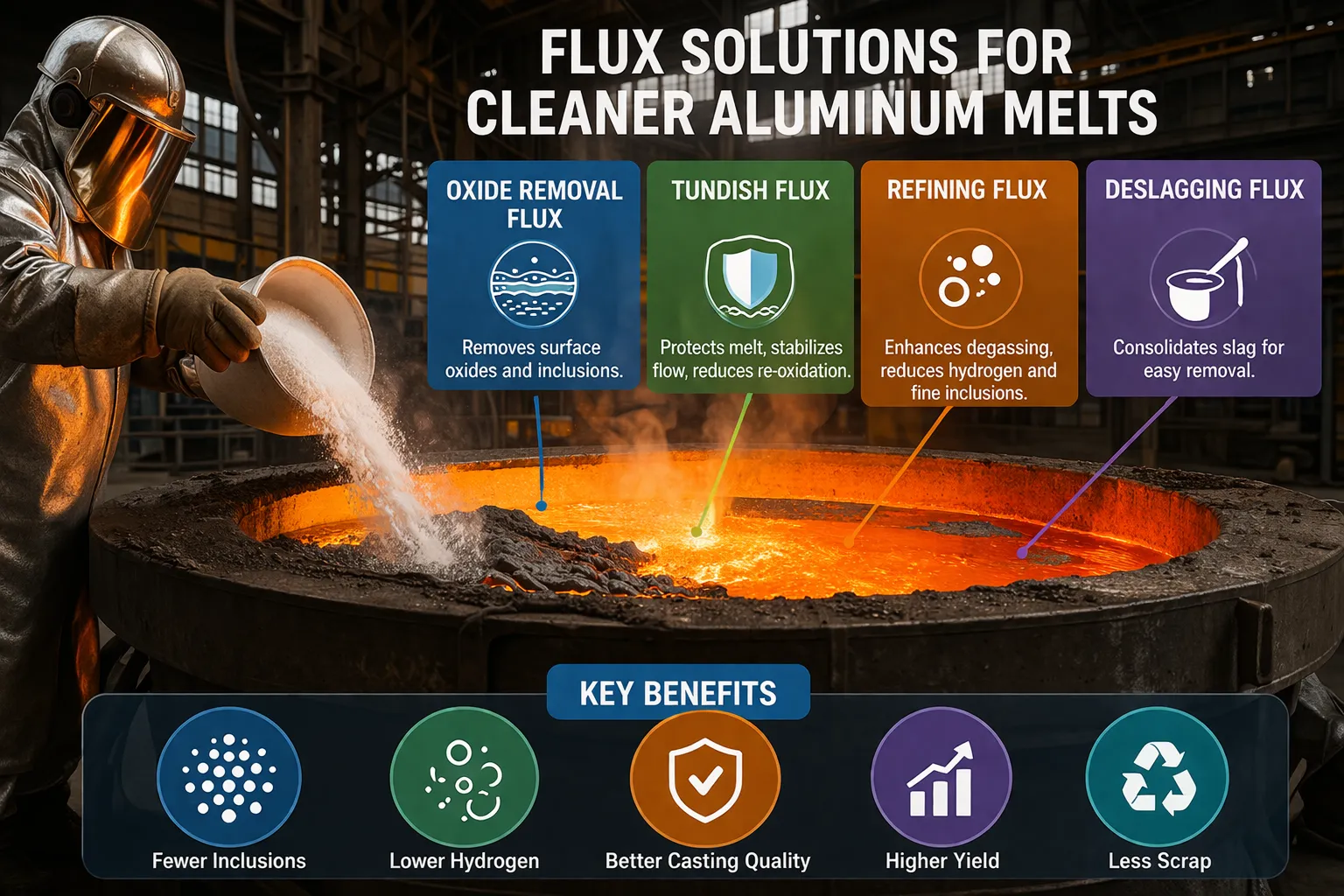
High-quality aluminum castings start with clean and well-treated molten metal. In industrial aluminum foundries, impurities such as oxide films, dross, and dissolved hydrogen are the main culprits behind porosity, inclusions, and surface defects. Flux used in metallurgy plays a central role in controlling these defects, and its effective application requires a combination of correct type, timing, and integration with purification equipment such as degassing systems and ceramic filters.
Click here to view our molten aluminum fluxes
What Is Oxide Removal Flux and How Is It Used?
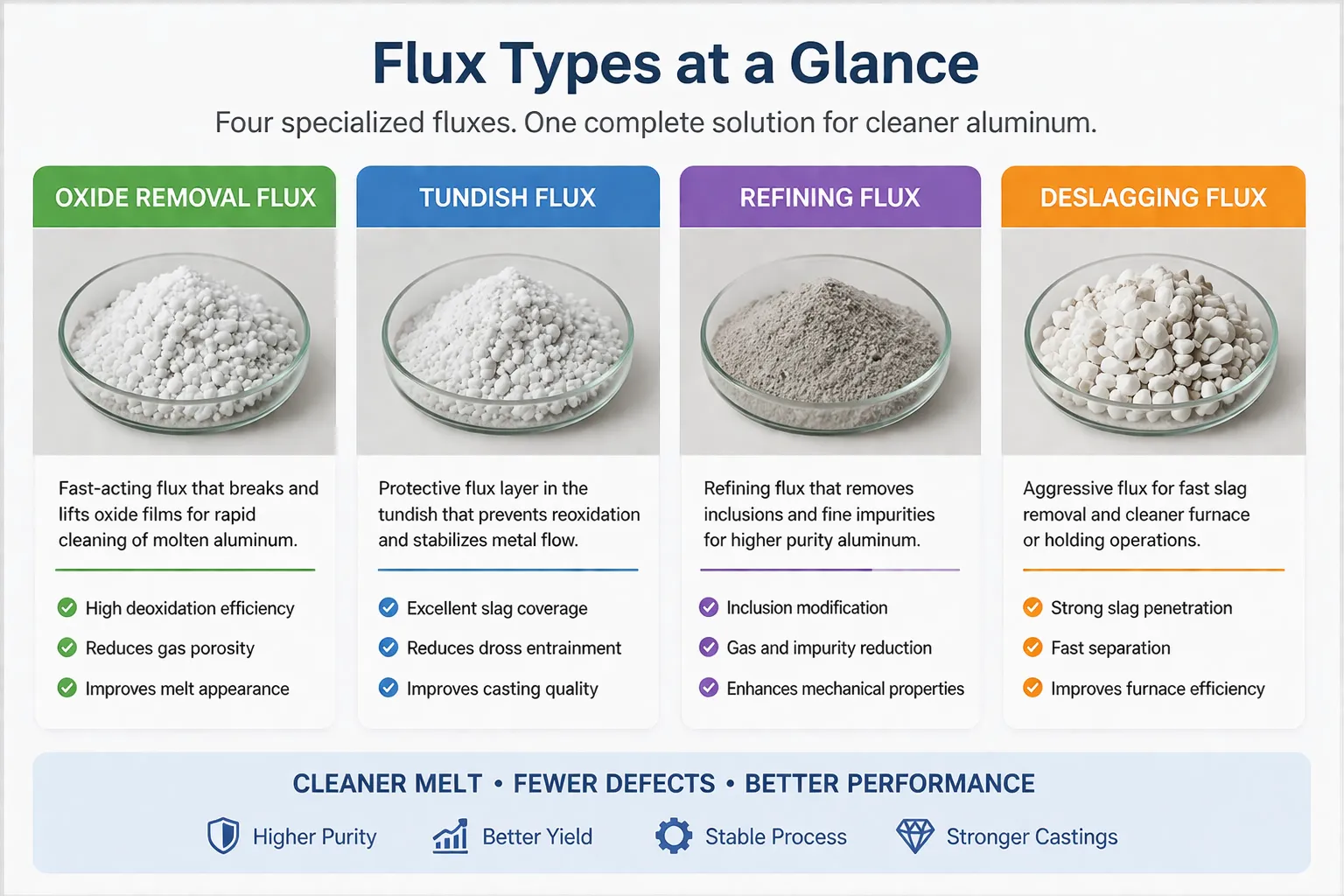
Oxide Removal Flux is specifically formulated to target surface oxide films and fine non-metallic inclusions that form during melting and holding. In practice:
- Application: Added directly to the melt surface during holding or pre-pouring. Flux aggregates oxides into a lightweight slag that can be skimmed off.
- Operational Tip: Use gentle rotary or manual stirring to avoid introducing turbulence. Skim frequently to prevent reintroduction of oxides.
- Practical Case: In a plant processing 20 tons of 5xx aluminum alloy, using oxide removal flux combined with a ceramic filter reduced inclusion count by 60% and improved casting surface smoothness.
What Is Tundish Flux and Why Is It Important?
Tundish Flux is applied in the tundish during continuous casting or ladle transfer. Its main functions:
- Oxidation Prevention: Forms a protective layer over the molten aluminum, reducing re-oxidation during handling.
- Flow Stabilization: Minimizes turbulence in the tundish and molds, preventing entrainment of oxides.
- Operational Tip: Combine tundish flux with pre-installed ceramic foam filter in the tundish. This enhances inclusion capture and reduces surface defects downstream.
- Industrial Insight: Plants that integrate tundish flux with proper filtration report a 25–30% reduction in surface defects on large structural castings.
How Does Refining Flux Work in Industrial Operations?
Refining Flux is essential for hydrogen removal and fine inclusion control:
- Application: Added before or during rotary degassing or inert gas injection. Flux promotes bubble nucleation, improving hydrogen escape.
- Operational Tip: In scrap aluminum or high-recycled alloy melts, refining flux restores melt quality by reducing dissolved hydrogen and minimizing fine oxides.
- Practical Data: In industrial trials, adding refining flux before treatment in theDegassing Unit lowered hydrogen content from 0.25 ppm to 0.08 ppm and reduced micro-inclusions by over 50%.
What Is Deslagging Flux and How Should It Be Applied?
Deslagging Flux is used at the final refining stage to consolidate residual slag:
- Application: Added after melt treatment or holding, prior to pouring. Flux reacts with remaining oxides, forming easily removable slag.
- Operational Tip: Combine with ladle skimming tools for efficient slag removal, preventing recontamination.
- Industrial Experience: In foundries handling mixed scrap batches, deslagging flux reduced slag carry-over by 50–60%, improving casting yield and reducing rework.
Not sure which flux type is right for you? Contact our experts for technical support.
Integrating Flux With Industrial Melt Purification Equipment
| Equipment | Flux Type | Operational Benefit |
|---|---|---|
| Rotary Degasser | Refining Flux | Enhances hydrogen removal and inclusion capture |
| Ceramic Foam Filter | Oxide Removal / Tundish Flux | Traps fluxed oxides; improves ingot surface quality |
| Ladle Skimmer | Deslagging Flux | Easier slag removal; prevents recontamination |
Industrial Tip: In aluminum foundries, combining flux with degassing and filtration reduces casting defects by up to 30% and increases yield.
Step-by-Step Industrial Practice for Using Flux
- Oxide Removal Stage: Add oxide removal flux at holding temperature; stir gently; skim slag frequently.
- Transfer / Tundish Stage: Apply tundish flux during ladle transfer or in tundish to maintain melt protection.
- Degassing Stage: Introduce refining flux before or during degassing; monitor hydrogen content.
- Pre-Pour Stage: Apply deslagging flux; perform skimming to remove residual slag and prepare melt for casting.
Practical Note: Adjust flux dosage based on alloy type, melt contamination, and process history. Overuse can increase slag volume without improving melt quality; underuse leaves residual oxides and hydrogen.
Common Operational Challenges and Solutions
- Temperature Sensitivity: Flux reacts optimally within a specific temperature range. Avoid adding flux too early or too late.
- Incomplete Mixing: Ensure uniform distribution; pockets of untreated melt reduce effectiveness.
- Scrap Integration: High-recycled content requires higher flux activity and frequent monitoring.
- Equipment Synchronization: Degassing, filtration, and flux addition must be timed correctly to maximize efficiency.
Industrial Tip: Keep a log of alloy type, flux type, dosage, and observed results to optimize operations continuously.
Real-World Performance Metrics
| Flux Type | Key Metric | Typical Improvement |
|---|---|---|
| Oxide Removal | Surface oxides | 80–90% reduction before filtration |
| Refining Flux | Hydrogen content | Reduced from 0.25 ppm to 0.08 ppm |
| Deslagging Flux | Residual slag | 50–60% reduction after skimming |
Data collected from multi-year aluminum casting operations and validated against ASM Metals Handbook standards
Recommended Storage and Handling Practices
- Store flux in dry, controlled conditions to maintain reactivity.
- Use batch tracking for quality assurance.
- Minimize exposure before addition to melt.
- Operators should wear PPE, as flux powders may irritate skin and eyes.
Conclusion
Using Oxide Removal Flux, Tundish Flux, Refining Flux, and Deslagging Flux in an integrated workflow is essential for industrial aluminum melt purification. By combining flux treatment with degassing systems, ceramic filters, and proper skimming techniques, foundries can achieve:
- Cleaner melts with lower hydrogen and inclusion levels
- Improved mechanical and surface properties of castings
- Higher yield and reduced scrap rates
- Consistent and repeatable production outcomes
.webp)
FAQ
1. What is the main purpose of flux in aluminum metallurgy?
Flux removes oxides, non-metallic inclusions, and reduces hydrogen, ensuring cleaner aluminum and higher casting quality.
2. How do I select the right flux for my alloy?
Selection depends on alloy type and contamination. Oxide Removal Flux targets surface oxides, Tundish Flux protects during transfer, Refining Flux aids degassing, and Deslagging Flux consolidates residual slag.
3. Can flux alone guarantee defect-free castings?
No. Flux improves melt cleanliness but must be combined with proper degassing, filtration, and skimming practices for defect-free castings.
4. When should oxide removal flux be added?
Add during holding or pre-pouring at proper melt temperature. Gentle stirring and regular skimming improve effectiveness.
5. How does tundish flux enhance quality?
It forms a protective layer on the melt in the tundish, reducing oxidation and turbulence, which helps prevent inclusions and surface defects.
6. What are best practices for refining flux?
Add before or during degassing, ensure even distribution, and adjust dosage based on contamination. Proper use lowers hydrogen and fine inclusions.
7. How does deslagging flux help at the final stage?
It consolidates residual slag before pouring, making skimming easier and preventing recontamination of the melt.
8. Can flux reduce scrap rates?
Yes. Proper flux application minimizes defects, improving yield and reducing scrap in industrial aluminum operations.
9. How should flux be stored?
Keep flux dry, in controlled conditions, and label batches clearly to maintain reactivity and consistency.
10. Are there industry references for flux use?
Yes. Flux application can be referenced against ASM Metals Handbook and ISO aluminum processing standards for best practices.