
What Is Ceramic Fiber Rope and What Makes It Different from Other High-Temperature Sealing Materials?
Ceramic fiber rope is a flexible, high-temperature insulation and sealing product made by braiding, twisting, or knitting continuous ceramic fiber yarns — typically alumina-silica compositions — into a rope form. Unlike fiberglass rope (which typically maxes out around 550°C) or mineral wool rope (useful to about 800°C), ceramic fiber rope retains its physical structure and sealing capability well above 1000°C, making it the go-to choice for applications where conventional materials simply burn away or compress into nothing.
The difference between a braided ceramic fiber rope and a twisted ceramic fiber rope matters more than most people realize. Braided rope offers better compression recovery — it bounces back closer to its original diameter after load removal, which makes it the preferred choice for door seals and gasketing applications where repeated opening and closing cycles will compress the rope. Twisted rope is denser and more resistant to fiber erosion from gas flow, so it tends to perform better in applications like burner block seals and expansion joint packing where airflow across the rope surface is a concern.
AdTech manufactures both types in standard and high-purity grades, with optional reinforcement cores available for applications requiring higher tensile strength.
Contact Us to learn more about
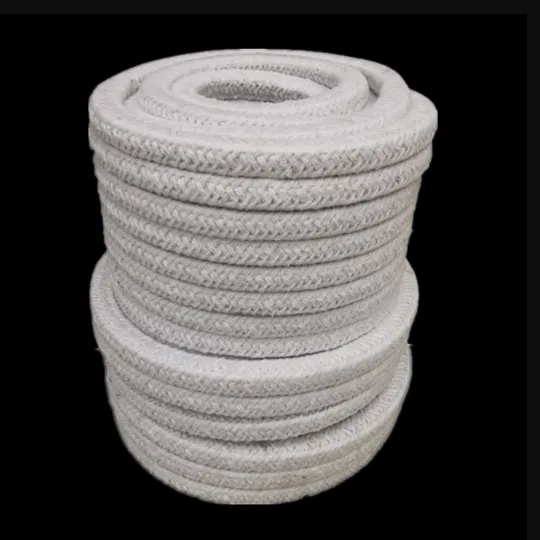
AdTech Ceramic Fiber Rope – Full Product Specifications
Core Technical Properties
| Property | Unit | Standard Grade | High-Purity Grade | High-Purity + Zirconia |
|---|---|---|---|---|
| Classification Temperature | °C | 1050 | 1260 | 1400 |
| Continuous Service Temperature | °C | 950 | 1100 | 1300 |
| Al₂O₃ Content | % | 42–44 | 50–52 | 34–36 |
| SiO₂ Content | % | 53–55 | 46–48 | 46–50 |
| ZrO₂ Content | % | — | — | 15–17 |
| Bulk Density | kg/m³ | 180–220 | 200–240 | 220–260 |
| Tensile Strength (unreinforced) | N | ≥40 (12mm dia.) | ≥45 (12mm dia.) | ≥50 (12mm dia.) |
| Thermal Conductivity at 600°C | W/m·K | 0.14 | 0.12 | 0.10 |
| Permanent Linear Shrinkage (24h at rated temp) | % | ≤3.0 | ≤2.5 | ≤2.0 |
| Shot Content | % | ≤15 | ≤10 | ≤8 |
All thermal and mechanical values are measured per ASTM C892 and ISO 10635 protocols. Shrinkage testing performed after 24-hour soak at classification temperature in oxidizing atmosphere.
Available Diameters and Construction Options
| Diameter (mm) | Construction Type | Core Option | Recommended Application |
|---|---|---|---|
| 6 | Braided | No core / Fiberglass core | Furnace door perimeter seals, small gap filling |
| 8 | Braided | No core / Fiberglass core | Expansion joints, thermocouple port seals |
| 10 | Braided / Twisted | No core / SS wire core | Launder cover seals, kiln car joints |
| 12 | Braided / Twisted | No core / SS wire core | Furnace door gaskets, burner block seals |
| 16 | Braided / Twisted | Fiberglass core / SS wire core | Large furnace seals, roller hearth kiln joints |
| 20 | Twisted | SS wire core | Heavy-duty expansion joint packing |
| 25 | Twisted | SS wire core | Industrial boiler door seals, coke oven seals |
| Custom up to 50mm | Twisted | SS wire core | Customer-specified heavy industrial seals |
Standard packaging: 25m and 50m spools. Bulk rolls up to 200m available for high-volume orders. Custom diameters available with minimum order quantity of 500m.
Where Is Ceramic Fiber Rope Actually Used? Real Applications Across Industries
Furnace Door and Lid Sealing
This is the bread-and-butter application for ceramic fiber rope, and the one where getting the specification right pays off most directly. A properly sealed furnace door keeps heat where it belongs — inside the furnace — rather than bleeding into the workspace, cooking the surrounding steel structure, and driving up your gas or electricity bill.
For aluminum holding and melting furnaces, we typically recommend 12–16mm braided ceramic fiber rope with a fiberglass core for door perimeter seals. The core adds tensile strength during installation and helps the rope maintain its round cross-section when compressed into a groove, which gives you a more consistent contact seal around the full door perimeter. If you’re working with a furnace that sees frequent door cycling — say, a batch heat treatment furnace or a die casting holding furnace that operators open and close dozens of times per shift — braided rope is the right call because it recovers better between compression events.
For customers running complete launder and furnace systems, our aluminum casting filtration and transfer equipment pairs naturally with ceramic fiber rope at all the sealing interfaces where molten metal transfer occurs.
Expansion Joint Packing
Industrial furnaces expand and contract with every heat cycle. Expansion joints are the engineered gaps that accommodate this movement without cracking refractory or distorting the furnace shell. Packing these joints with ceramic fiber rope — rather than leaving them open or using a material that deteriorates — prevents heat bypass while still allowing the movement the joint was designed to accommodate.
Twisted ceramic fiber rope works better here than braided because the denser fiber structure resists the abrasion that occurs as joint faces move against the packing material during thermal cycling.
Kiln Car and Roller Hearth Joint Sealing
In tunnel kilns and roller hearth kilns used for ceramics manufacturing and battery material processing, ceramic fiber rope seals the gaps between kiln car decks, between cars and the kiln sidewalls, and around roller tube entry points in the kiln shell. These are punishing environments — the rope sees constant gas flow, temperature cycling, and mechanical movement — and the standard 1260°C high-purity grade is the most common specification for these applications.
Burner Block and Port Sealing
Where burner blocks penetrate furnace walls, the annular gap between the block and the shell refractory needs a seal that can withstand both high temperature and direct exposure to combustion gas flow. Twisted ceramic fiber rope packed into this gap prevents hot gas bypass and protects the surrounding structure. This is one application where the lower shot content of our high-purity grade pays dividends — fewer unfiberized particles means less material washing out of the seal over time.
Pipe and Valve Insulation Wrapping
Ceramic fiber rope is also used as a wrapping material on high-temperature pipes, flanges, and valve bodies. A few layers of rope wrapped tightly and secured with stainless steel wire creates an insulating jacket that reduces heat loss, protects personnel from contact burns, and keeps pipe surface temperatures within the range where standard steel maintains its structural rating.
How Does Ceramic Fiber Rope Compare to Alternative Sealing Materials?
Engineers evaluating sealing options for high-temperature applications typically consider three or four alternatives. Here’s how ceramic fiber rope stacks up:
| Material | Max Service Temp (°C) | Compression Recovery | Gas Erosion Resistance | Relative Cost | Best For |
|---|---|---|---|---|---|
| Ceramic Fiber Rope (standard) | 950–1050 | Good | Good | Medium | General furnace sealing ≤1000°C |
| Ceramic Fiber Rope (high-purity) | 1100–1300 | Good | Good | Medium-High | Demanding furnace/kiln applications |
| Fiberglass Rope | 550 | Fair | Poor | Low | Low-temp oven seals only |
| Basalt Fiber Rope | 700–750 | Fair | Fair | Low-Medium | Moderate temp applications |
| Mineral Wool Rope | 800 | Poor | Poor | Low | Backup/secondary sealing only |
| Graphite Packing Rope | 450 (oxidizing) / 3000 (inert) | Excellent | Excellent | High | Chemical sealing, not high-temp oxidizing |
Comparison data drawn from published material datasheets and the ASTM C892 high-temperature fiber blanket standard, supplemented by AdTech field performance data across customer installations in 60+ countries.
What Grade of Ceramic Fiber Rope Do You Actually Need?
Honestly, this is where most purchasing mistakes happen. People either over-specify (buying zirconia-grade rope for a 900°C application) or under-specify (ordering standard grade for a furnace that regularly sees spike temperatures above 1100°C). Neither extreme serves you well.
Here’s a practical way to think about it:
Standard grade (1050°C classification): If your continuous operating temperature stays below 900°C and peak temperatures never exceed 1000°C, standard grade is completely appropriate and you’re not leaving any performance on the table. This covers the majority of aluminum holding furnace door seals, most kiln car joints in ceramic manufacturing, and general industrial oven applications.
High-purity grade (1260°C classification): This is the workhorse for aluminum melting furnace door seals (where furnace temperatures run 750–800°C but door face temperatures can be considerably higher), steel reheat furnace applications, and glass lehrs. If you’re unsure between standard and high-purity, this is the grade we recommend as a default for most industrial furnace work.
Zirconia grade (1400°C classification): Reserved for the genuinely extreme applications — steel arc furnace components, high-fire ceramic kilns, specialty glass melting equipment. The zirconia content significantly improves high-temperature stability and resistance to shrinkage, but the cost premium is real. Don’t buy this unless you actually need it.
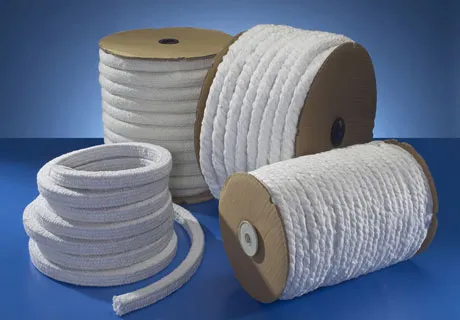
AdTech Real Case: Furnace Sealing Overhaul for an Aluminum Extrusion Plant in Malaysia
In mid-2025, we started working with an aluminum extrusion company based in Selangor, Malaysia — about 30km outside Kuala Lumpur. They operate four gas-fired holding furnaces feeding three extrusion lines producing 6000-series aluminum profiles for the construction and automotive sectors.
The situation when they first reached out: Their furnace door sealing was a recurring headache. They were using locally sourced mineral wool rope — cheap, easy to get, and completely inadequate for the job. The rope was compressing flat and losing its resilience within 8–10 weeks of installation on the furnace doors, leaving visible gaps around the door perimeter. Operators had started overlapping strips of ceramic fiber blanket as a makeshift patch, which worked for a few days before the blanket frayed and fell apart.
The measurable consequences: their production team had logged furnace door surface temperatures of 280–340°C on the external face — well above what the door frame steel was rated for — and their energy meter showed the holding furnaces consuming roughly 18% more gas than the OEM specification for those furnace sizes. The maintenance manager described it as “chasing a problem that never stayed fixed.”
What we put together for them: After a video call with their engineering team and a review of their furnace door drawings (they sent us the original equipment documentation), we recommended 16mm braided ceramic fiber rope in our 1260°C high-purity grade with stainless steel wire cores for the door perimeter grooves. The SS wire core was specifically chosen because their door groove depth was slightly undersized for the door thickness, and the core would help maintain rope cross-section under the compression created when the door closed.
The initial order covered all four furnaces: 340 meters of 16mm rope, plus a supply of our ceramic fiber board for repairing the backup insulation behind the door lining, which had also degraded. One of our applications engineers joined a remote installation session with their maintenance team via video, walking through the proper installation sequence — groove cleaning, rope sizing, compression calculation, and anchoring method.
What happened after installation: They ran the first furnace for 30 days before checking, expecting to need adjustments. They didn’t. Door external face temperatures dropped to 75–90°C. Three months later, all four furnaces were showing stable seal performance with no measurable gap formation. Their energy consumption for the four holding furnaces dropped by approximately 15.5%, which their operations director calculated as savings of around MYR 142,000 (~$30,000 USD) annually.
Twelve months after the initial installation, none of the rope had required replacement — compared to the 8–10 week replacement cycle they’d been running with the previous material.
They’ve since placed four follow-up orders, expanding the relationship to include ceramic foam filters for their casting operations and fluxes for aluminum degassing. The maintenance manager told us on a call last year that the sealing project was the one that convinced their management to consolidate their consumables sourcing with AdTech. That’s the kind of outcome we’re always trying to engineer.
How to Install Ceramic Fiber Rope Correctly and Get the Most from It
Installation is where good material choices either pay off or get wasted. A few things worth knowing before you start:
Size the rope correctly for the groove. Ceramic fiber rope should compress 20–30% when the furnace door closes or the joint is made up. Too little compression and you don’t have a real seal; too much and you’re over-stressing the fibers and accelerating fatigue. Measure your groove depth and width, and choose a rope diameter that gives you that 20–30% compression in the closed position.
Clean the groove before installation. Old ceramic material, carbon deposits, and furnace scale all need to come out before you put new rope in. Any debris in the groove prevents the new rope from seating properly and creates local stress concentrations.
Use refractory adhesive to anchor the rope. A thin bead of high-temperature adhesive (rated ≥1000°C) in the groove, applied before pressing the rope in, prevents the rope from pulling out during door operation. Don’t use standard construction adhesive — it burns out and makes removal harder next time.
Avoid stretching during installation. Ceramic fiber rope doesn’t stretch back. If you pull it tight to get it around a corner, you’re permanently thinning that section. Cut the rope to length and work it into the groove with gentle hand pressure.
First firing after installation: Ramp slowly — no more than 100°C per hour up to operating temperature — on the first heat-up after a fresh seal installation. This allows any residual binder moisture to drive off gradually without creating steam pressure that can disrupt the fiber structure.
Why AdTech Ceramic Fiber Rope?
We’ve been supplying thermal insulation and consumable materials to foundries and industrial processors for years, and the one thing we hear consistently from customers who’ve tried multiple suppliers is that rope quality varies enormously in ways that aren’t visible until the product is in service. Fiber diameter distribution, shot content, binder quality, braid tightness — these are the variables that separate a rope that lasts 18 months from one that’s falling apart at the eight-week mark.
AdTech manufactures ceramic fiber rope at controlled production facilities with incoming fiber QC tes ting and finished product dimensional and thermal verification on every production batch. We’re also not selling rope in isolation — we understand the full thermal system your rope is working within, from the furnace refractory through the sealing interface to the outer shell, because we supply complete aluminum casting system components across all those layers.
If you’re specifying ceramic fiber rope for a new installation or looking to move away from a material that’s been causing you problems, reach out to our technical team with your application details.
FAQ
1. What temperature can ceramic fiber rope withstand?
It depends on the grade. Our standard ceramic fiber rope is classified to 1050°C with a continuous service rating around 950°C. The high-purity grade handles continuous operation at 1100°C and is classified to 1260°C. For extreme environments — steel arc furnaces, specialty glass melting — our zirconia-reinforced rope is rated to 1400°C classification with continuous use up to 1300°C. The key distinction is between classification temperature (survives short exposure) and continuous service temperature (performs reliably over months or years). Always spec against your sustained operating temperature, not your peak spike temperature.
2. What is the difference between braided and twisted ceramic fiber rope?
Braided ceramic fiber rope uses an interlocking fiber yarn pattern that gives it better compression recovery — it springs back closer to its original diameter after being squeezed. That makes it the better choice for furnace door seals and any application involving repeated compression and release cycles. Twisted rope is denser, more tightly packed, and resists fiber erosion from gas flow better than braided construction. It’s preferred for expansion joint packing, burner block seals, and static installations where the rope is compressed once and stays that way. In practice, about 65% of our orders are braided and 35% are twisted, though that ratio shifts depending on the industry.
3. Does ceramic fiber rope need a reinforcement core?
Not always, but in many applications a core significantly improves performance. A fiberglass core adds tensile strength and helps the rope maintain its round cross-section when compressed into a groove — useful for furnace door seals where you need even contact pressure around the full perimeter. A stainless steel wire core provides even greater structural support and is recommended for applications where the rope must resist pulling forces or where the groove geometry puts the rope under tension during service. For light-duty oven seals and wrapping applications below 800°C, unreinforced rope works perfectly well.
4. How long does ceramic fiber rope last in a furnace door seal?
With the correct grade and proper installation, you should expect 12–18 months of reliable service life in a typical aluminum holding or melting furnace door application. Some of our customers in lower-cycle operations (furnaces opened once or twice per day) report rope lasting well over two years without replacement. The factors that shorten rope life are excessive compression beyond 30%, exposure to temperatures above the continuous service rating, chemical attack from flux or metal splash, and physical damage from rough door operation. If you’re replacing rope every 8–12 weeks, the material is almost certainly underspecified for your conditions.
5. Can ceramic fiber rope be used in direct contact with molten aluminum?
We don’t recommend it as a primary containment material. Ceramic fiber rope is an insulation and sealing product, not a refractory lining. That said, incidental contact with aluminum splash or minor drips won’t destroy the rope — the alumina-silica composition is chemically compatible with molten aluminum, and we’ve seen ropes in launder cover sealing applications where occasional metal contact occurs without significant degradation. For applications where direct, sustained contact with molten metal is expected, look at our ceramic fiber board or rigid refractory products instead.
6. What diameter ceramic fiber rope should I use for my application?
Match the rope diameter to your groove or gap dimensions, aiming for 20–30% compression when the joint is closed. If your furnace door groove is 14mm deep and 16mm wide, a 16mm diameter rope gives you roughly 25% compression in depth — right in the sweet spot. Going too small leaves gaps and defeats the sealing purpose; going too large over-compresses the fiber structure and leads to accelerated compression set and shorter service life. If you’re not sure, send us your groove dimensions and we’ll recommend the right size. We stock diameters from 6mm up to 50mm and can produce custom sizes for large-volume orders.
7. Is ceramic fiber rope safe to handle?
Yes, with standard industrial precautions. Ceramic fiber rope can release airborne fibers during cutting and handling, similar to any ceramic fiber product. The IARC classifies refractory ceramic fibers as Group 2B — “possibly carcinogenic to humans” — so PPE is required: an N95 or P100 respirator when cutting, safety glasses, gloves, and long-sleeved clothing to prevent skin irritation. Cutting with a sharp blade produces less dust than sawing, and wetting the cut area further reduces airborne fiber generation. We provide a full Safety Data Sheet with every shipment. For customers in the EU subject to stricter RCF regulations, we also offer low-biopersistence (LBP) fiber alternatives — ask our team for details.
8. How does ceramic fiber rope compare to ceramic fiber blanket for sealing?
They serve different purposes despite being made from similar raw materials. Ceramic fiber rope is specifically engineered for gap filling, perimeter sealing, and packing into grooves and channels. Its round cross-section creates concentrated contact pressure against groove walls, which is what makes a seal work. Ceramic fiber blanket is a flat, flexible sheet designed for broad-area insulation — furnace wall backup, kiln linings, pipe wrapping. Some maintenance teams cut blanket into strips and stuff it into grooves as a makeshift gasket, and honestly, it’s a poor substitute. The blanket doesn’t have the density or compression resilience to maintain a seal through thermal cycling. If you’re currently using rolled-up blanket strips where rope should be, switching to purpose-made ceramic fiber rope will give you dramatically better sealing performance and longer service intervals.
9. Can I use ceramic fiber rope in an oxidizing atmosphere?
Absolutely. Alumina-silica ceramic fiber rope is inherently stable in oxidizing atmospheres — it’s already an oxide material, so there’s nothing to oxidize further. Where you need to be cautious is in reducing atmospheres (high CO or H₂ environments), which can cause chemical reduction of the silica component at temperatures above 1000°C, leading to embrittlement and premature failure. Our high-purity grade (higher alumina content) handles mildly reducing conditions better than standard grade. For severely reducing environments, the zirconia-reinforced grade offers the best chemical stability. If your application involves vacuum or controlled-atmosphere furnaces, let us know the specific gas composition and we’ll confirm the right grade.
10. What is the minimum order quantity for AdTech ceramic fiber rope?
For standard diameters (6mm, 8mm, 10mm, 12mm, 16mm, 20mm, 25mm) in standard or high-purity grades, there’s no minimum for stock items — we ship from existing inventory in 25m or 50m spools. For custom diameters, non-standard constructions, or the zirconia grade, the minimum order is typically 500m, though we can sometimes accommodate smaller quantities depending on production scheduling. Bulk rolls up to 200m are available for high-volume users who want to reduce spool changes during installation. Contact our sales and technical team with your specific requirements and we’ll confirm availability, lead time, and pricing within 24 hours.