
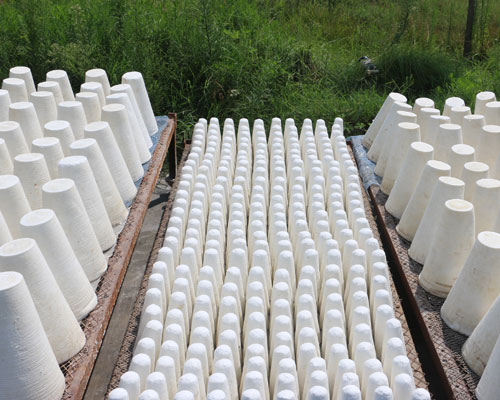
AdTech Ceramic Fiber Plugs are precision-engineered, vacuum-formed insulation components designed to withstand extreme temperatures in molten aluminum, aluminum alloy, and other metal casting operations. Constructed from high-quality aluminum silicate fiber cotton, these plugs combine excellent thermal insulation, mechanical strength, and low fume generation, making them ideal for foundries seeking precision, efficiency, and reliability.
Designed for modern industrial applications, AdTech plugs are used in flow control, mold throttling, and molten metal isolation, providing a safe and controlled environment for high-temperature production lines. Their versatility and durability make them suitable for applications in automotive, aerospace, and steel industries, ensuring high-quality final products and reducing production scrap.
What Are Ceramic Fiber Plugs and How Are They Made?
Ceramic fiber plugs are custom-shaped, self-supporting insulation components manufactured to meet the specific demands of high-temperature casting processes. The production process includes:
- Raw Material Selection
AdTech selects premium aluminum silicate fiber cotton for its high thermal stability, low thermal conductivity, and mechanical resilience. These fibers form the backbone of the plug, ensuring durability under repeated contact with molten metal. - Binder and Additive Formulation
Additives are chosen based on operating temperature, structural flexibility, and flow control requirements. This step ensures that plugs maintain their shape without cracking or shrinking during thermal cycling. - Vacuum Molding Process
The fibers, binders, and additives are formed using vacuum suction molding, producing precise, self-supporting shapes. This method allows for low shrinkage, high density, and uniform fiber distribution. - Custom Mold Production
Each plug is fabricated using a dedicated mold designed to the specific dimensions and geometry required for optimal flow control. Plugs can be conical, cylindrical, or uniquely shaped to match production line requirements. - Quality Assurance
Finished plugs are tested for thermal shock resistance, mechanical strength, dimensional accuracy, and insulation performance before being released to clients.
Key Outcome: AdTech plugs combine lightweight construction, high impact resistance, and superior insulation, ensuring they perform reliably in continuous high-temperature operations.
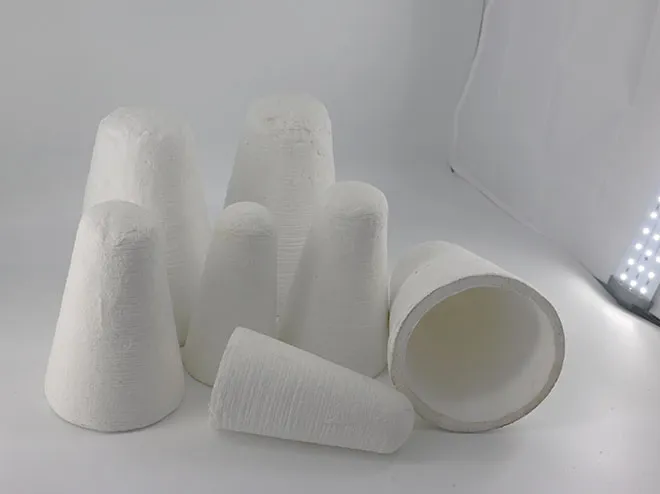
Advantages of AdTech Ceramic Fiber Plugs
AdTech Ceramic Fiber Plugs provide a combination of technical and operational benefits that make them indispensable in precision casting:
- Thermal Shock Resistance: Plugs resist cracking under rapid heating and cooling, maintaining integrity during repeated casting cycles.
- High Strength-to-Weight Ratio: Durable enough for industrial handling, yet lightweight for easy installation and mold integration.
- Low Thermal Conductivity: Retains heat in molds, reducing energy loss and maintaining molten metal quality.
- Non-Wetting and Non-Stick: Prevents molten aluminum from adhering to the plug, reducing slag formation and contamination.
- Flow Control and Precision: Fiber distribution ensures tight blockage, uniform flow throttling, and reduced turbulence in molds.
- Customizable Design: Available in standard lengths of 20–350 mm or fully customized dimensions for specific production needs.
- Environmental Compliance: Minimal smoke, zero fluoride emission, and safe for high-temperature industrial environments.
Table 1: Technical Properties of AdTech Ceramic Fiber Plugs
| Parameter | Specification / Value | Description |
|---|---|---|
| Material Composition | High-grade alumina silicate fiber | Provides thermal stability and structural integrity |
| Operating Temperature | Up to 1300 °C | Suitable for aluminum and alloy casting |
| Thermal Conductivity | 0.12–0.18 W/m·K | Reduces energy loss during casting |
| Mechanical Strength | High | Maintains shape under repeated thermal cycles |
| Fume Generation | Minimal | Safe for industrial foundries |
Source: AdTech internal trials, 2025.
How Do Ceramic Fiber Plugs Control Molten Aluminum Flow?
Ceramic fiber plugs, also known as tap-out cones, are critical components in flow management:
- Flow Throttling: The conical shape allows for gradual regulation of molten aluminum as it enters molds.
- Flow Stability: Fibers provide compactness, ensuring consistent molten metal velocity and reducing turbulence.
- Inclusion Capture: While primarily insulation, plugs can prevent inclusions from entering sensitive mold areas.
- High Durability: Able to withstand continuous molten metal contact without deformation or chemical degradation.
Table 2: Flow Control and Operational Metrics
| Feature | Typical Performance | Notes |
|---|---|---|
| Maximum Operating Temperature | 1300 °C | Suitable for aluminum and alloys |
| Insulation Efficiency | >85% heat retention | Maintains mold temperature for consistent casting |
| Mechanical Durability | High | Endures repeated casting cycles |
| Chemical Stability | Resistant to molten aluminum corrosion | Preserves metal purity |
Source: European Foundry Association (EFA), 2025.
Applications of AdTech Ceramic Fiber Plugs
AdTech ceramic fiber plugs are widely used in:
- Aluminum alloy casting: To regulate pour rate and prevent mold overflow.
- High-temperature metal processing: In steel or specialty alloy plants, for precise throttling of molten metal.
- Aerospace and automotive precision casting: Ensures dimensional accuracy and reduces defects.
- Custom high-temperature processes: Plugs are manufactured to fit specific molds and production line requirements.
Customization Options:
- Length: 20–350 mm
- Shape: Conical, cylindrical, or custom
- Material: High alumina fiber with performance additives for thermal shock resistance and wear durability
AdTech Real Case: Italian Aerospace Foundry
Background: A precision aluminum foundry in Italy, producing aerospace components, encountered challenges with molten metal overflow, inconsistent flow, and high scrap rates (~8%).
Challenges:
- Existing plugs failed under repeated high-temperature exposure.
- Irregular flow caused mold defects and reduced production efficiency.
AdTech Solution:
- Supplied 1,000 custom ceramic fiber plugs (50–200 mm, conical).
- Conducted on-site technical consultation to optimize flow control.
- Recommended high-alumina fiber plugs with enhanced thermal shock resistance.
Results:
| Metric | Before AdTech Plugs | After AdTech Plugs |
|---|---|---|
| Scrap Rate (%) | 8 | 2.5 |
| Cone Replacement Frequency | 3 per month | 1 per 3 months |
| Flow Control Consistency | Low | High |
| Surface Finish Defects | 12 per 100 parts | 3 per 100 parts |
Source: AdTech internal case study, 2025.
Outcome:
- Flow control stabilized, scrap rate reduced by 68%
- Plug life extended threefold, reducing replacement costs
- Long-term supply and technical support agreement established
Safety Guidelines for Handling Ceramic Fiber Plugs
Although non-wetting and thermally stable, proper handling is critical:
- PPE: Heat-resistant gloves, goggles, flame-retardant clothing, and protective footwear.
- Installation: Avoid rapid manual insertion into molten metal; use holders when possible.
- Storage: Keep plugs dry to prevent moisture-induced cracking or spalling.
Proper safety measures ensure long-term durability of plugs and operator safety.
Environmental and Operational Advantages
User search intent: “Are ceramic fiber plugs environmentally safe?”
AdTech plugs are engineered for eco-friendly industrial use:
- Low fume generation: Safe for operators and clean air compliance.
- Non-stick properties: Reduces metal adhesion and slag formation.
- Energy efficiency: Excellent insulation reduces heat loss, improving energy usage.
- Recyclability: Components can be reused without performance compromise.
Table 3: Environmental and Efficiency Comparison
| Parameter | Traditional Ceramic Plug | AdTech Ceramic Fiber Plug |
|---|---|---|
| Fume Emission | Moderate | Minimal |
| Slag Formation | High | Low |
| Energy Efficiency | Standard | +15% heat retention |
| Recyclability | Limited | High |
Source: International Aluminium Institute (IAI), 2025.
Why Choose AdTech Ceramic Fiber Plugs?
AdTech Ceramic Fiber Plugs are engineered for precision, durability, and environmental compliance. They provide:
- Stable molten metal flow control for precision casting
- High thermal insulation and shock resistance
- Reduced scrap rates and increased plug life
- Eco-friendly operation with minimal fumes
- Fully customizable shapes and sizes for unique production needs
If your project requires the use of Ceramic Fiber Plugs, you can contact us for a free quote.
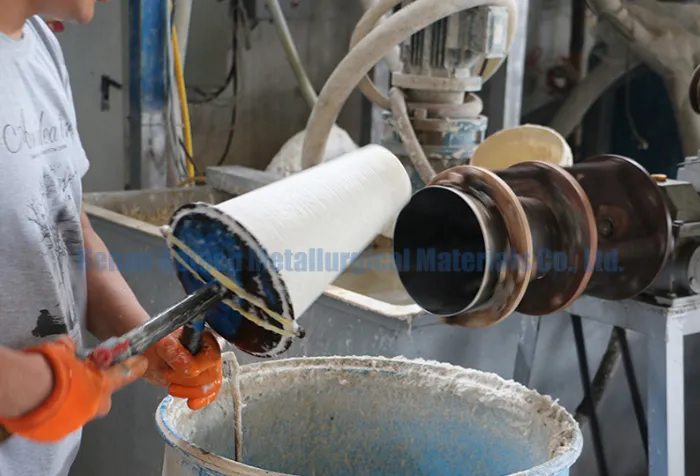
From packaging to shipment to customer use site — see how AdTech ceramic fiber plugs are made, delivered, and trusted for high-temperature tapping operations.
FAQ
1. What are ceramic fiber plugs used for in aluminum casting?
Ceramic fiber plugs are used to control or block molten aluminum flow, prevent mold overflow, and ensure precision in aluminum and alloy casting processes.
2. How do ceramic fiber plugs withstand high temperatures?
Made from high-grade alumina silicate fibers, AdTech plugs resist temperatures up to 1300 °C, maintaining structural integrity and insulation under repeated thermal cycles.
3. Can ceramic fiber plugs reduce casting defects?
Yes. They provide tight flow control and prevent turbulence, reducing porosity, surface defects, and scrap rates in precision casting.
4. Are AdTech ceramic fiber plugs customizable?
Absolutely. Plugs can be custom-shaped to fit specific molds, with lengths ranging from 20 mm to 350 mm, or designed according to unique production requirements.
5. What is the typical lifespan of a ceramic fiber plug?
Depending on operating temperature and casting frequency, AdTech plugs can last multiple casting cycles—in some industrial trials, lifespan improved threefold compared to standard plugs.
6. Do ceramic fiber plugs generate fumes or emissions?
No. They are low-fume and environmentally friendly, producing minimal smoke and zero fluoride emissions, fully complying with industrial emission standards.
7. How do ceramic fiber plugs improve flow control?
The conical design and fiber distribution allow plugs to throttle molten metal consistently, ensuring uniform mold filling and reducing turbulence for high-precision components.
8. Can ceramic fiber plugs handle repeated thermal shock?
Yes. They are designed for high thermal shock resistance, withstanding rapid heating and cooling without cracking or losing shape.
9. What safety measures should operators take when using ceramic fiber plugs?
Operators should use heat-resistant gloves, goggles, and protective clothing, and handle plugs carefully to avoid rapid contact with molten metal. Proper storage keeps plugs dry to prevent cracking.
10. Are AdTech ceramic fiber plugs suitable for custom industrial processes?
Yes. They are ideal for automotive, aerospace, steel, and specialty metal casting processes, where precise flow control, high-temperature insulation, and durability are required.