
What Is a Launder Dam and Why Is It Important in Aluminum Casting?
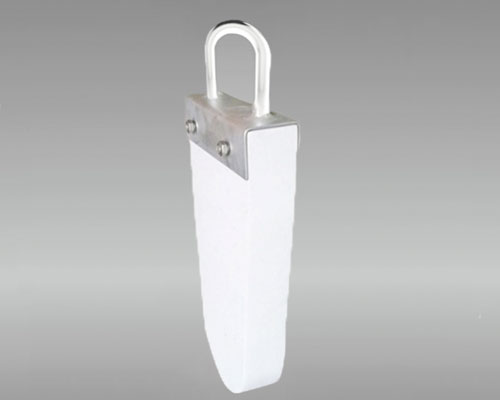
A launder dam is a refractory flow-control component installed inside molten aluminum launders to regulate metal depth, stabilize flow velocity, and improve melt treatment efficiency. Although relatively simple in structure, a properly designed launder dam directly affects metal cleanliness, filtration performance, temperature uniformity, and overall casting stability.
In modern aluminum casting operations, molten metal travels through a series of treatment stages before reaching the casting machine. Along this path, maintaining consistent flow conditions is critical. A launder dam helps create controlled metal levels within the launder system, reducing turbulence and allowing upstream treatment equipment to operate under more stable conditions.
For billet casting, slab casting, foundry casting, and rolling ingot production, launder dams are widely used together with filtration systems, degassing units, and refractory launders to improve process reliability and casting quality.
What Does a Launder Dam Do in a Molten Aluminum Launder?
The primary function of a launder dam is to partially obstruct the molten metal flow path, creating a controlled metal head upstream.
This seemingly simple action provides several important process benefits:
- Stabilizes molten aluminum flow
- Controls metal level inside the launder
- Reduces flow turbulence
- Improves filtration efficiency
- Promotes inclusion flotation
- Enhances temperature uniformity
- Supports consistent casting conditions
Without proper flow control, excessive velocity fluctuations may negatively affect downstream filtration and melt treatment systems.
Key Functions of a Launder Dam
| Function | Benefit |
|---|---|
| Metal level control | Maintains stable melt depth |
| Flow regulation | Reduces sudden velocity changes |
| Turbulence reduction | Minimizes oxide generation |
| Treatment optimization | Improves filtration and degassing performance |
| Process stability | Supports consistent casting quality |
How Does a Launder Dam Improve Molten Aluminum Quality?
Molten aluminum quality is highly dependent on flow behavior.
When metal moves through launders at excessive speed or under unstable conditions, several issues can occur:
- Surface turbulence
- Oxide film formation
- Inclusion entrainment
- Temperature variation
- Reduced filtration efficiency
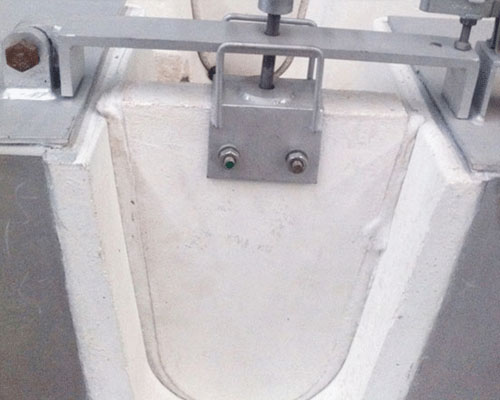
A properly positioned launder dam helps create a more uniform flow profile by slowing and redistributing molten aluminum.
This controlled flow environment can contribute to cleaner metal and better downstream treatment performance.
Impact on Metal Cleanliness
| Casting Condition | Without Dam | With Dam |
| Flow stability | Variable | Stable |
| Oxide entrainment risk | Higher | Lower |
| Filtration efficiency | Reduced | Improved |
| Temperature consistency | Less stable | More stable |
| Inclusion removal potential | Lower | Higher |
Why Is Flow Control Critical Before Ceramic Foam Filtration?
One of the most overlooked factors affecting ceramic foam filter performance is molten aluminum flow stability.
Many filtration problems are not caused by the filter itself but by unstable upstream flow conditions.
When molten aluminum enters a filter box at excessive velocity:
- Metal may bypass filtration zones
- Filter loading becomes uneven
- Oxide films may break and re-enter the melt
- Filtration efficiency may decrease
Installing a launder dam upstream of filtration equipment helps establish a more controlled metal head and more uniform flow distribution.
For casting lines using ceramic foam filtration, flow-control components often work together with:
- Launders
- Filter boxes
- Transition plates
- Hot-top casting systems
- Online degassing equipment
These systems are commonly integrated into complete molten aluminum treatment solutions available through AdTech’s product portfolio.
What Materials Are Used to Manufacture Launder Dams?
Launder dams operate continuously in direct contact with molten aluminum and therefore require excellent thermal and chemical stability.
Common materials include:
Fused Silica
Widely used for general aluminum casting applications due to:
- Low thermal conductivity
- Good thermal shock resistance
- Stable dimensional performance
High-Purity Silica-Based Refractories
Often selected for:
- Billet casting
- Rolling slab production
- High-quality alloy manufacturing
Specialty Refractory Composites
Used in demanding applications where:
- Longer service life is required
- Higher erosion resistance is needed
- Thermal cycling is severe
Typical Material Comparison
| Material | Thermal Shock Resistance | Erosion Resistance | Typical Application |
| Fused Silica | Excellent | Good | Standard casting |
| High-Purity Silica | Excellent | Very Good | Billet casting |
| Composite Refractory | Excellent | Excellent | High-volume production |
How Does a Launder Dam Work with Online Degassing Equipment?
Online degassing systems rely on stable molten aluminum flow to achieve consistent hydrogen removal.
Flow instability may reduce treatment efficiency by altering:
- Residence time
- Bubble distribution
- Metal circulation patterns
A launder dam installed before or after the degassing chamber can help maintain a more uniform metal level and improve process consistency.
This is one reason why many modern casting lines combine flow-control components with specialized molten aluminum treatment equipment such as:
- Rotary degassing units
- Filter boxes
- Launder systems
- Ceramic foam filters
The effectiveness of each individual component is often influenced by the stability of the entire treatment process.
Can a Launder Dam Reduce Oxide Formation?
Yes, indirectly.
Oxides are generated whenever molten aluminum is exposed to oxygen.
While a launder dam does not remove oxides, it helps reduce the flow conditions that encourage oxide entrainment.
When turbulence decreases:
- Surface disturbance is reduced
- Oxide films are less likely to fold into the melt
- Secondary oxidation decreases
- Inclusion generation may be reduced
For this reason, flow-control design is often considered an important part of overall metal cleanliness management.
How Is a Launder Dam Installed?
Installation methods vary according to launder design and casting system configuration.
Most systems position the dam:
- Before filtration chambers
- After degassing units
- Near flow-control sections
- At transition zones within the launder network
Several factors must be considered:
Dam Height
The height determines the resulting metal level and flow restriction.
Flow Capacity
The opening size must match casting throughput requirements.
Thermal Expansion
Proper installation should accommodate thermal movement during operation.
Refractory Compatibility
Material selection should match adjacent refractory components.
How Do You Choose the Right Launder Dam?
Selecting the correct launder dam requires evaluating multiple process variables.
Aluminum Alloy Type
Different alloys may have different cleanliness requirements.
Casting Speed
Higher production rates often require different flow-control geometry.
Launder Dimensions
The dam must be compatible with launder width and metal depth.
Treatment Equipment Layout
Flow-control design should work together with filtration and degassing systems.
Desired Metal Cleanliness
Higher-quality products generally require tighter control of molten aluminum flow behavior.
Selection Guide
| Process Factor | Recommended Focus |
| High casting speed | Stable flow control |
| Precision alloys | Enhanced cleanliness |
| Large casting lines | Durable refractory materials |
| Continuous production | Long service life |
| High filtration demand | Optimized metal head control |
What Are the Common Problems Caused by Improper Launder Dam Design?
An improperly designed dam may create new process issues rather than solve existing ones.
Common problems include:
Excessive Flow Restriction
May lead to overflow risks and unstable metal levels.
Insufficient Flow Control
May fail to reduce turbulence effectively.
Premature Erosion
Poor material selection can shorten service life.
Uneven Metal Distribution
Improper geometry may create localized flow disturbances.
Successful implementation depends on balancing flow control with casting throughput requirements.
Why Are Launder Dams Used in Modern Aluminum Casting Lines?
As casting quality requirements continue to increase, process stability becomes increasingly important.
A launder dam is a relatively low-cost component, but it influences several critical aspects of molten aluminum treatment:
- Flow stability
- Filtration performance
- Hydrogen removal consistency
- Inclusion control
- Temperature management
- Casting quality
For aluminum producers seeking cleaner metal and more predictable production performance, properly engineered flow-control components remain an essential part of modern molten aluminum handling systems.
FAQ
1. What is the main purpose of a launder dam?
A launder dam controls molten aluminum flow and maintains stable metal levels within the launder system.
2. Does a launder dam remove inclusions?
No. It does not directly remove inclusions but helps create flow conditions that improve filtration and inclusion separation efficiency.
3. Where is a launder dam installed?
Typically before filtration units, near degassing equipment, or at strategic locations within molten aluminum launders.
4. What material is commonly used for launder dams?
Fused silica and high-purity silica-based refractory materials are among the most common choices.
5. Can a launder dam improve ceramic foam filter performance?
Yes. Stable molten aluminum flow generally improves filter loading conditions and filtration efficiency.
6. Is a launder dam required for every casting line?
Not necessarily, but it is widely used in modern aluminum casting systems where flow stability and metal cleanliness are important process objectives.