
The global aluminium industry produced roughly 71 million metric tonnes of primary aluminium in 2024, with just ten companies accounting for over half of that total. If you’re sourcing aluminium for automotive, aerospace, packaging, or construction projects, knowing which producers lead on capacity, vertical integration, and product range saves you real headaches down the line. This guide ranks the world’s largest aluminium companies by primary production volume, breaks down their operations, and explains what actually separates a tier-one smelter from the rest.
I’ve spent years working with procurement data and supply-chain analytics in the metals sector, and one thing I’ve learned: raw tonnage doesn’t tell the full story. Downstream capabilities, recycling infrastructure, and specialty alloy expertise matter just as much—sometimes more—when you’re choosing a supplier for precision casting or high-purity applications.
Why Does the Global Aluminium Market Keep Growing?
Global aluminium demand has grown at a compound annual rate of about 3.5% over the past decade, driven primarily by electric vehicle manufacturing, renewable energy infrastructure, and lightweight packaging. The International Aluminium Institute (IAI) reports that transportation and construction together consume more than 45% of all aluminium produced worldwide.
What many people overlook is the role of secondary aluminium—recycled metal that requires only 5% of the energy needed for primary smelting. Several companies on this list have invested heavily in scrap-based production, which gives them a cost edge and a better emissions profile.
A few key demand drivers worth noting:
- EV battery enclosures and structural components — automakers need high-strength, lightweight alloys
- Solar panel frames — aluminium extrusions dominate this segment
- Beverage can sheet — the single largest end-use for flat-rolled aluminium in North America
- Aerospace forgings and castings — where alloy purity and degassing treatment become absolutely critical
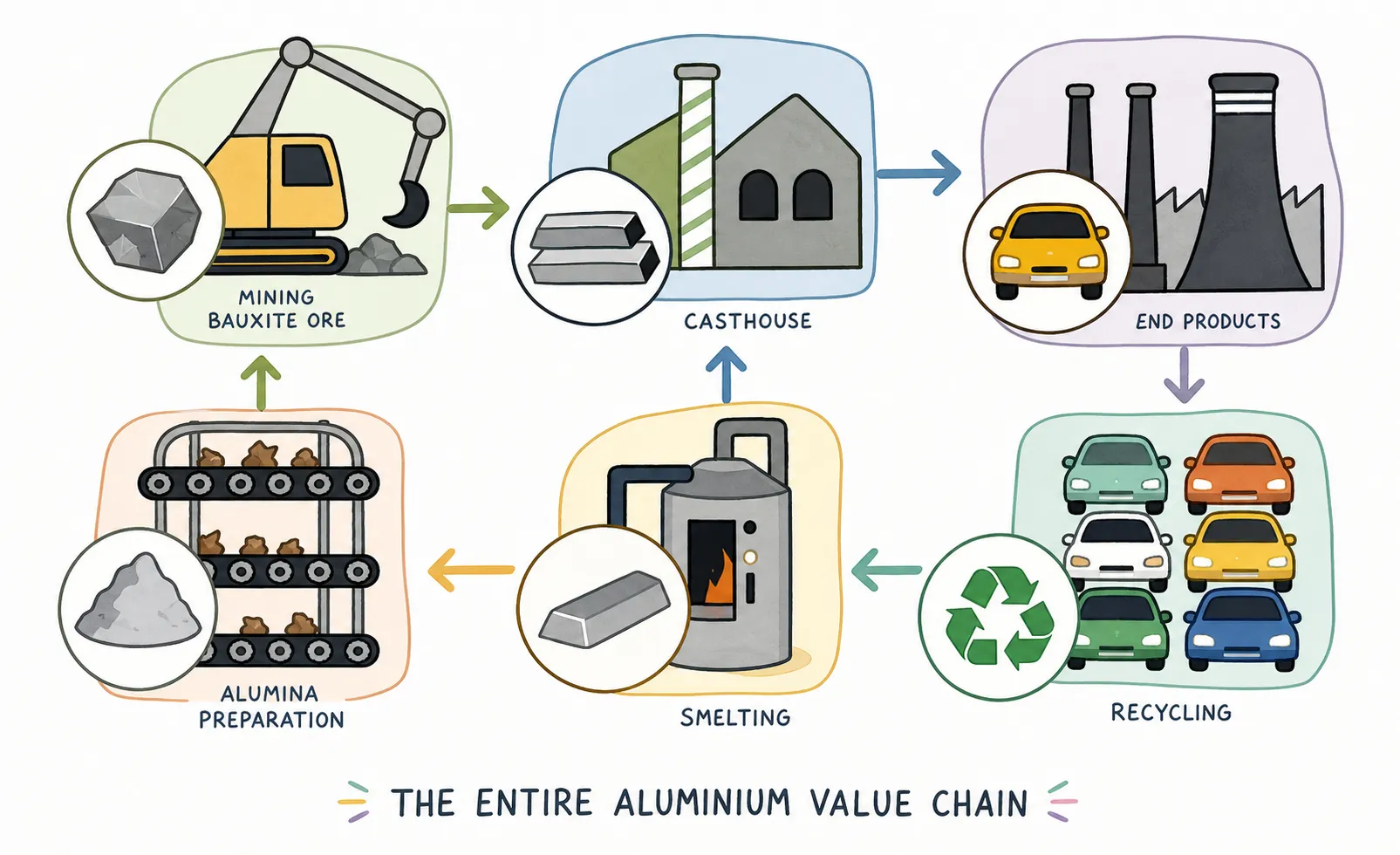
How Are These Companies Ranked?
The ranking below uses primary aluminium production capacity (in million metric tonnes per annum, or MTPA) as the primary sorting criterion, cross-referenced with 2023–2024 production reports, annual filings, and IAI data. Where two companies are close in output, I’ve considered bauxite reserves, alumina refining capacity, and downstream integration as tiebreakers.
| Rank | Company | Headquarters | Primary Al Production (MTPA, approx.) |
|---|---|---|---|
| 1 | China Hongqiao Group | Binzhou, China | ~6.5 |
| 2 | Aluminium Corporation of China (Chalco) | Beijing, China | ~6.0 |
| 3 | UC Rusal | Moscow, Russia | ~3.8 |
| 4 | Xinfa Group | Chiping, China | ~3.2 |
| 5 | Rio Tinto Aluminium | Melbourne, Australia | ~3.1 |
| 6 | State Power Investment Corp (SPIC) | Beijing, China | ~2.8 |
| 7 | Alcoa Corporation | Pittsburgh, USA | ~2.2 |
| 8 | Emirates Global Aluminium (EGA) | Abu Dhabi, UAE | ~2.7 |
| 9 | Norsk Hydro | Oslo, Norway | ~2.2 |
| 10 | Vedanta Aluminium (Hindalco’s competitor*) | New Delhi, India | ~2.3 |
Note: Hindalco Industries (Novelis’ parent) could reasonably claim this spot depending on how you count Novelis’ rolling capacity vs. primary smelting. I’ve included Vedanta here because their Jharsuguda smelter in Odisha—at 1.8 MTPA from a single site—is the largest single-location aluminium smelter outside China. That’s a distinction worth knowing.
1. China Hongqiao Group — The Undisputed Volume Leader
What makes Hongqiao the world’s biggest aluminium producer?
Founded in 1994 in Shandong Province, Hongqiao has scaled at a pace that frankly stunned Western competitors. Their 2023 annual report shows revenue exceeding RMB 140 billion (roughly $19.5 billion USD) with primary aluminium output around 6.5 million tonnes.
Hongqiao’s advantage is brutally simple: integrated power generation. They operate their own coal-fired and, increasingly, hydropower plants in Yunnan Province, where they’ve relocated significant smelting capacity since 2021. Electricity accounts for 30–40% of primary aluminium production costs, so controlling your own power supply is the single biggest competitive lever in this industry.
Key operations:
- Shandong smelting base (original hub)
- Yunnan Province hydropower-linked smelters (expansion since 2021)
- Guinea bauxite mining (through Winning Consortium)
- Indonesia alumina refinery (joint venture)
One criticism I’d level at Hongqiao: transparency. Their reporting doesn’t always meet the disclosure standards you’d expect from a company this size, and several short-seller reports over the years have questioned their cost figures. That said, their output numbers are broadly confirmed by IAI statistics.
2. Chalco (Aluminium Corporation of China)
Is Chalco bigger than Hongqiao?
Not anymore, though it was for many years. Chalco—the listed subsidiary of Chinalco—remains China’s second-largest and the world’s second-largest primary aluminium producer at approximately 6.0 MTPA. What separates Chalco from Hongqiao is its deeper upstream integration: Chinalco controls massive bauxite reserves domestically and in Guinea, and operates major alumina refineries.
Chalco’s product mix skews more toward industrial-grade aluminium and alumina trading than specialty downstream products. Their 2023 net profit surged on the back of higher aluminium prices and lower coal costs in the second half of the year.
| Metric | Hongqiao | Chalco |
|---|---|---|
| Primary Al Output (MTPA) | ~6.5 | ~6.0 |
| Alumina Capacity (MTPA) | ~8.0 | ~17.0 |
| Bauxite Reserves | Guinea (JV) | Guinea + domestic |
| 2023 Revenue (USD approx.) | $19.5B | $32B+ |
| Listed Exchange | HKEX | Shanghai + HKEX |
Chalco’s higher revenue reflects its alumina trading business, which dwarfs Hongqiao’s.
3. UC Rusal — The Largest Non-Chinese Producer
Rusal produces around 3.8 MTPA from smelters spread across Siberia, where cheap hydroelectric power from rivers like the Yenisei and Angara gives them some of the lowest production costs on the planet. Their Krasnoyarsk, Bratsk, and Sayanogorsk smelters are engineering marvels—enormous facilities running virtually 24/7 in brutally cold conditions.
Since 2022, Western sanctions on Russia have reshaped Rusal’s customer base. They’ve pivoted heavily toward Chinese and Indian buyers, and their London Metal Exchange deliverability has become complicated. For Western buyers, this effectively removes Rusal metal from the supply chain, tightening availability of everything from commodity-grade P1020 ingot to foundry alloys.
This is where melt quality and in-house metal treatment become more important for downstream users. When your primary metal source narrows, the burden falls harder on foundries and casthouse operations to refine molten aluminium properly before casting—removing dissolved hydrogen, alkali metals, and non-metallic inclusions that compromise final product integrity.
4. Xinfa Group
Xinfa is less well-known internationally but produces roughly 3.2 MTPA from its base in Chiping, Shandong Province. They’re vertically integrated from coal mining and power generation through to alumina refining and primary smelting. Xinfa is privately held, which makes detailed financial analysis difficult, but industry consensus places them firmly in the top five globally.
5. Rio Tinto Aluminium
Which Western company produces the most aluminium?
Rio Tinto’s aluminium division (formerly Alcan, acquired in 2007 for $38 billion) operates smelters in Canada, Australia, New Zealand, and Iceland, producing approximately 3.1 MTPA. Their Canadian operations—particularly the Kitimat smelter in British Columbia and the Arvida complex in Quebec—benefit from abundant, low-cost hydroelectricity.
What makes Rio Tinto distinctive is their technology licensing business. They developed the AP Technology™ smelting process, which achieves some of the lowest energy consumption per tonne of any smelting technology worldwide. Their ELYSIS joint venture with Alcoa aims to commercialize carbon-free smelting by eliminating carbon anodes entirely—replacing them with inert ceramic anodes that emit oxygen instead of CO₂.
Rio Tinto Aluminium at a glance:
| Operation | Location | Power Source | Capacity |
|---|---|---|---|
| Kitimat | BC, Canada | Hydro | ~420,000 t/yr |
| Grande-Baie/Laterrière | Quebec, Canada | Hydro | ~230,000 t/yr |
| Boyne Island | Queensland, Australia | Coal/gas | ~500,000 t/yr |
| ISAL | Hafnarfjörður, Iceland | Hydro/geothermal | ~210,000 t/yr |
| Tiwai Point | Southland, New Zealand | Hydro | ~345,000 t/yr |
6. State Power Investment Corporation (SPIC)
SPIC is a Chinese state-owned enterprise whose aluminium operations fly under most Western analysts’ radar. Through subsidiaries, they operate smelters primarily in Qinghai, Ningxia, and other inland provinces, with total capacity around 2.8 MTPA. Their core advantage, as the name suggests, is power generation—they’re primarily an energy company that happens to produce aluminium because they have surplus cheap electricity.
7. Emirates Global Aluminium (EGA)
How did a desert country become an aluminium powerhouse?
It’s a fair question. The UAE has no bauxite, no hydroelectric dams, and until recently, no alumina refineries. What it does have is cheap natural gas and a strategic location between Asian and European markets.
EGA operates two massive smelters—Jebel Ali in Dubai and Al Taweelah in Abu Dhabi—with combined capacity of approximately 2.7 MTPA, making it the largest producer in the Middle East and the fifth-largest globally outside China. They commissioned the Al Taweelah alumina refinery in 2019, processing bauxite from their own Guinea mine (through Guinea Alumina Corporation), which gave them the upstream integration they previously lacked.
EGA’s casthouse product range is impressive. They produce everything from standard P1020A ingot to high-purity foundry alloys, extrusion billet, and rolling slab. Their metal quality is consistently high, which matters enormously for downstream users running sensitive casting operations where even trace levels of sodium or calcium cause porosity and hot-tearing issues.
Speaking from experience in foundry operations, the quality of your primary metal is only half the equation. What happens in the casthouse—filtration, degassing, and grain refinement—determines whether you get castings that pass X-ray inspection or end up as scrap. This is especially true for aerospace and structural automotive applications where porosity tolerances are measured in fractions of a percent.
8. Alcoa Corporation
Alcoa invented the modern aluminium industry. Charles Martin Hall’s 1886 electrolytic reduction process is literally the foundation of everything on this list. Today, Alcoa operates a leaner, more focused business after spinning off Arconic (now Howmet Aerospace) in 2016.
Current primary aluminium production sits around 2.2 MTPA from smelters in the US (Massena, NY and Ferndale, WA), Canada (Deschambault and Baie-Comeau, Quebec), Norway (Lista and Mosjøen), and Australia. Alcoa also controls enormous bauxite mining operations in Western Australia and alumina refining capacity in Australia, Spain, and Brazil.
Alcoa’s “Sustana” brand of low-carbon aluminium—smelted using hydroelectric power in Canada and Norway—commands a price premium of $10–25/tonne over standard metal, reflecting growing buyer demand for verified low-carbon supply chains.
9. Norsk Hydro
Hydro is probably the most vertically integrated aluminium company in Europe, with operations spanning bauxite mining (Paragominas, Brazil), alumina refining (Alunorte—the world’s largest alumina refinery), primary smelting, and downstream extrusion and recycling.
Primary aluminium production runs at approximately 2.2 MTPA. Their Karmøy smelter in Norway houses a pilot line using their proprietary HAL4e technology, which reduces energy consumption to around 11.5–12.0 kWh/kg—among the lowest ever demonstrated at industrial scale.
Hydro has also invested aggressively in aluminium recycling through their “CIRCAL” brand, which contains a minimum of 75% post-consumer recycled content. This is where the industry is heading, frankly—primary smelting will always exist, but the economics and environmental math increasingly favor secondary production for many applications.
10. Vedanta Aluminium
Vedanta’s Jharsuguda smelter in Odisha, India, deserves special attention. At 1.8 MTPA from a single location, it’s one of the largest aluminium smelters on earth. Combined with their Korba smelter in Chhattisgarh and BALCO operations, Vedanta’s total primary output reaches approximately 2.3 MTPA.
India’s aluminium demand is growing faster than almost any other major market—driven by infrastructure spending, power transmission, and a booming automotive sector. Vedanta is well-positioned to capture this domestic growth, though their reliance on coal-fired power generation puts them at a disadvantage in carbon-conscious export markets.
What Role Does Metal Treatment Play in Aluminium Quality?
Learn More About Our Molten Aluminum Treatment
This is something that doesn’t get enough attention in industry rankings. A tonne of primary aluminium from any of these producers still contains dissolved hydrogen, alkali metal impurities, and non-metallic inclusions (oxides, carbides, borides) that must be removed before the metal is suitable for critical applications.
The casthouse is where raw metal becomes a usable product. Equipment like ceramic foam filters for molten aluminium, degassing rotors, and flux injection systems directly determines the quality of the final ingot, billet, or slab.
This matters more than most people realize. A single part-per-million of sodium in 6xxx-series extrusion billet can cause surface tearing during extrusion. Dissolved hydrogen above 0.10 mL/100g of aluminium creates porosity that fails radiographic inspection in aerospace castings. These aren’t theoretical problems—they cost foundries and rolling mills real money every day.
| Quality Parameter | Acceptable Level (Typical) | Measurement Method | Consequence if Exceeded |
|---|---|---|---|
| Dissolved Hydrogen | < 0.10 mL/100g Al | Reduced Pressure Test (RPT) / ALSCAN | Porosity, blistering |
| Sodium (Na) | < 2 ppm | Spectrographic analysis | Hot cracking, surface defects |
| Non-metallic Inclusions | < 1.0 mm²/kg (PoDFA) | PoDFA / Prefil | Reduced mechanical properties |
| Grain Size | < 200 µm (equiaxed) | Macro-etch / ASTM E112 | Inconsistent mechanical properties |
Contact Us for molten aluminum treatment
Which Country Produces the Most Aluminium?
China dominates. It’s not even close. Chinese smelters produced approximately 41–42 million tonnes of primary aluminium in 2024, roughly 58–59% of global output. The next four largest producing countries—India, Russia, Canada, and the UAE—collectively produced around 14 million tonnes.
This concentration creates supply-chain risk that Western manufacturers are increasingly trying to mitigate through nearshoring, recycling investment, and long-term contracts with non-Chinese producers. Whether those strategies will materially shift the balance is debatable—China’s cost advantages in power and scale are structural, not temporary.
Why Aluminium Quality Is Decided Long Before the Final Part Is Made
When people talk about the aluminium industry, they usually focus on the names at the top of the supply chain—mines, refineries, and giant smelters. That matters, of course. But in real-world production, the difference between metal that merely meets spec and metal that performs reliably in casting, extrusion, or machining is often decided later, in the melt handling and casting stage. That’s where filtration, degassing, flow control, and other molten-metal treatment steps stop being “shop-floor details” and start acting like profit drivers.
In my view, this is exactly why suppliers of molten aluminium casting and filtration products occupy a far more important position in the value chain than they’re usually given credit for. A world-class smelter can still deliver disappointing downstream results if inclusion control is weak, hydrogen isn’t managed properly, or the metal flow system introduces instability. On the other hand, well-designed consumables and treatment equipment can quietly improve yield, reduce scrap, protect surface quality, and help manufacturers get more value from every tonne they buy. In other words, the biggest aluminium companies may shape global supply—but the companies supporting cleaner, more consistent casting are often the reason that metal is truly usable in high-spec applications.
FAQ
1. Which company is the largest aluminium producer in the world?
China Hongqiao Group holds the top position with approximately 6.5 million metric tonnes of primary aluminium output per year. They’ve held this spot since overtaking Chalco around 2015, largely because they generate their own electricity—the single biggest cost factor in smelting.
2. How much aluminium does the world produce annually?
Global primary aluminium production reached roughly 71 million metric tonnes in 2024, according to International Aluminium Institute data. China alone accounts for about 58–59% of that total, with the rest split among India, Russia, Canada, the UAE, Australia, Norway, and others.
3. Why does China dominate global aluminium production?
Three reasons: cheap coal-fired and hydroelectric power, massive government-backed capital investment, and enormous domestic demand from construction and manufacturing. Chinese smelters also benefit from lower labor costs and less restrictive environmental regulation compared to Western counterparts, though Beijing has tightened emissions standards significantly since 2020.
4. What is the difference between primary and secondary aluminium?
Primary aluminium is smelted from alumina (refined bauxite ore) using electrolysis—an energy-intensive process consuming roughly 13–15 kWh per kilogram. Secondary aluminium is produced by remelting scrap, which uses only about 5% of that energy. Both can achieve identical alloy specifications, but secondary production requires rigorous melt treatment, filtration, and degassing to remove contaminants picked up during the scrap’s previous life cycle.
5. What is low-carbon aluminium and why does it cost more?
Low-carbon aluminium—branded as Sustana (Alcoa), CIRCAL (Hydro), or similar—is metal produced using hydroelectric, solar, or other renewable energy sources, resulting in less than 4.0 tonnes of CO₂ per tonne of aluminium versus the industry average of roughly 16.1 tonnes. Buyers pay a $10–30/tonne premium because verifiable low-carbon supply chains are limited, and demand from automakers and consumer goods companies keeps growing.
6. Which country outside China produces the most aluminium?
India has overtaken Russia for the number-two spot in recent years, with total primary output exceeding 4.1 million tonnes in 2024. Vedanta’s Jharsuguda smelter alone produces 1.8 MTPA from a single site. Russia (Rusal, ~3.8 MTPA) and Canada (Rio Tinto and Alcoa operations, ~3.1 MTPA combined) follow closely.
7. Why is metal quality control so important in aluminium casting?
Because dissolved hydrogen, alkali metals like sodium and calcium, and non-metallic inclusions (oxides, spinels, carbides) directly cause porosity, hot tearing, and surface defects in finished castings. For aerospace and structural automotive parts, even 0.05 mL/100g of excess dissolved hydrogen can push a casting beyond acceptable porosity limits. Proper degassing and ceramic foam filtration in the casthouse isn’t optional—it’s what separates saleable product from scrap.
8. What are the main end-use sectors for aluminium globally?
Transportation (including automotive and aerospace) consumes roughly 27% of global aluminium, followed by construction at about 24%, packaging at 16%, electrical applications at 13%, and consumer goods and machinery making up the rest. Electric vehicle production is the fastest-growing segment, with each EV using 30–50% more aluminium than a comparable internal combustion vehicle.
9. Is aluminium production bad for the environment?
Primary smelting is energy-intensive and, when powered by coal, generates significant CO₂ emissions. The global average carbon footprint is about 16.1 tonnes of CO₂ per tonne of aluminium. However, hydro-powered smelters in Canada, Norway, and Iceland produce metal at under 4.0 tonnes CO₂/tonne. Recycling cuts emissions by approximately 95%. The industry is also investing in inert anode technology—Rio Tinto and Alcoa’s ELYSIS joint venture—which could eliminate direct smelting emissions entirely by replacing carbon anodes with ceramic ones that release oxygen instead of CO₂.
10. How do foundries ensure consistent aluminium alloy quality?
Consistent quality comes down to three things: incoming metal chemistry verification through spectrographic analysis, proper melt treatment during casting including rotary degassing, flux injection, and inline filtration using ceramic foam or deep-bed filters, and solidification control through grain refinement and thermal management. Most quality failures I’ve seen in foundry audits trace back to shortcuts in one of these three areas—usually melt treatment, because it’s the step that seems easiest to rush when production schedules get tight.