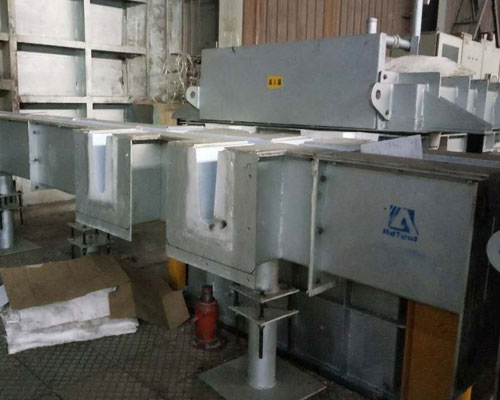
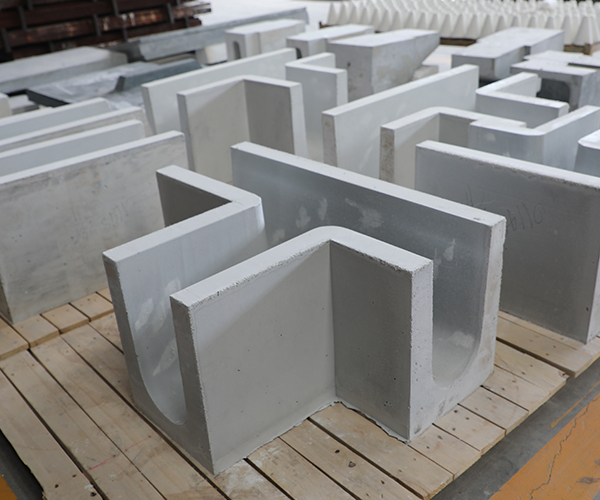
Prefabricated Refractory Launders for Molten Aluminum
Prefabricated refractory launders are used to transfer molten aluminum between furnaces, melt treatment equipment, filtration systems, and casting machines. Depending on the industry and equipment layout, they may also be called troughs, runners, or molten-metal transfer channels.
Unlike conventional launders that are built and repaired on site with castable refractory, prefabricated launders are manufactured to a defined shape and dimension before installation. They can be supplied as straight sections, bends, branches, Y- or T-shaped configurations, and other components designed for molten-metal flow control.
For aluminum casting, the launder must withstand continuous contact with high-temperature molten aluminum while limiting metal adhesion, erosion, and heat loss.

Why Are Launders Critical in Aluminum Casting?
The launder is one of the most demanding refractory components in a molten aluminum transfer system.
Molten aluminum continuously flows across the refractory surface, creating thermal, chemical, and mechanical stresses. Over time, conventional refractory materials may experience:
- Aluminum buildup on the working surface
- Erosion caused by continuous metal flow
- Thermal shock during heating and shutdown
- Repeated repair and maintenance
- Heat loss during long-distance transfer
- Damage to the refractory lining during cleaning
When aluminum adheres strongly to the launder surface, operators may need to stop production and manually remove the buildup. Aggressive cleaning can further damage the refractory lining and shorten its service life.
For high-throughput casting operations, reducing maintenance is therefore an important part of launder design.
Prefabricated Launder vs. Traditional Castable Launder
Traditional launders are often constructed or repaired on site using unshaped refractory castables. The refractory is mixed, installed, dried, and heated before use.
This approach can work for simple applications, but it has several limitations when frequent maintenance is required.
| Traditional Castable Launder | Prefabricated Refractory Launder |
|---|---|
| Constructed on site | Manufactured before installation |
| Dimensions depend on field construction | Controlled dimensions and geometry |
| Requires drying and curing after installation | Factory-prepared refractory structure |
| Repairs can be labor-intensive | Damaged sections can be replaced according to design |
| Surface quality depends on installation | Working surface can be controlled during manufacturing |
| Complex shapes are more difficult to build | Straight, curved, Y/T and customized sections available |
| Repeated maintenance can interrupt production | Designed for longer service under suitable conditions |
The right choice depends on the casting line, operating temperature, metal flow rate, launder configuration, and maintenance requirements.
What Makes a Good Aluminum Launder?
A launder for molten aluminum needs more than high-temperature resistance. The refractory must also perform well in direct contact with molten metal.
Low Wettability to Molten Aluminum
A low-wettability working surface helps reduce aluminum adhesion and buildup.
Less buildup means the flow channel can remain more stable during production and may require less frequent cleaning.
Erosion Resistance
Molten aluminum flowing continuously through a launder can gradually wear the refractory surface. Good erosion resistance helps maintain the designed flow path and extend service life.
Thermal Shock Resistance
Launders experience repeated heating and cooling during production, shutdown, maintenance, and restart. The refractory must therefore withstand thermal cycling without excessive cracking or spalling.
Mechanical Strength
The launder structure must maintain its shape during installation and operation. Adequate mechanical strength is particularly important for long sections, large launders, and customized configurations.
Thermal Insulation
A properly designed launder helps reduce heat loss as molten aluminum moves between process stages. This becomes increasingly important when the transfer distance is long or when the process requires tight temperature control.
AdTech Prefabricated Refractory Launders
AdTech provides prefabricated refractory troughs and launders for molten aluminum transfer and casting applications.
Our launders use high-silicon refractory material designed for high-temperature molten aluminum service. The working surface is designed for low wettability and resistance to molten aluminum erosion, helping reduce metal buildup and maintain a stable transfer channel.
The refractory structure also provides thermal insulation during molten aluminum transfer.
Depending on the casting-line layout, AdTech can provide customized launder sections and configurations for connection between:
Melting Furnace → Holding/Purification Furnace → Degassing → Filtration → Casting Machine

Customized Launder Configurations
Molten aluminum transfer systems are rarely identical from one plant to another. The launder may need to pass around equipment, change direction, divide the metal flow, or connect different equipment elevations.
AdTech launders can therefore be manufactured according to the required layout and dimensions.
Available configurations can include:
- Straight launders
- Curved sections
- Elbow sections
- Y-shaped configurations
- T-shaped configurations
- Transition sections
- Flow-control components
- Customized connection sections
- Launder covers and insulation components
The exact configuration depends on the customer’s casting-line layout and molten aluminum flow requirements.
Launder Applications in Aluminum Processing
Prefabricated launders can be used in various stages of aluminum melt transfer, including:
- Furnace discharge
- Holding furnace transfer
- Degassing system connections
- Filtration system connections
- Casting platform transfer
- Continuous casting lines
- Casting-rolling lines
- Molten aluminum distribution systems
For systems incorporating on-line degassing and filtration, the launder can be designed around the position and connection dimensions of the treatment equipment.

Reduce Heat Loss During Molten Aluminum Transfer
Molten aluminum can lose heat while traveling through a transfer channel, particularly when the transfer distance is long or the launder is poorly insulated.
The launder therefore serves two functions:
1. Transfer molten aluminum
Provide a defined and stable flow path between process stages.
2. Retain heat
Reduce heat loss from the molten metal during transfer.
AdTech launders can also be combined with insulating covers or boards to further reduce heat loss from the exposed molten-metal surface.
For a specific installation, the actual temperature loss depends on the launder structure, insulation, metal temperature, flow rate, transfer distance, and ambient conditions.
Why Choose a Prefabricated Refractory Launder?
For aluminum producers, the value of a prefabricated launder is not simply its refractory material.
It also comes from consistent dimensions, controlled manufacturing quality, easier installation, and reduced dependence on extensive field construction.
A suitable prefabricated system can help:
- Reduce on-site refractory work
- Improve dimensional consistency
- Maintain a smoother molten-metal flow path
- Reduce aluminum buildup
- Resist erosion and thermal shock
- Reduce maintenance requirements
- Improve the service life of the transfer system
- Reduce production interruptions caused by frequent refractory repairs
The actual service life depends on alloy type, metal temperature, flow rate, operating time, preheating, cleaning methods, and other process conditions.
How to Select a Refractory Launder?
The launder should be designed around the actual operating conditions rather than selected only by length and width.
Important information includes:
| Selection Factor | Why It Matters |
|---|---|
| Aluminum alloy | Different alloys can have different effects on refractory materials |
| Molten aluminum temperature | Determines thermal requirements |
| Metal flow rate | Influences erosion and flow stability |
| Transfer distance | Affects insulation requirements |
| Equipment layout | Determines launder geometry and connection positions |
| Elevation difference | Influences flow direction and launder design |
| Operating hours | Important for service-life requirements |
| Cleaning method | Affects refractory surface wear |
| Degassing/filtration equipment | Determines connection and transition design |
A plant drawing or equipment layout is especially useful when designing a customized launder system.
Installation and Preheating
Before molten aluminum enters the launder, the complete flow path should be inspected to ensure that it is clean, properly connected, and free from visible damage or gaps.
The refractory launder should then be preheated gradually and uniformly according to the supplied installation procedure.
Proper preheating helps remove residual moisture from the refractory and brings the launder closer to the required operating temperature before molten aluminum enters the system.
For customized AdTech systems, the specific heating rate, temperature, and holding time should follow the installation instructions supplied with the product.
Contact Us for technical consultation
AdTech Refractory Launder Solutions
AdTech develops refractory launders and molten aluminum transfer components for aluminum melting, melt treatment, filtration, and casting systems.
Rather than using one standard launder for every application, we can design the structure according to the casting-line layout, molten aluminum flow, transfer distance, operating temperature, connection dimensions, and insulation requirements.
For a customized recommendation, provide your equipment layout or launder drawing together with the approximate molten aluminum flow rate, alloy, operating temperature, and required dimensions.
Our sales and application engineering team can then recommend a suitable refractory launder configuration for your process.