
What Is Ceramic Fiber Board and Why Does It Matter?
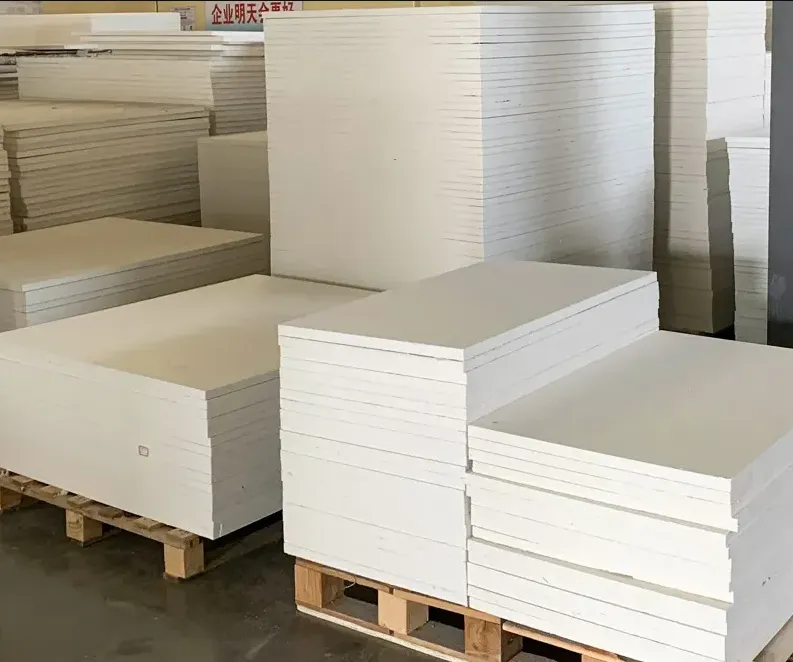
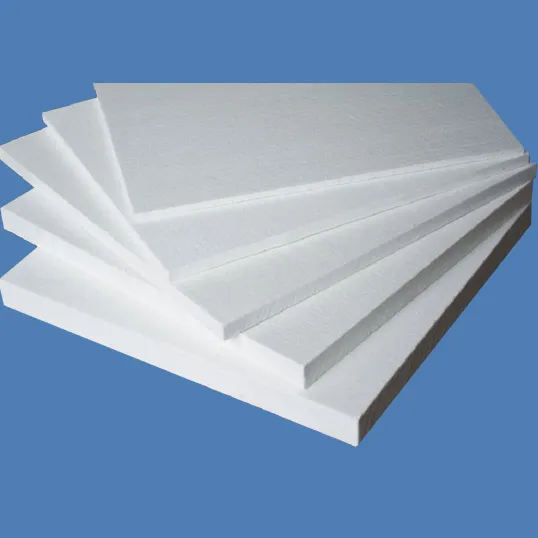
Ceramic fiber board is a rigid, lightweight insulation panel manufactured from alumina-silica fibers, typically formed through a vacuum-pressing process with inorganic binders. Unlike ceramic fiber blanket, which is flexible and prone to sagging over time, the board form holds its shape under sustained thermal load, making it the go-to choice for structural insulation in kilns, furnaces, ladles, and heat treatment equipment.
The fibers themselves are produced by melting a blend of alumina (Al₂O₃) and silica (SiO₂) at roughly 2000°C, then spinning or blowing the melt into fine filaments. These filaments get chopped, slurried, and pressed into boards of varying density and thickness. The result? A product that weighs a fraction of traditional firebrick but delivers comparable — sometimes superior — thermal resistance.
At AdTech, we manufacture ceramic fiber boards across multiple classification temperature grades, from standard 1260°C boards up to high-purity 1600°C panels engineered for aluminum casting, steel processing, and specialty ceramics firing. You can explore the full range of our ceramic fiber insulation products to see what’s available for your specific application.
What makes this material genuinely important is its thermal conductivity profile. At a mean temperature of 600°C, a quality ceramic fiber board delivers thermal conductivity around 0.12–0.18 W/m·K — roughly one-fifth of what you’d see from dense refractory brick. That translates directly into thinner lining designs, lower shell temperatures, and reduced fuel consumption.
How Does Ceramic Fiber Board Compare to Other Refractory Insulation Materials?
This is the question I get asked most. Plant engineers often weigh ceramic fiber board against insulating firebrick (IFK), calcium silicate board, microporous insulation, and even castable refractories. Here’s how they stack up in practice:
| Property | Ceramic Fiber Board (1260°C grade) | Insulating Firebrick (IFB-23) | Calcium Silicate Board | Microporous Insulation |
|---|---|---|---|---|
| Max. Service Temperature | 1260°C (2300°F) | 1260°C (2300°F) | 1050°C (1920°F) | 1000°C (1830°F) |
| Bulk Density | 280–400 kg/m³ | 640–800 kg/m³ | 850–1000 kg/m³ | 200–300 kg/m³ |
| Thermal Conductivity @ 600°C | 0.12–0.16 W/m·K | 0.28–0.35 W/m·K | 0.14–0.19 W/m·K | 0.025–0.035 W/m·K |
| Compressive Strength | 0.2–0.8 MPa | 1.5–3.0 MPa | 3.0–5.0 MPa | 0.1–0.2 MPa |
| Thermal Shock Resistance | Excellent | Moderate | Poor | Poor |
| Typical Installed Cost (relative) | Medium | Medium-High | High | Very High |
Data compiled from manufacturer technical datasheets and cross-referenced with ASTM C155 and ISO 10635 classification standards for refractory insulation materials.
Ceramic fiber board occupies a sweet spot. It’s lighter than IFB, handles thermal shock far better than calcium silicate, and costs a fraction of microporous panels. Where microporous wins on raw insulation value, it loses badly on mechanical handling — those panels crack if you look at them sideways. In aluminum melting and holding furnaces, where you need something you can actually install without treating it like glass, ceramic fiber board wins hands down.
What Are the Main Types and Temperature Grades of Ceramic Fiber Board?
Not all ceramic fiber boards are created equal. The classification temperature — the highest temperature at which the board maintains less than 2% permanent linear shrinkage after 24 hours of exposure — determines its grade. Here’s the breakdown:
| Grade / Classification | Primary Fiber Chemistry | Max. Use Temperature | Key Applications |
|---|---|---|---|
| Standard (STD) | Al₂O₃ 43–47%, SiO₂ 50–54% | 1050°C (1920°F) | Low-temp backup insulation, chimney linings |
| High-Purity (HP) | Al₂O₃ 45–49%, SiO₂ 48–52% | 1260°C (2300°F) | Aluminum furnaces, heat treatment kilns |
| High-Alumina (HA) | Al₂O₃ 52–55%, SiO₂ 43–46% | 1400°C (2550°F) | Steel ladle covers, glass forehearths |
| Zirconia-Containing (HZ) | Al₂O₃ 35–37%, SiO₂ 47–50%, ZrO₂ 15–17% | 1430°C (2600°F) | Continuous casting tundishes, petrochemical reactors |
| Polycrystalline (PCW) | Al₂O₃ 72–97% | 1600°C (2900°F) | Specialty high-temp applications, aerospace furnaces |
Temperature classifications follow ASTM C892 and EN 1094-1 standards for refractory ceramic fiber products. Fiber chemistry percentages are nominal values.
For most aluminum processing and non-ferrous metal casting applications, the HP-grade 1260°C board is the workhorse. It handles the thermal cycling that comes with batch operations without crumbling, and its low iron oxide content (typically under 1.2%) means minimal contamination risk in contact with molten aluminum.
AdTech’s ceramic fiber board lineup covers grades from 1260°C through 1600°C, with custom density options ranging from 280 kg/m³ to 400 kg/m³ depending on whether your priority is maximum insulation or mechanical strength for load-bearing installations.
Where Is Ceramic Fiber Board Used in Industrial Applications?
I’ll skip the generic “it’s used in furnaces” answer. Here’s where this material actually earns its keep in day-to-day operations:
Aluminum smelting and casting: Ceramic fiber boards serve as sidewall and roof insulation in melting furnaces, holding furnaces, and degassing units. They also work as backer insulation behind castable linings, reducing heat loss through the furnace shell. In continuous casting operations, boards line the troughs and launders that channel molten aluminum between stations. AdTech supplies a range of aluminum casting materials specifically engineered for this environment.
Steel and iron processing: Ladle covers, tundish linings, and annealing furnace walls use high-alumina or zirconia-grade boards. The thermal shock resistance matters here — steel ladle covers see temperature swings from ambient to 1500°C and back within hours.
Ceramics and glass manufacturing: Kiln car tops, kiln furniture supports, and glass forehearth insulation all rely on ceramic fiber board’s dimensional stability at temperature. The low thermal mass means kilns heat up faster, which cuts cycle times and energy costs.
Petrochemical and power generation: Reformer furnaces, catalytic cracker linings, and boiler insulation systems use ceramic fiber boards as backup insulation behind the hot-face lining. The U.S. Department of Energy’s Industrial Technologies Program has repeatedly identified ceramic fiber insulation as a key technology for reducing industrial energy consumption.
Laboratory and testing equipment: Muffle furnaces, tube furnaces, and thermal test chambers use ceramic fiber board panels because they can be precision-machined to tight tolerances — something you can’t easily do with blanket or castable products.
How Do You Select the Right Ceramic Fiber Board Thickness and Density?
This is where a lot of purchasing decisions go sideways. I’ve spoken with plant managers who ordered 50mm boards for a furnace that needed 30mm — wasting money and internal volume — and others who went too thin and ended up with shell temperatures that made OSHA nervous.
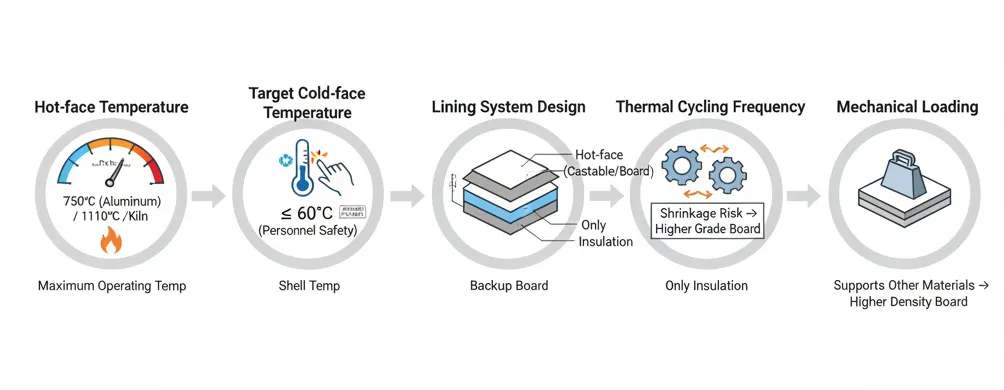
The key variables are:
- Hot-face temperature — your maximum sustained operating temperature
- Target cold-face (shell) temperature — usually 60°C or below for personnel safety per ASTM C680 heat loss calculations
- Lining system design — is the board the hot-face, backup, or only insulation layer?
- Thermal cycling frequency — more cycles = more shrinkage risk = need for higher-grade board
- Mechanical loading — if the board supports other materials, you need higher density
For a typical aluminum holding furnace operating at 750°C, a 25mm HP-grade board at 320 kg/m³ density behind a castable hot-face will bring the shell temperature well below safety thresholds. For a heat treatment kiln running at 1100°C with ceramic fiber board as the hot-face, you’d typically spec a 50mm board backed by 25mm of lower-grade insulation board, bringing total lining thickness under 80mm — far thinner than the 230mm+ you’d need with conventional firebrick.
Does Ceramic Fiber Board Shrink at High Temperature?
Yes, and pretending otherwise is dishonest. All refractory ceramic fiber products experience some degree of permanent linear shrinkage when held at or near their classification temperature for extended periods. The question isn’t if it shrinks — it’s how much and does it matter for your application.
A well-manufactured 1260°C-grade ceramic fiber board will typically show less than 2% linear shrinkage after 24 hours at 1260°C. At its actual service temperature — say, 1000°C — the shrinkage after the same exposure period drops to well under 1%. Over months of continuous service, cumulative shrinkage can open gaps between boards, which is why proper joint design with staggered layering and ceramic fiber gasket strips is critical.
| Temperature Exposure (24h soak) | Typical Linear Shrinkage — 1260°C HP Board | Typical Linear Shrinkage — 1400°C HA Board |
|---|---|---|
| 1000°C | <0.5% | <0.3% |
| 1100°C | 0.8–1.2% | <0.5% |
| 1200°C | 1.5–2.0% | 0.6–1.0% |
| 1300°C | 3.5–5.0% (exceeds classification) | 1.2–1.8% |
| 1400°C | N/A (fiber degradation) | 1.8–2.5% |
Shrinkage data based on laboratory testing per ASTM C356 (Linear Shrinkage of Preformed High-Temperature Thermal Insulation). Actual field shrinkage may vary based on atmosphere and thermal cycling.
The practical lesson: always select a board grade that gives you at least 100–150°C of headroom above your normal operating temperature. If your furnace runs at 1100°C routinely, don’t spec a 1260°C board and expect it to last five years without maintenance. Go with the 1400°C grade — the price difference is modest compared to the cost of a reline.
Is Ceramic Fiber Board Safe to Handle and Install?
This is a fair question, and it deserves a straight answer. Ceramic fiber boards are classified as refractory ceramic fibers (RCF), which fall under regulatory scrutiny in the EU (REACH Regulation, Annex XVII) and are considered a possible carcinogen (Group 2B) by the International Agency for Research on Cancer (IARC). In the United States, OSHA has established a permissible exposure limit (PEL) of 1 fiber per cubic centimeter for synthetic mineral fibers.
In practice, ceramic fiber board generates far less airborne fiber than blanket or bulk fiber during handling, because the fibers are locked into a rigid matrix by the binders. Cutting and machining with power tools is where exposure risk increases — always use dust extraction, wear P100 respirators, and follow manufacturer handling guidelines. Newer formulations using alkaline earth silicate (AES) fibers — sometimes marketed as bio-soluble fiber boards — offer an alternative that’s exempt from RCF classification in the EU, though their maximum service temperature is generally limited to around 1200°C.
AdTech Real Case: Transforming a Turkish Aluminum Extrusion Plant
In late 2022, a mid-sized aluminum extrusion manufacturer in Izmir, Turkey, reached out to AdTech about persistent overheating problems on their two 8-ton aluminum holding furnaces. The furnaces were lined with conventional insulating firebrick — a design that dated back to the early 2000s. Shell temperatures on the sidewalls regularly exceeded 85°C, the furnaces took over three hours to reach operating temperature after weekend shutdowns, and natural gas consumption was running roughly 15% above the numbers the furnace builder had originally quoted.
Their maintenance team had tried patching the existing lining with ceramic fiber blanket stuffed into cracked joints — a common stopgap that, frankly, never works long-term. The blanket compressed under its own weight within months, and the problem returned.
AdTech’s technical sales engineer visited the site, took thermal imaging scans of both furnaces, and proposed a full lining retrofit using 50mm HP-grade ceramic fiber board (1260°C classification, 320 kg/m³ density) as backup insulation behind a 40mm low-cement castable hot-face. The design also incorporated AdTech’s ceramic fiber gasket strips at all board joints to accommodate thermal expansion.
The customer ordered 220 boards (1200mm × 1000mm × 50mm) for both furnaces, plus 60 additional boards cut to custom dimensions for the furnace roofs. AdTech’s application engineering team provided detailed installation drawings showing staggered joint patterns and anchor bolt locations.
Results after six months of operation:
- Sidewall shell temperatures dropped from 85°C to under 55°C — well within safety limits
- Heat-up time from cold fell from 3+ hours to under 90 minutes
- Monthly natural gas consumption decreased by 22%, saving the facility approximately $4,800 USD per month across both furnaces
- Zero maintenance interventions on the insulation lining during the first two campaign cycles
The plant manager told us — and I’m paraphrasing here — that the payback period on the entire retrofit, including labor, was under five months. They’ve since placed a second order for ceramic fiber board to reline their homogenizing furnace, and we’re now in discussions about supplying degassing equipment and filtration systems for their casting line. That’s the kind of relationship we’re built for — not one-off sales, but long-term technical partnerships where both sides keep winning.
How Long Does Ceramic Fiber Board Last in Service?
There’s no single answer because service life depends on a tangled web of variables: operating temperature, cycling frequency, atmosphere (oxidizing vs. reducing), mechanical vibration, and whether the board is exposed to molten metal splash or chemical attack.
As a rough benchmark, well-installed HP-grade ceramic fiber board operating at 900–1000°C in an oxidizing atmosphere — think a typical aluminum melting furnace — will deliver 3–7 years of reliable service before shrinkage and fiber devitrification warrant replacement. In lower-temperature backup insulation roles (behind firebrick or castable), 10+ years is achievable and common.
Reducing atmospheres — especially those containing hydrogen or carbon monoxide — accelerate fiber degradation. In those environments, the board may need replacement in 2–3 years, or you should consider upgrading to polycrystalline alumina board, which resists reduction far better than standard alumina-silica fibers.
The cheapest insulation isn’t always the one with the lowest price tag — it’s the one that delivers the lowest total cost per operating hour. That calculus almost always favors buying one grade higher than you think you need.
Can Ceramic Fiber Board Be Machined and Customized?
Absolutely — and this is one of its genuine advantages over blanket, module, or castable insulation. Ceramic fiber board can be cut with standard woodworking tools: table saws, band saws, routers, and even hand saws. It drills cleanly, accepts threaded fasteners (stainless steel anchors are standard), and can be machined to tolerances of ±0.5mm on CNC routers.
This machinability makes it ideal for complex furnace geometries — curved walls, port openings, burner tile surrounds, and thermocouple entry points. At AdTech, we offer pre-cut boards to customer drawings, which saves on-site labor and minimizes fiber dust generation during installation.
For applications requiring even tighter tolerances or surface smoothness — like mold insulation in investment casting — boards can be surface-ground after manufacturing. This adds cost but delivers a surface finish that raw vacuum-formed boards can’t match.
What Should You Look for When Buying Ceramic Fiber Board from a Supplier?
After fifteen-plus years in this industry, here’s my honest shortlist:
Consistent density. Variation in bulk density within a single batch means inconsistent thermal performance. Ask the supplier for their density tolerance — it should be within ±10% of the nominal value.
Low shot content. “Shot” refers to unfiberized globules of mite that didn’t fully form into fibers during manufacturing. High shot content (above 15%) reduces insulation efficiency, increases thermal conductivity, and makes the board more brittle. Premium boards from manufacturers like AdTech hold shot content under 10%.
Documented shrinkage data. Any reputable supplier should provide shrinkage test results per ASTM C356 or equivalent. If they can’t, walk away.
Technical support. You’re not just buying a board — you’re buying an insulation solution. The supplier should be able to help you design the lining, select the right grade, and troubleshoot problems in the field. That’s the level of support AdTech’s engineering team provides on every project, from a ten-board sample order to a full plant refit.
Traceability. Each batch should come with a certificate of conformity linking it to raw material lots and production records. This matters for quality-critical applications and ISO 9001-audited facilities.
The Bottom Line on Ceramic Fiber Board
This isn’t a glamorous product. Nobody puts it on a conference poster. But it quietly saves industrial operations millions of dollars in energy costs every year, keeps furnace shells cool enough to touch, and makes lining designs possible that would be physically impossible with traditional refractory brick.
If you’re evaluating ceramic fiber board for a new build or retrofit, start by getting the operating conditions right — temperature, atmosphere, cycling pattern — and work backward to the grade and thickness you need. Then find a supplier who manufactures their own product, tests it to international standards, and picks up the phone when you have a problem six months after installation.
That’s what we do at AdTech. Contact us or browse the ceramic fiber board product page to start the conversation. We’ll talk engineering first, pricing second — because getting the spec right is the only thing that matters when your furnace is running at 1200 degrees.
FAQ
1. What is the maximum temperature ceramic fiber board can withstand?
It depends on the grade. Standard boards handle up to 1050°C, HP-grade boards reach 1260°C, high-alumina boards go to 1400°C, and polycrystalline alumina boards can operate at 1600°C or higher. Always select a grade with at least 100–150°C headroom above your actual operating temperature.
2. What is the difference between ceramic fiber board and ceramic fiber blanket?
Board is rigid, self-supporting, and dimensionally stable — it holds its shape under sustained heat. Blanket is flexible and works well for wrapping irregular shapes, but it compresses and sags over time in vertical or overhead installations. For structural furnace linings, board is almost always the better choice.
3. How thick should ceramic fiber board be for my furnace?
That depends on your hot-face temperature, target shell temperature, and whether the board serves as primary insulation or backup behind castable. For a typical aluminum holding furnace at 750°C, 25–50mm of HP-grade board behind a castable hot-face is usually sufficient. AdTech’s engineering team can run the heat-loss calculation for your specific setup.
4. Can ceramic fiber board be used in direct contact with molten aluminum?
Not recommended for sustained contact. Molten aluminum wets and penetrates alumina-silica fibers, degrading the board rapidly. For direct metal contact, use a castable or precast refractory hot-face with ceramic fiber board as backup insulation behind it.
5. Does ceramic fiber board contain asbestos?
No. Ceramic fiber board is made from synthetic alumina-silica fibers — it has never contained asbestos. However, refractory ceramic fibers (RCF) are classified as a possible carcinogen (IARC Group 2B), so proper PPE and dust control during cutting and installation are mandatory.
6. How do you cut ceramic fiber board on site?
Use a standard circular saw, band saw, or even a sharp utility knife for thinner boards. Always cut in a well-ventilated area with dust extraction, and wear a P100 respirator. The material machines cleanly and can be drilled or routed without cracking.
7. Will ceramic fiber board shrink during use?
Yes — all ceramic fiber products experience some permanent linear shrinkage at elevated temperatures. A quality 1260°C HP board typically shows less than 2% shrinkage after 24 hours at its classification temperature. Proper joint design with staggered seams and ceramic fiber gasket strips accommodates this movement.
8. How long does ceramic fiber board last in a furnace?
In a typical aluminum furnace running at 900–1000°C with an oxidizing atmosphere, expect 3–7 years from HP-grade board in the hot zone. In backup insulation roles behind firebrick or castable, 10+ years is common. Reducing atmospheres and heavy thermal cycling shorten lifespan significantly.
9. Is ceramic fiber board fireproof?
Yes. It’s non-combustible and carries a 0/0/0 flame spread/smoke developed classification per ASTM E84. The material won’t burn, won’t produce toxic smoke, and actually serves as fire protection in many building and industrial applications.
10. What certifications should I look for when purchasing ceramic fiber board?
Look for compliance with ASTM C892 (classification standard for RCF boards), EN 1094-1 (European equivalent), and a manufacturer certificate of conformity for each batch. Reputable suppliers like AdTech provide full material test reports including density, shrinkage, thermal conductivity, and shot content with every shipment.