
What Is Ceramic Fiber Rope and How Is It Made?
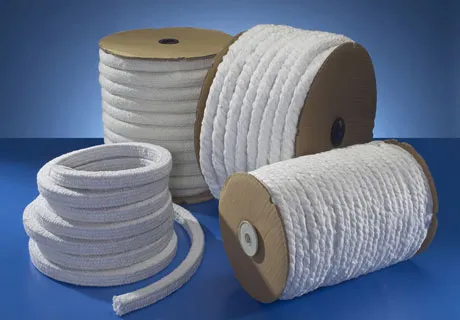
Ceramic fiber rope is a flexible, heat-resistant sealing material braided or twisted from continuous ceramic fiber yarn. The yarn itself is spun from alumina-silica fibers — the same base chemistry used in ceramic fiber blanket and board — but drawn into fine, continuous filaments that can be processed on textile braiding equipment.
Most manufacturers produce ceramic fiber rope through one of two methods: round braiding around a core, or square braiding for denser cross-sections. Some ropes incorporate an internal core of additional ceramic fiber yarn or, in some cases, a stainless steel wire reinforcement (typically Inconel 601 or 304SS) for applications where the rope is subject to mechanical abrasion or needs to maintain its round profile under compression.
The fibers are typically composed of 45–55% alumina (Al₂O₃) and 45–52% silica (SiO₂), with trace amounts of iron oxide, titanium dioxide, and alkali metal oxides. This chemistry delivers continuous service capability at temperatures ranging from 1000°C up to 1260°C for standard grades, and as high as 1430°C for zirconia-enriched formulations.
What sets ceramic fiber rope apart from other high-temperature sealing options — graphite packing, fiberglass rope, mineral wool rope — is the combination of flexibility, temperature resistance, and chemical inertness. It doesn’t melt, doesn’t off-gas toxic fumes below its classification temperature, and compresses predictably into irregular gaps. That last point matters more than most people realize. Furnace doors, expansion joints, and flue connections are never perfectly flat or round, and you need a seal that conforms to reality, not engineering drawings.
AdTech produces ceramic fiber rope in diameters from 5mm to 50mm, with both round and square braid configurations available. You can review the complete ceramic fiber rope specifications on our product page, but keep reading — the specs alone won’t tell you which rope to buy or how to install it properly.
If your project requires the use of ceramic fiber rope, you can contact us for a free quote.
Why Use Ceramic Fiber Rope Instead of Other High-Temperature Seals?
I’ll be blunt: ceramic fiber rope isn’t always the right answer. But for a surprisingly wide range of industrial sealing problems, it’s the most cost-effective solution that actually works long-term.
Let me put it in context. A plant engineer at an aluminum casting facility typically has four or five options for sealing a furnace door:
- Ceramic fiber rope — flexible, easy to replace, good to 1260°C+
- Graphite packing — excellent chemical resistance, but oxidizes above 450°C in air
- Fiberglass rope — cheap, but maxes out at around 550°C
- Expanded PTFE gasket — outstanding chemical resistance, limited to 260°C
- Metal-jacketed gaskets — extremely durable, but expensive and requires precision-machined flanges
In oxidizing atmospheres above 500°C, fiberglass and graphite both fail. PTFE is completely out of the picture. Metal gaskets work but cost five to ten times more per linear meter, and they demand flange surfaces machined to tight tolerances. Ceramic fiber rope fills the gap — it handles the heat, conforms to rough or warped surfaces, and costs a fraction of engineered metal seals.
| Sealing Material | Max. Continuous Temperature (Air) | Flexibility / Conformability | Relative Cost per Meter | Chemical Resistance |
|---|---|---|---|---|
| Ceramic Fiber Rope (standard) | 1260°C (2300°F) | Excellent | Low–Medium | Good (neutral/oxidizing) |
| Graphite Braided Packing | 450°C in air / 3000°C inert | Good | Medium | Excellent (reducing) |
| Fiberglass Rope | 550°C (1020°F) | Good | Low | Moderate |
| Expanded PTFE Rope | 260°C (500°F) | Excellent | Medium–High | Outstanding |
| Inconel Wire-Mesh Gasket | 1100°C (2010°F) | Poor | Very High | Excellent |
Performance ratings based on manufacturer published data and industrial gasket selection guidelines per ASME B16.20 and API 607 fire-safe standards.
Where ceramic fiber rope falls short is in reducing atmospheres containing hydrogen or carbon monoxide at sustained high temperatures — the silica component reduces and the fibers embrittle over time. For those environments, you’re better off with a high-alumina or polycrystalline fiber rope, or stepping up to a metallic seal entirely.
What Temperature Can Ceramic Fiber Rope Handle?
Temperature rating is the single most misunderstood specification in this product category. Every ceramic fiber rope comes with a “classification temperature” — but that number tells you the maximum temperature at which the fibers maintain structural integrity for a defined test period, not the temperature you should run them at every day.
Here’s the real-world breakdown by grade:
| Rope Grade | Fiber Chemistry | Classification Temperature | Recommended Max. Continuous Use | Typical Applications |
|---|---|---|---|---|
| Standard (STD) | Al₂O₃ ~47%, SiO₂ ~53% | 1050°C (1920°F) | 900°C | Oven door seals, low-temp expansion joints |
| High-Purity (HP) | Al₂O₃ ~48%, SiO₂ ~52%, low Fe₂O₃ | 1260°C (2300°F) | 1100°C | Furnace door seals, kiln car seals, flue joints |
| High-Alumina (HA) | Al₂O₃ ~55%, SiO₂ ~44% | 1400°C (2550°F) | 1200°C | Steel ladle seals, glass furnace joints |
| Zirconia (HZ) | Al₂O₃ ~36%, SiO₂ ~49%, ZrO₂ ~15% | 1430°C (2600°F) | 1250°C | Extreme-duty sealing, continuous casting |
Classification temperatures per ASTM C892 and EN 1094-1. Recommended continuous use temperatures include a safety margin to account for thermal cycling and long-term fiber devitrification.
The HP-grade 1260°C rope is by far the most widely used in general industry — it covers aluminum processing, heat treatment, ceramics manufacturing, and most petrochemical sealing applications. Unless your process genuinely operates above 1100°C at the seal location, the HP grade is almost certainly sufficient and costs 30–40% less than HA or HZ grades.
One thing I’ve learned from years of field work: the temperature at the seal is almost never the same as the furnace operating temperature. A furnace running at 1200°C internally might only see 700–900°C at the door seal, because the seal sits at the outer edge of the refractory lining where temperature drops off sharply. Measure the actual seal location temperature with a thermocouple or IR gun before you spec the rope — you might save yourself money.
What Are the Common Sizes and Forms of Ceramic Fiber Rope?
Ceramic fiber rope comes in more variations than most people expect. The two main variables are cross-section shape and diameter (or width, for square braid).
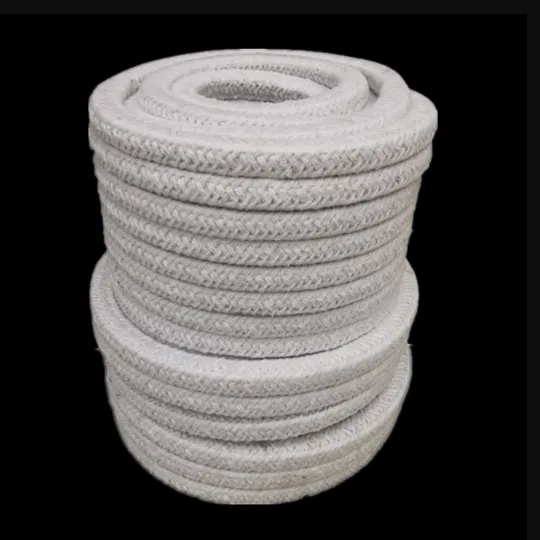
Round braid is the standard. It’s available in diameters from about 3mm up to 75mm, though the most commonly ordered sizes fall between 10mm and 30mm. Round braid compresses well into grooves and channels, making it ideal for furnace door seals, viewport frames, and pipe penetrations through furnace walls.
Square braid — sometimes called ceramic fiber packing — has a rectangular cross-section, typically from 6mm × 6mm up to 50mm × 50mm. It’s designed for stuffing box applications and flat-face gasket joints where a round profile would leave gaps. Square braid is also popular for sealing the joints between ceramic fiber board panels in furnace linings, where it acts as a compressible expansion joint.
Twisted rope is a simpler, less expensive construction — two or three yarns twisted together without a formal braid pattern. It works fine for non-critical sealing like chimney flue joints and wood stove door gaskets, but it doesn’t hold its shape as well as braided rope under repeated compression cycles.
Reinforced rope incorporates a stainless steel or Inconel wire core or outer wrap. This version resists abrasion and maintains its profile in high-vibration environments — think boiler door seals on industrial water-tube boilers or hatch seals on rotary kilns.
AdTech stocks round braid ceramic fiber rope in 5mm, 8mm, 10mm, 12mm, 15mm, 20mm, 25mm, 30mm, 40mm, and 50mm diameters, with custom sizes available on request. For a full overview of available configurations, check our ceramic fiber rope product page.
Where Is Ceramic Fiber Rope Used in Real Industrial Settings?
Let me walk through the applications I’ve actually seen in the field, rather than listing generic use cases from a textbook.
Furnace and kiln door seals. This is the bread-and-butter application. Every time a furnace door closes, the rope compresses against the door frame and creates a thermal barrier that prevents hot gas leakage. Without it, you lose heat, waste fuel, and risk flame impingement on the furnace shell. In aluminum melting and holding furnaces — the kind AdTech supports across its aluminum casting product range — door seals take a beating from thermal cycling and occasional molten metal splash. HP-grade rope in 15–25mm diameter handles this environment well, typically lasting 12–24 months before replacement depending on how frequently the door cycles.
Expansion joints in refractory linings. Refractory materials expand when heated. Without provision for that expansion, the lining cracks — or worse, it buckles and pushes bricks or panels out of alignment. Ceramic fiber rope packed into joints between firebrick courses or between ceramic fiber board panels absorbs that expansion without losing its sealing function. This is one of those details that separates a good furnace build from a bad one.
Flue and duct connections. The junction between a furnace exhaust port and its flue ductwork is rarely airtight without a gasket. Ceramic fiber rope wound around the flue pipe OD before insertion into the port creates a reliable, heat-resistant seal that accommodates differential thermal expansion between the furnace shell and the duct.
Heat treatment and annealing equipment. Retort furnaces, bell furnaces, and vacuum furnace charge doors all use ceramic fiber rope seals. In controlled-atmosphere heat treatment, the seal quality directly affects atmosphere integrity — a leaking door seal means oxygen infiltration, which means surface oxidation on your workpieces.
Glass manufacturing. Forehearth covers, spout seals, and feeder mechanism joints rely on ceramic fiber rope to contain heat and prevent glass leakage at connection points.
Pipe and cable penetrations. Any pipe, thermocouple sheath, or electrical conduit that passes through a furnace wall needs a seal around the annular gap. Ceramic fiber rope is the standard solution — easy to install, easy to replace, and far cheaper than fabricating a custom metal collar for every penetration.
How Do You Install Ceramic Fiber Rope Properly?
Installation is straightforward, but a few details make the difference between a seal that lasts two years and one that fails in two months.
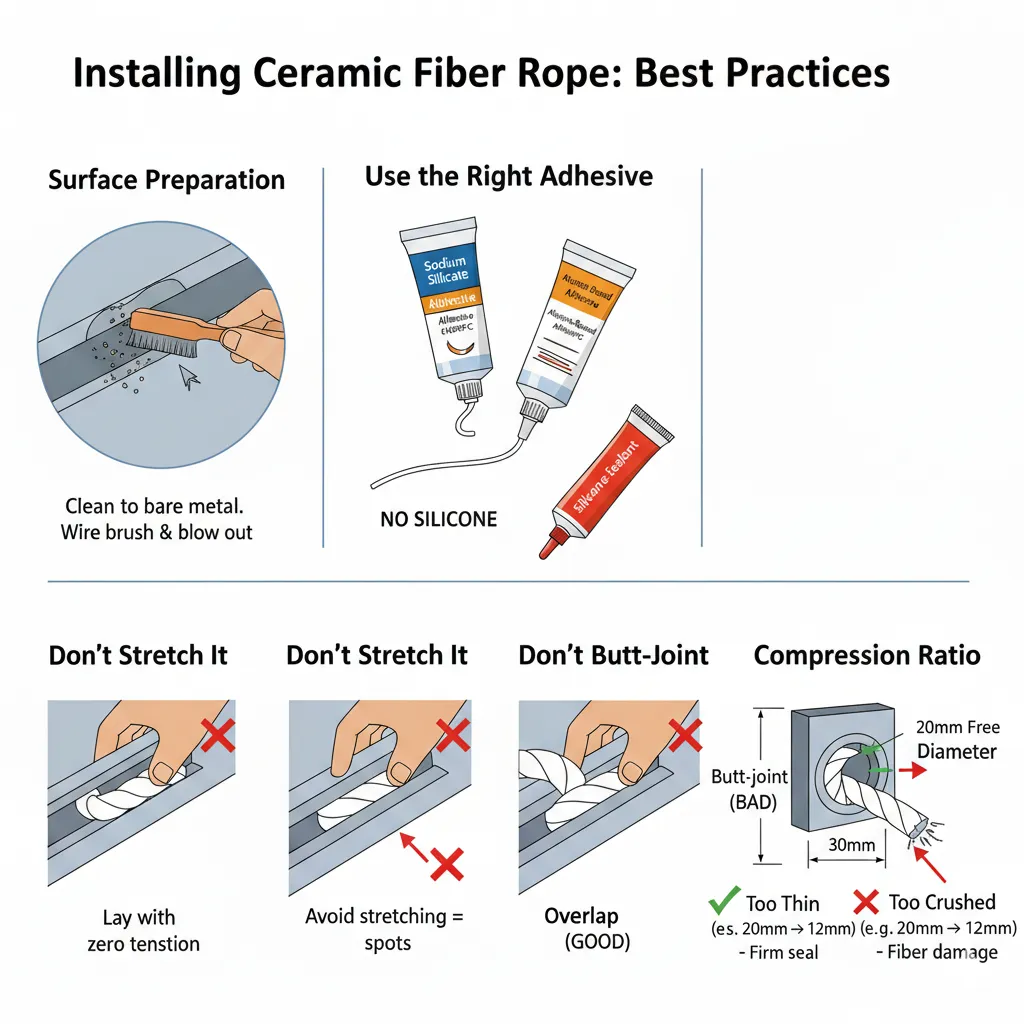
Surface preparation matters. Clean the groove or channel down to bare metal or clean refractory. Old rope residue, scale, and slag create an uneven seating surface that prevents proper compression. Wire brush the channel and blow it out with compressed air before you start.
Use the right adhesive. For applications below 1000°C, a high-temperature sodium silicate adhesive (water glass) works well for tacking the rope in place during door closure. Above 1000°C, use an alumina-based adhesive. Regular silicone sealant has no place in this application — it breaks down above 300°C and creates a mess.
Don’t stretch it. Ceramic fiber rope should be laid into the groove with zero tension. If you pull it tight around corners, it thins out and creates weak spots in the seal. Cut slightly longer than you think you need, and compress the ends together at the joint rather than leaving a gap.
Overlap, don’t butt-joint. At the point where the rope ends meet (usually near the bottom of a door seal), overlap them by at least 30mm and taper the ends so they mesh smoothly. A butt joint — where two square-cut ends simply press against each other — opens up as the rope shrinks slightly during the first heating cycle.
Compression ratio. A well-designed door seal compresses the rope by about 30–50% of its free diameter. If a 20mm rope is only being compressed to 18mm, it’s not sealing properly. If it’s being crushed to 5mm, the fibers are being destroyed and the seal will fail prematurely. Aim for the sweet spot — firm compression with visible deformation but no fiber breakage.
How Does Ceramic Fiber Rope Perform Over Time?
Nothing lasts forever, and ceramic fiber rope is no exception. Here’s what happens during its service life and what determines when you need to replace it.
First heat cycle (curing). During the first firing, organic binder components in the rope burn out and the rope shrinks slightly — typically 2–4% in length and diameter. This is normal and expected. The shrinkage stabilizes after the first full heat cycle.
Months 1–12. In a well-designed seal operating within its rated temperature range, the rope maintains its flexibility and compression recovery. It darkens in color from white to tan or light brown as trace organics burn away and minor iron oxide content in the fibers oxidizes.
Months 12–24. Gradual fiber devitrification begins, especially at the hot face of the rope (the side exposed to furnace heat). The fibers slowly convert from amorphous to crystalline phase (mullite and cristobalite), which makes them more brittle. The rope begins losing compression recovery — it still fills the gap, but it doesn’t spring back as effectively after a door opening.
Beyond 24 months. At this stage, the rope is usually significantly embrittled and may have developed hairline cracks along its length. It still provides some thermal barrier, but its sealing effectiveness against gas leakage has degraded substantially. This is when replacement makes economic sense — the cost of a new rope is trivial compared to the fuel wasted through a leaking door seal.
| Service Condition | Expected Rope Lifespan | Primary Degradation Mechanism |
|---|---|---|
| Furnace door seal, 700–900°C, daily cycling | 12–24 months | Fiber embrittlement from thermal cycling |
| Expansion joint, 600–800°C, continuous | 24–48 months | Gradual devitrification and compression set |
| Flue connection seal, 300–500°C, continuous | 36–60 months | Slow thermal aging, minimal degradation |
| Kiln car seal, 1000–1100°C, heavy cycling | 6–12 months | Rapid devitrification + mechanical abrasion |
Lifespan estimates based on field observation data across multiple AdTech customer installations and cross-referenced with published fiber degradation studies in the Journal of the European Ceramic Society.
AdTech Real Case: Solving a Persistent Seal Failure at a Vietnamese Steel Mill
In early 2025, a steel rolling mill in Hai Phong, Vietnam, contacted AdTech about a recurring problem with their reheating furnace. The facility operated two walking-beam reheating furnaces, each running continuously at 1250°C to heat steel billets before rolling. The furnace charge and discharge doors — massive water-cooled structures — relied on ceramic fiber rope seals to prevent hot gas escape.
The problem was this: the rope seals they’d been sourcing from a local supplier were failing within eight weeks. The rope hardened, crumbled, and fell out of the door groove in chunks, leaving gaps where 1200°C+ combustion gases escaped directly onto the furnace hall floor. Workers complained about the radiant heat. Energy consumption was elevated because the furnace control system compensated for heat loss by increasing burner firing rates. And the maintenance crew was spending two shifts every month replacing door seals — time they should have been using for other work.
When we examined a sample of the failed rope, the cause was obvious. The supplier had been providing a standard 1050°C-grade rope for a 1250°C application. The fibers were completely devitrified — essentially converted to a brittle ceramic powder that had no flexibility or resilience left.
AdTech recommended switching to our HA-grade ceramic fiber rope (1400°C classification, 25mm round braid with Inconel 601 wire reinforcement). The wire reinforcement was critical here because the walking-beam mechanism subjects the door seals to significant vibration, and standard unreinforced rope tends to abrade and disintegrate under those conditions.
We shipped 480 meters of rope — enough for both furnaces plus a six-month maintenance stock — along with a technical bulletin covering proper installation, adhesive selection, and compression gap specifications for their specific door design.
The results were dramatic:
- Seal replacement interval extended from 8 weeks to over 7 months
- Furnace shell temperature near the door frames dropped by 40°C, indicating substantially reduced gas leakage
- Natural gas consumption on both furnaces decreased by an estimated 8%, saving the mill roughly $11,000 per month
- Maintenance labor freed up from bimonthly seal replacements was redirected to other preventive maintenance tasks
- Worker heat exposure complaints near the door areas dropped to zero
The plant’s maintenance director visited our facility later that year to discuss additional applications, including sealing solutions for their soaking pit furnaces and potential use of our high-temperature insulation products for ladle and tundish applications. We’ve been their primary ceramic fiber products supplier ever since.
What made this project work wasn’t just supplying a better rope — it was correctly diagnosing the failure mode (wrong temperature grade), recommending the right reinforcement for the mechanical environment (vibration from walking beams), and providing installation guidance that their maintenance team could actually follow. That’s the difference between a parts supplier and a technical partner.
What Should You Check Before Ordering Ceramic Fiber Rope?
Before you place a purchase order, get these details sorted:
Actual temperature at the seal location. Not the furnace operating temperature — the temperature where the rope sits. Measure it. Then choose a rope grade with at least 150°C of headroom above that measurement.
Cross-section shape and size. Measure the groove or channel the rope will sit in. For door seals, the rope’s free diameter should be 1.5–2× the groove depth so it compresses properly when the door closes. Round braid for grooved channels, square braid for flat-face joints.
Length per piece. Ceramic fiber rope is supplied in coils, typically 15–30 meters per coil depending on diameter. Measure the total perimeter of your seal and order enough for the full loop plus 100mm overlap. If you’re stocking for planned replacements, factor in your replacement interval and order accordingly.
Reinforcement requirements. If the rope is subject to abrasion, vibration, or will be used as packing in a valve stuffing box, specify wire-reinforced construction. Standard unreinforced rope is fine for static door seals and expansion joints.
Atmosphere. Oxidizing (air, combustion products) is standard territory for alumina-silica ropes. Reducing or hydrogen-rich atmospheres require high-alumina or polycrystalline grades — talk to AdTech’s technical team before ordering if your environment is anything other than plain oxidizing.
The Practical Reality of Ceramic Fiber Rope
Here’s what twenty years of furnace maintenance experience has taught me about this product: it’s a consumable, not a permanent installation. Budget for it. Stock it. Replace it on schedule, not when it fails — because by the time it fails, you’ve already been losing energy and money for months without realizing it.
The cost of ceramic fiber rope is almost laughably small compared to the cost of the heat it retains. A full door seal on a large industrial furnace might use $50 worth of rope and save $500 a month in fuel. The math isn’t even close.
If you’re looking for a reliable supply of ceramic fiber rope across the full range of grades, sizes, and constructions, get in touch with AdTech or browse the detailed specs on our ceramic fiber rope product page. We ship globally, we support technically, and we answer the phone when something goes wrong at 2 AM on a Saturday — because that’s invariably when furnace problems happen.
FAQ
1. What is ceramic fiber rope made from?
It’s braided or twisted from continuous alumina-silica ceramic fiber yarn, typically containing 45–55% Al₂O₃ and 45–52% SiO₂. Some grades include zirconia for higher temperature performance. The yarn can be braided around a ceramic fiber core or a stainless steel/Inconel wire core for added mechanical strength.
2. What temperature rating should I choose for a furnace door seal?
Measure the actual temperature at the seal location — not the internal furnace temperature. Door seals typically see 30–50% lower temperatures than the furnace interior. Choose a rope grade with at least 150°C headroom above your measured seal temperature. For most aluminum and heat treatment furnaces, HP-grade (1260°C) rope is more than adequate.
3. How often does ceramic fiber rope need replacing?
It depends on temperature, cycling frequency, and mechanical wear. For a furnace door seal cycling daily at 700–900°C, expect 12–24 months of effective service. Expansion joint seals in continuous-operation furnaces can last 3–4 years. Replace on a schedule — don’t wait for visible failure, because energy losses start well before the rope completely breaks down.
4. Can ceramic fiber rope be used as valve packing?
Yes, square-braid ceramic fiber rope works as high-temperature packing in valve stuffing boxes where temperatures exceed the limits of graphite or PTFE packing. Wire-reinforced versions are recommended for valve applications because they resist extrusion under pressure better than unreinforced rope.
5. What’s the difference between round braid and square braid ceramic fiber rope?
Round braid has a circular cross-section and is designed for door seal grooves, pipe penetration seals, and any application where the rope sits in a rounded channel. Square braid has a rectangular cross-section suited for flat-face gasket joints, stuffing boxes, and sealing gaps between ceramic fiber board panels in furnace linings.
6. Does ceramic fiber rope shrink the first time it’s heated?
Yes. Expect 2–4% shrinkage in both length and diameter during the first full heat cycle as organic binders burn out. This is normal and stabilizes after the initial firing. Always cut rope slightly longer than your measured seal perimeter and overlap the ends by at least 30mm to compensate.
7. Is ceramic fiber rope safe to handle with bare hands?
The fibers can cause temporary skin irritation similar to fiberglass. Wear gloves and long sleeves during handling and installation. When cutting rope, use a sharp blade rather than tearing — tearing releases more airborne fiber. A P100 respirator is recommended during cutting, especially in enclosed spaces.
8. Can I use ceramic fiber rope in a wood stove or fireplace?
Absolutely — it’s one of the most common residential applications. Standard-grade rope (1050°C) is more than sufficient for wood stove door seals, where temperatures rarely exceed 400–500°C at the gasket. A 10mm or 12mm round braid is the typical size for most stove door channels.
9. What adhesive should I use to hold ceramic fiber rope in place?
For applications below 1000°C, sodium silicate (water glass) adhesive works well as a tacking agent. Above 1000°C, use an alumina-based high-temperature adhesive. Never use standard silicone sealant — it decomposes above 300°C and leaves residue that interferes with the seal. AdTech’s technical team can recommend the right adhesive for your specific application.
10. How does ceramic fiber rope compare to fiberglass rope for sealing?
Fiberglass rope is cheaper but maxes out at around 550°C — above that, the glass fibers soften and the rope loses all structural integrity. Ceramic fiber rope handles temperatures more than double that range. For any application above 500°C, ceramic fiber rope is the only sensible textile-based sealing option. Below 500°C, fiberglass works fine if budget is the primary concern.