
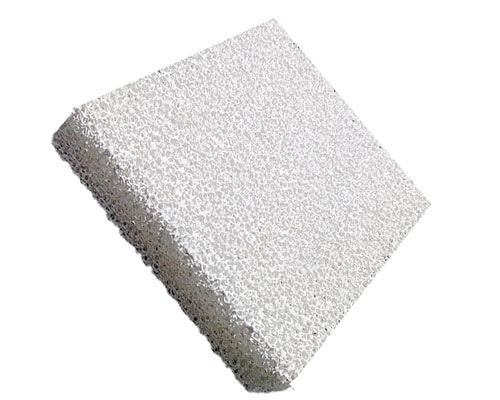
Overview and purpose
Porous Ceramic Filter is a high-performance filtration material widely used in industrial liquid and gas purification. As an important type of porous product, it features high porosity, low pressure loss, excellent filtration efficiency, and long service life. With its interconnected pore structure, porous ceramic filter material can provide reliable filtration performance in demanding environments such as high-temperature dust removal, wastewater treatment, and chemical processing.
As a leading type of these products, ceramic foam filters offer a unique combination of high porosity and mechanical strength.
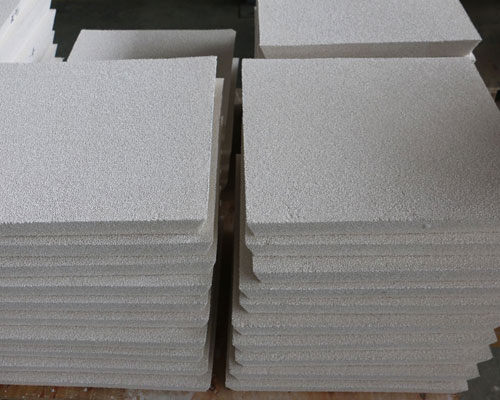
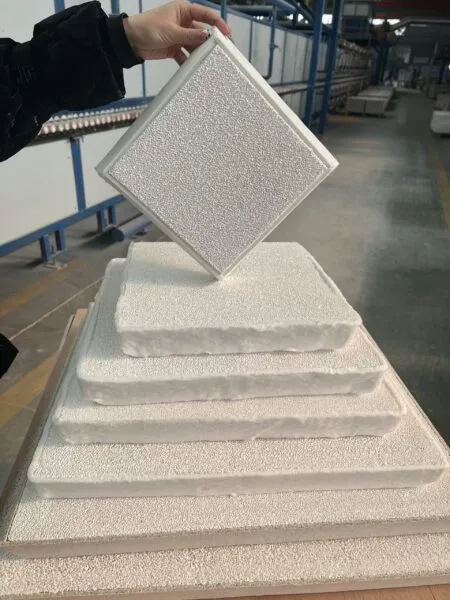
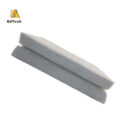
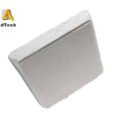
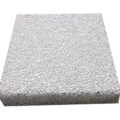
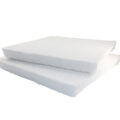
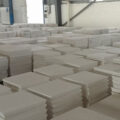
porous ceramic filter plates for industrial filtration
Main Features of Porous Ceramic Filter Product
High Porosity and Filtration Performance
Porous Ceramic Filter Product has high porosity and excellent filtering performance. The high porosity provides a large internal surface area and increases the contact area between the filter material and high-temperature flue gas, sewage, or other polluted fluids. This helps improve the filtration and purification effect while reducing the overall cost of fluid treatment.
Low Pressure Loss and Operating Efficiency
Another major advantage is low pressure loss during the filtration process. This allows the system to maintain stable flow while achieving high filtration efficiency. In addition, porous ceramic filter products have a long service life, making them a cost-effective choice for industrial filtration applications.
Mechanical Strength and Chemical Resistance
These filters also offer high mechanical strength and can withstand large pressure differences. They have excellent corrosion resistance and erosion resistance, ensuring high reliability and operational safety under harsh working conditions.
Key Features and Benefits of Porous Ceramic Filter Product(Table)
| Feature | Description | Benefit |
|---|---|---|
| High Porosity | The filter material has a highly porous structure with a large internal surface area. | Improves contact with gases or liquids and enhances filtration and purification efficiency. |
| Low Pressure Loss | The porous structure allows fluid to pass through with relatively low resistance. | Helps maintain stable system flow and reduces energy consumption. |
| High Filtration Efficiency | The filter combines surface filtration, depth filtration, and adsorption. | Enables effective removal of particles and impurities in industrial processes. |
| Controlled Pore Size Distribution | The pore size is carefully designed for stable filtration performance. | Improves particle capture efficiency and filtration accuracy. |
| Three-Dimensional Network Structure | The pores are interconnected in a tortuous network. | Increases particle retention path and improves primary purification performance. |
| High Mechanical Strength | The material can withstand large pressure differences. | Ensures stable operation and improves equipment safety. |
| Corrosion and Erosion Resistance | The ceramic material performs well in harsh chemical and abrasive environments. | Extends service life and improves reliability in industrial applications. |
| Regenerable Structure | The filter can be cleaned by blowback or backwashing. | Reduces maintenance cost and supports long-term reuse. |
| High Temperature Resistance | The material can operate in high-temperature environments up to 1350°C. | Suitable for hot gas filtration and dust removal applications. |
| Low Thermal Expansion | The ceramic structure remains stable under temperature changes. | Reduces the risk of damage in extreme thermal conditions. |
(All performance descriptions are based on typical operating conditions in industrial applications.)
Pore Structure and Filtration Performance
Controlled Pore Size Distribution
The pore size distribution of Porous Ceramic Filter Product is carefully controlled, which helps improve filtration accuracy and particle removal efficiency. In suitable operating conditions, more than 95% of high-temperature dust particles can be removed in a single filtration stage.
Three-Dimensional Interconnected Network Structure
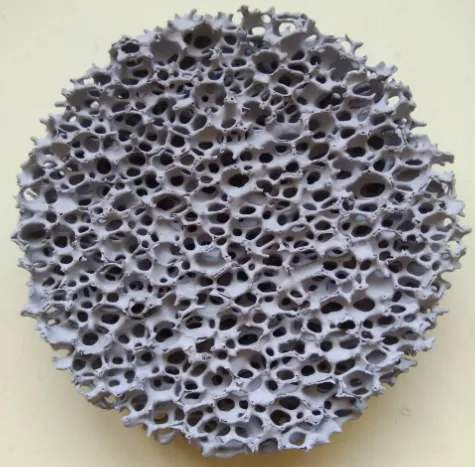
The pore structure is a three-dimensional interconnected network. This design increases the path of solid particles inside the filter material and significantly improves the primary purification rate. At the same time, the network structure reduces excessive particle accumulation inside the filter body, which helps lower maintenance frequency.
This structure is a defining characteristic of high-quality ceramic foam filter products.”
Backflush and Regeneration Performance
Because of this open porous network, cleaning resistance during backflushing is reduced, making the filter easier to regenerate and maintain.
Working Principle of Porous Ceramic Filter Product
The filtration of Porous Ceramic Filter Product combines adsorption, surface filtration, and depth filtration. This combined filtration mechanism enables the filter to remove particles of different sizes with high efficiency.
The main filtration mechanisms include inertial collision, diffusion, and interception.
Inertial Collision
When fluid passes through the microporous channels of the porous ceramic filter element, impurity particles may collide with the pore wall due to inertia. This inertial collision is generally proportional to the square of the particle diameter and is influenced by flow velocity and fluid viscosity.
Diffusion Capture
Very fine particles can also be captured by diffusion. Due to Brownian motion, these particles deviate from the streamline and come into contact with the microporous channel wall, where they are trapped.
Particle Interception and Filter Cake Formation
Larger impurity particles are removed by interception. When the particles are larger than the effective pore passage, they are retained on the filter surface and gradually form a filter cake layer. Smaller particles may also be captured inside the porous ceramic structure through inertia, diffusion, and bridging effects within the tortuous microporous channels.
Nominal Pore Size vs Actual Filtration Accuracy
Because of the complex migration path inside the porous ceramic material, the actual filtration accuracy can be much higher than the nominal pore size. For example, a porous ceramic filter element with a pore size of 10 μm may achieve a filtration accuracy of about 1 μm in liquid filtration and about 0.5 μm in gas filtration under suitable conditions.
Regeneration and Cleaning Method
Filter Performance Degradation Over Time
After the porous ceramic filter operates for a period of time, particulate impurities in the fluid may block some internal channels. At the same time, the filter cake layer on the surface may become thicker, which increases filtration resistance and reduces flow rate.
Supported Cleaning and Regeneration Methods
To restore filtration performance, Porous Ceramic Filter Product can be regenerated by gas blowback, liquid backwashing, or gas-liquid combined cleaning. These cleaning methods help remove deposited particles from the porous network and restore the filter element to a condition close to its original performance.
Service Life Extension
Regular back-blowing and backwashing can greatly extend the service life of porous ceramic filter elements and reduce replacement costs.
Temperature Resistance and Mechanical Strength
Thermal Stability and Operating Temperature Range
Porous Ceramic Filter Product has excellent thermal conductivity and a low coefficient of thermal expansion. It can be used for high-temperature dust purification at temperatures up to 1350°C and can also work at extremely low temperatures down to -40°C without damage.
Mechanical Performance Under Operating Conditions
In addition to excellent temperature resistance, the material also offers strong mechanical performance. It can withstand large pressure differences and maintain stable filtration performance in demanding industrial systems, making it a safe and reliable choice for continuous operation.
The main Technical Performance and Operating Characteristics of Porous Ceramic Filter Product(Table)
| Item | Performance / Characteristic | Notes |
|---|---|---|
| Filtration Mechanism | Adsorption, surface filtration, and depth filtration | Multiple mechanisms work together to improve particle removal. |
| Particle Capture Methods | Inertial collision, diffusion, and interception | Suitable for capturing both large and fine particles. |
| Particle Removal Efficiency | >95% for high-temperature dust particles | Actual performance depends on operating conditions. |
| Pore Structure | Three-dimensional interconnected porous network | Improves filtration accuracy and reduces particle accumulation. |
| Nominal Pore Size Example | 10 μm | Can achieve finer actual filtration performance. |
| Liquid Filtration Accuracy | Approximately 1 μm | Depends on medium properties and flow conditions. |
| Gas Filtration Accuracy | Approximately 0.5 μm | Higher precision in gas filtration applications. |
| Supported Cleaning Methods | Gas blowback, liquid backwashing, combined cleaning | Supports full regeneration and performance recovery. |
| Operating Temperature Range | -40°C to 1350°C | Suitable for both low and high temperature environments. |
| Typical Applications | Gas filtration, wastewater treatment, metallurgy | Designed for demanding industrial systems. |
(Sources for all parameter norms: official manufacturing datasheets and published technical literature.)
Ceramic Foam Filter vs Porous Ceramic Filter Product
Understanding the difference between ceramic foam filters and porous ceramic filter products is important when selecting the right filtration solution for industrial applications.
Structure and Filtration Mechanism
Ceramic foam filters feature an open-cell foam structure with relatively large pores, typically measured in PPI (pores per inch). They are designed for coarse filtration and are highly effective at removing large impurities from molten metals.
In contrast, porous ceramic filter products have a more controlled and uniform pore size distribution, usually in the micrometer (μm) range. This allows them to perform fine filtration through a combination of surface filtration, depth filtration, and adsorption.
Application Differences
Ceramic foam filters are mainly used in metallurgical processes, such as aluminum and steel casting, where they help remove inclusions from molten metal. These filters are typically single-use due to the extreme operating conditions.
Porous ceramic filter products, on the other hand, are widely used in gas and liquid filtration systems, including high-temperature dust removal, wastewater treatment, and chemical processing. They are designed for long-term use and can be regenerated through backwashing or blowback cleaning.
Performance and Reusability
While ceramic foam filters offer excellent thermal shock resistance and high porosity, they are generally not reusable. In contrast, porous ceramic filters provide higher filtration precision, longer service life, and lower long-term operating costs due to their regenerable structure.
Key Differences at a Glance(Table)
| Aspect | Ceramic Foam Filter | Porous Ceramic Filter Product |
|---|---|---|
| Structure | Open-cell foam | Controlled microporous structure |
| Filtration Type | Coarse filtration | Fine filtration |
| Pore Size | Larger (PPI) | Smaller (μm) |
| Applications | Molten metal filtration | Gas & liquid filtration |
| Reusability | Single-use | Reusable |
| Service Life | Short | Long |
Overall, porous ceramic filter products are better suited for high-precision and long-term filtration, while ceramic foam filters are mainly used for molten metal applications.
Why Modern Ceramic Foam Filters Look Different from Traditional Foam Structures
Industry Definition vs Physical Structure
In many industrial applications, the term “ceramic foam filter” is used as a general classification rather than a strict description of the material’s visible structure. Traditionally, ceramic foam filters are known for their open-cell, sponge-like appearance. However, with advances in manufacturing technology, modern ceramic foam filters can feature a more refined and uniform porous structure.
Advancements in Manufacturing Technology
With advances in manufacturing technology, modern ceramic foam filters can feature a more refined and uniform porous structure.
Improved Filtration Performance
These improved structures are designed to enhance filtration accuracy, mechanical strength, and overall performance. Compared to traditional foam-like materials, advanced porous ceramic filters provide better control over pore size distribution, resulting in more efficient particle capture and more stable operation under demanding conditions.
Classification Based on Application
As a result, even if a ceramic filter does not exhibit a visibly coarse foam structure, it may still be classified as a ceramic foam filter based on its application, function, and industry standards.
Why Modern Designs Are Preferred
In fact, many high-performance ceramic foam filters used today adopt optimized porous designs to meet the increasing demands of industrial filtration systems. These advanced porous ceramic foam filters are particularly suitable for applications requiring high precision, durability, and long service life, making them a preferred choice in modern industrial filtration systems.
Applications of Porous Ceramic Filter Product
Porous Ceramic Filter Product is widely used in many industrial filtration fields, including:
Most Common Industrial Applications
- High-temperature gas filtration
- Dust removal systems
- Industrial wastewater treatment
- Chemical liquid filtration
- Environmental protection equipment
- Metallurgical filtration processes
For demanding applications such as molten metal purification, our ceramic foam filters for foundries are the recommended solution.
Recommended Operating Conditions
Because of its high filtration efficiency, excellent corrosion resistance, and regenerable structure, it is especially suitable for applications requiring stable performance under high temperature, high pressure, or chemically aggressive conditions.
Looking for a Reliable Ceramic Foam Filter Supplier?
Choosing the right filtration material is critical for performance and cost efficiency. Our ceramic foam filters are designed to meet demanding industrial requirements, offering consistent quality, high filtration efficiency, and reliable supply.
Explore our ceramic foam filter products to find the right solution for your application.
View Our Ceramic Foam Filter Products »
FAQ
1. How do I choose the right porous ceramic filter product for my application?
The right product depends on several factors, including the filtration medium, particle size, required filtration accuracy, operating temperature, pressure conditions, and flow rate. The shape and dimensions of the filter should also match the equipment design and system layout.
2. What factors affect the filtration efficiency of a porous ceramic filter?
Filtration efficiency is affected by pore size, pore structure, flow velocity, particle characteristics, fluid viscosity, operating pressure, and the formation of a filter cake layer during operation. Proper product selection and operating conditions are important for achieving stable filtration performance.
3. How often does a porous ceramic filter need maintenance?
Maintenance frequency depends on the dust load or impurity concentration in the fluid, the system operating conditions, and the cleaning method used. In many applications, maintenance is performed when pressure drop increases or flow rate decreases beyond the normal operating range.
4. Can a porous ceramic filter product be customized?
Yes. Porous ceramic filter products can often be customized according to specific industrial requirements, including pore size, dimensions, thickness, shape, filtration accuracy, and structural design. Customization helps improve compatibility with different systems and working conditions.
5. Is porous ceramic filter product suitable for continuous industrial operation?
Yes. Because of its high mechanical strength, thermal stability, and corrosion resistance, porous ceramic filter product is suitable for continuous operation in many industrial environments. Its regenerable structure also helps support long-term use with proper cleaning and maintenance.
6. What causes clogging in a porous ceramic filter?
Clogging usually occurs when particulate matter accumulates on the filter surface or inside the pore channels over time. High impurity concentration, insufficient cleaning, unsuitable pore size, or unstable operating conditions may accelerate blockage and increase filtration resistance.
7. How can pressure drop be controlled in a porous ceramic filtration system?
Pressure drop can be controlled by selecting the correct pore size, maintaining an appropriate flow rate, preventing excessive particle loading, and performing regular backwashing or blowback cleaning. Proper system design also helps maintain stable filtration performance.
8. What is the difference between nominal pore size and actual filtration accuracy?
Nominal pore size refers to the approximate size of the pores in the filter material, while actual filtration accuracy reflects the real particle removal performance during operation. Because of the complex pore channels and multiple filtration mechanisms, porous ceramic filters can often capture particles smaller than their nominal pore size.
9. In what situations should a porous ceramic filter be replaced instead of regenerated?
Replacement is usually necessary when the filter structure is damaged, when repeated cleaning can no longer restore acceptable flow or filtration performance, or when long-term use causes irreversible blockage or material degradation.
10. What information should be provided before selecting a porous ceramic filter supplier?
It is helpful to provide details such as the application type, filtration medium, operating temperature, pressure, flow rate, particle size range, required filtration accuracy, chemical environment, and preferred product dimensions. This helps the supplier recommend a more suitable filtration solution.
Related posts:
 Foundry Ceramic Filters
 Ceramic Filter for Aluminum Foundry
 Ceramic Foam Filter Manufacturers
 Ceramic Filter Plate
 Filter Foundry
 Foam Ceramic Filters
 Ceramic Filter for Casting
 Ceramic Foam Filter Boards
 Aluminum Casting Filter Media
 Selection of Ceramic Foam Filter
 Ceramic Foam Filter from China
 Filters of Molten Aluminum