
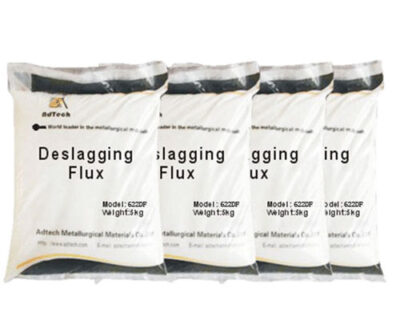
In aluminum melting and casting, dross is not just waste—it represents direct metal loss and hidden production cost.
In many foundries, untreated dross can still contain a significant amount of recoverable aluminum, especially when scrap ratios are high or furnace operation is unstable. A properly selected Drossing Flux for Aluminum helps separate metal from slag, improve melt cleanliness, and stabilize casting quality.
This guide is based on real plant practices and practical application experience, not theoretical descriptions.
What Is Drossing Flux for Aluminum and What Does It Do?
Drossing flux for aluminum is a slag treatment and melt protection material used during aluminum melting to:
- Aggregate oxide impurities into removable slag
- Separate trapped aluminum from dross
- Form a protective layer on molten metal
- Reduce further oxidation during holding
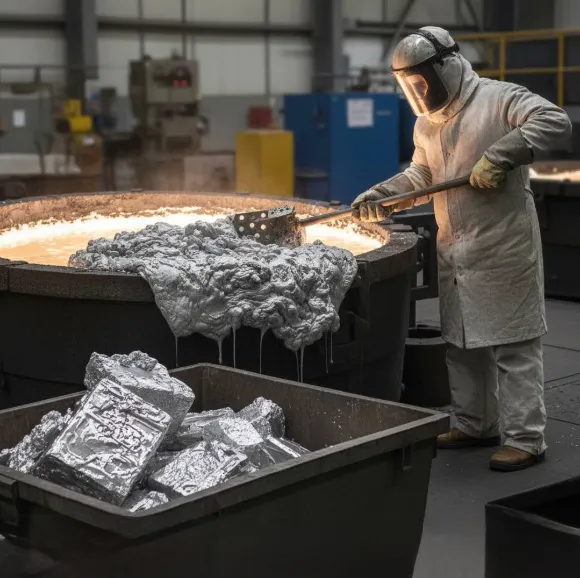
Unlike traditional salt-heavy fluxes, modern formulations (such as silicate-based systems) focus more on physical aggregation, coverage, and insulation, rather than aggressive chemical reactions.
In practical operation, this means:
- Cleaner melt surface
- Lower aluminum loss
- Easier slag removal
Why Does Aluminum Form Dross During Melting?
Aluminum is highly reactive with oxygen, which makes dross formation unavoidable.
During melting:
- Surface oxidation continuously forms oxide film
- Charging scrap introduces impurities and air
- Mechanical disturbance breaks oxide layers
- Aluminum droplets become trapped inside dross
According to metallurgical studies, aluminum oxidation is a rapid surface reaction that intensifies with temperature and turbulence (source: Springer materials research on aluminum oxidation behavior).
Real production observation:
- Scrap melting → significantly more dross
- Frequent furnace opening → increased oxidation
- Poor temperature control → unstable slag formation
How Does Drossing Flux for Aluminum Work in Practice?
In real foundry environments, drossing flux works through a combination of physical and thermal mechanisms. Fluxing efficiency depends on temperature, composition, and application method, all of which directly influence inclusion removal and melt cleanliness.
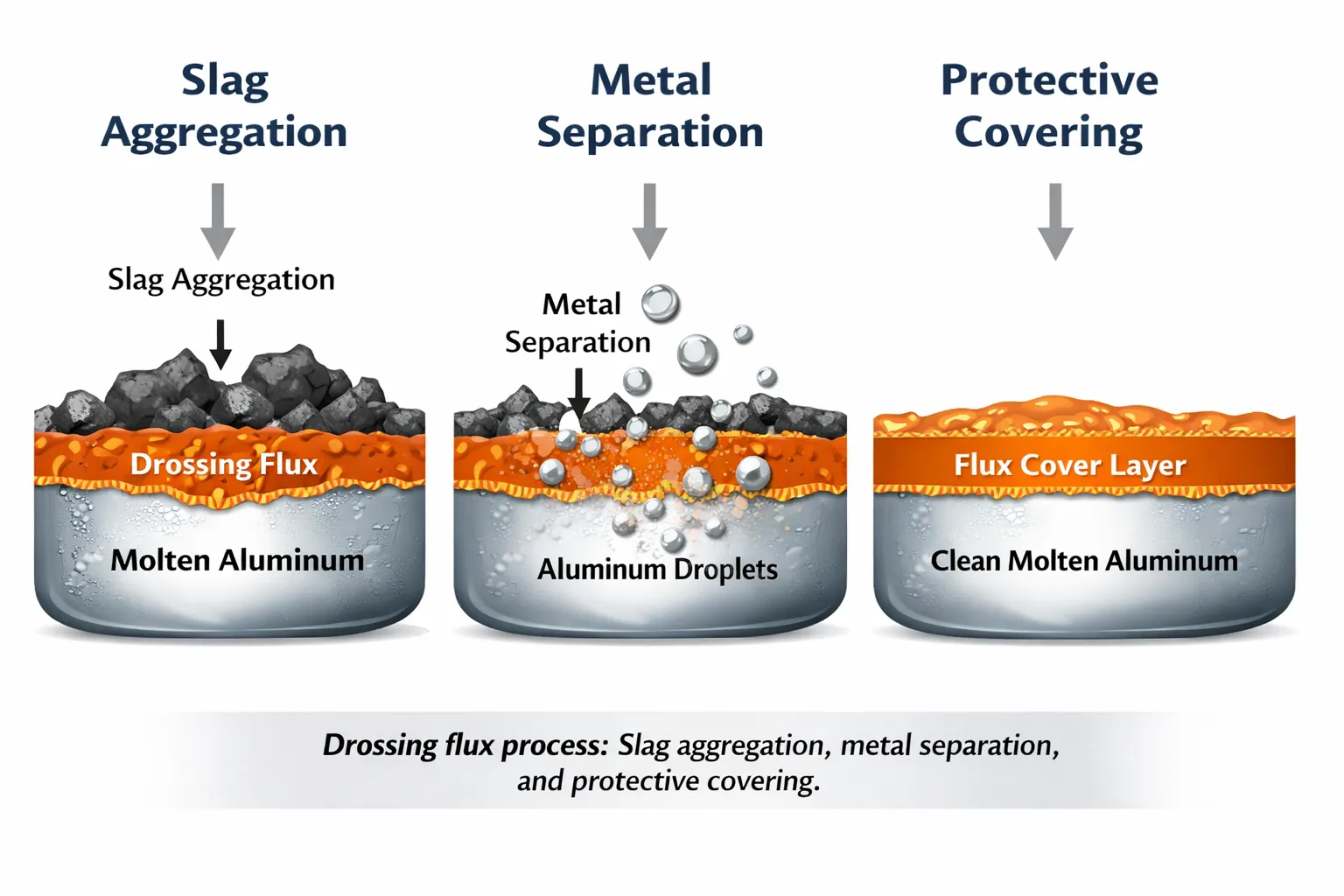
1. Slag aggregation
Flux spreads across the molten surface and gathers fine oxide particles into larger, compact slag masses.
2. Metal separation
It reduces adhesion between aluminum and oxide, allowing trapped metal to flow back into the melt.
3. Protective covering
A surface layer forms that isolates molten aluminum from air, reducing further oxidation.
4. Thermal insulation
Helps maintain temperature stability during holding, especially in open furnaces.
Practical indicator:
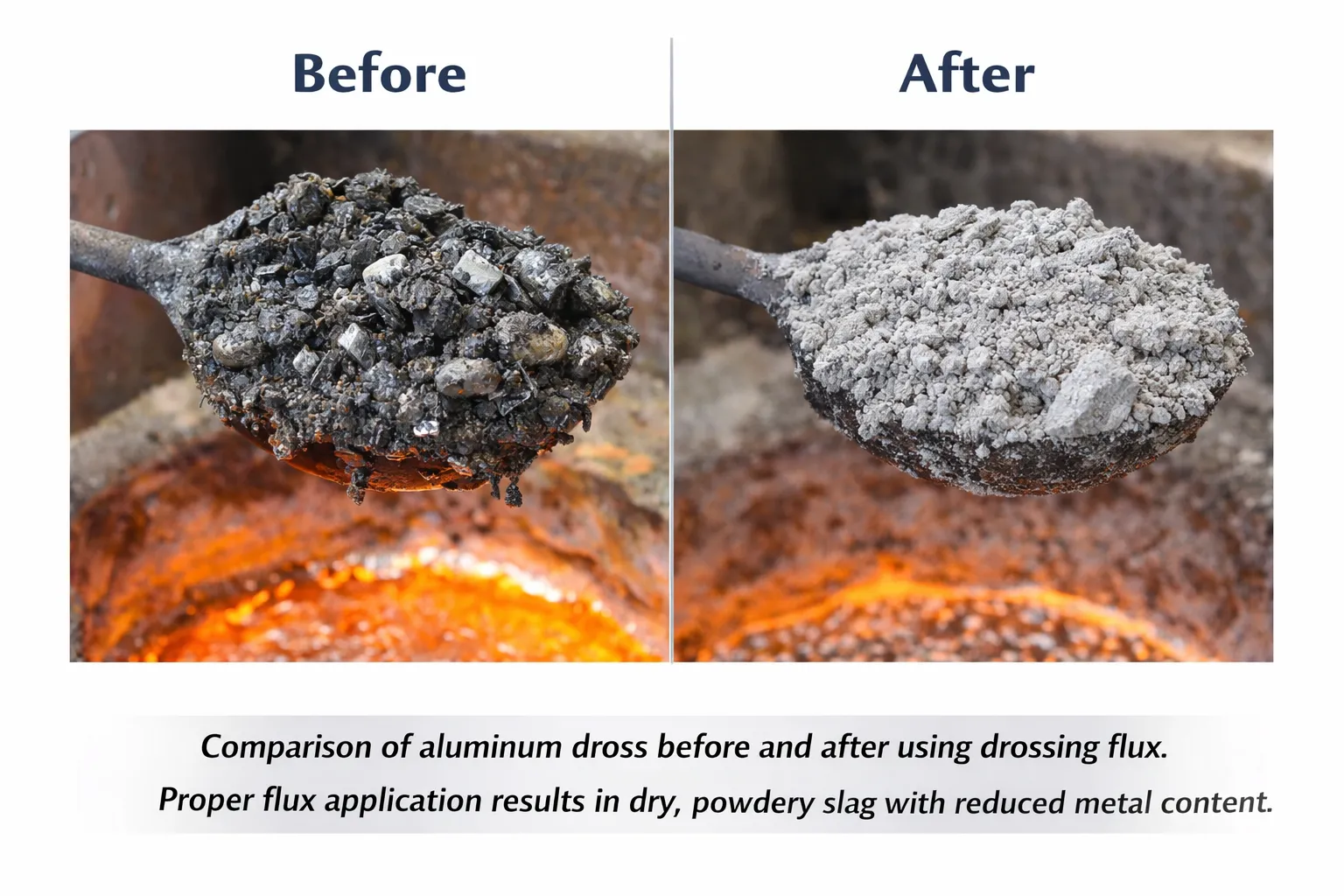
- Good flux → dry, loose, powdery dross
- Poor flux → sticky, metallic dross
What Is the Composition of Drossing Flux for Aluminum?
Different flux systems exist, but they generally fall into two categories:
Composition Comparison Table
| Flux Type | Main Components | Working Principle |
|---|---|---|
| Traditional salt-based flux | NaCl, KCl, fluorides | Chemical reaction & oxide dissolution |
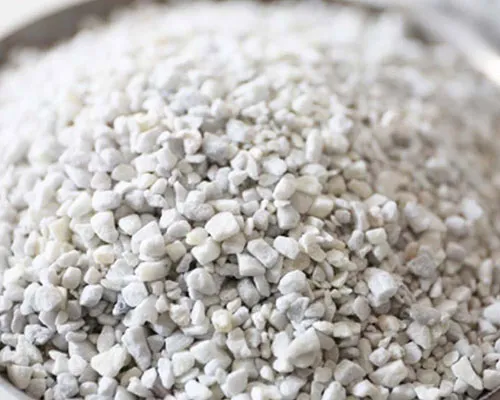
| Silicate-based flux | Mineral silicates (e.g., volcanic ash) | Physical aggregation & insulation |
his distinction is important because it directly affects:
- Emissions
- Metal recovery efficiency
- Environmental compliance
This comparison is based on industry flux formulation practices and aluminum melt treatment principles widely referenced in metallurgical research.
How Much Drossing Flux Should Be Used per Ton of Aluminum?
Correct dosage is critical for both performance and cost control.
Table 1: Recommended Dosage Table
| Application Condition | Dosage (kg/ton) |
|---|---|
| Normal melting conditions | 1 – 3 |
| High scrap ratio | 3 – 5 |
| Heavy oxidation | Adjust based on observation |
These values reflect actual foundry usage ranges and are consistent with practical melting operations.
👉Tips:
- Even distribution is more important than total quantity
- Overuse does not improve performance and may increase cost
- Apply in stages rather than all at once
What Is the Best Temperature for Using Drossing Flux?
Temperature directly impacts flux performance.
Table 2: Recommended Temperature Table
| Process Stage | Temperature (°C) |
|---|---|
| Flux addition | 700 – 740 |
| Reaction stage | 720 – 760 |
| Slag removal | 690 – 720 |
Temperature control is a key factor in melt fluidity and surface tension, both of which influence flux efficiency
👉Tips:
- Too low → flux cannot fully activate
- Too high → oxidation increases
How to Use Drossing Flux for Aluminum Step by Step?
Correct application has more impact than flux type.
Standard Operating Procedure
- Remove large floating slag from surface
- Evenly spread flux across molten aluminum
- Apply light stirring if needed (avoid turbulence)
- Allow reaction time (1–3 minutes)
- Skim off compact slag layer
👉Tips:
- Avoid aggressive stirring (introduces air)
- Use preheated tools to prevent temperature drop
- Ensure full surface coverage
What Other Products Are Used Together with Drossing Flux for Aluminum?
In real production environments, drossing flux is rarely used alone. Most aluminum casting plants combine multiple melt treatment solutions to achieve better results.
- Deslagging Flux– removes fine inclusions and improves melt purity
- Ceramic Foam Filter– filters non-metallic particles during casting
- Aluminum Degassing Unit– removes hydrogen and reduces porosity
Combining these solutions can significantly improve casting quality, especially in recycled aluminum or high-demand applications.
Why Does Drossing Flux Improve Casting Quality?
Many users focus only on slag removal, but the impact goes further.
Quality improvements include:
- Reduced inclusion defects
- Better surface finish
- Improved mechanical properties
- Lower rejection rates
This is because fewer oxide inclusions enter the mold during casting.
Practical result:
Better melt cleanliness leads to more stable downstream processing.
Can Drossing Flux Also Work as Covering and Insulation Flux?
Yes, and this is increasingly important in modern foundries.
A well-designed flux can:
- Cover molten aluminum surface
- Reduce heat loss
- Prevent secondary oxidation
- Stabilize holding furnace conditions
This multifunctional behavior reduces the need for separate materials.
When Should You Use Deslagging Flux Instead of Drossing Flux?
Different flux types serve different purposes.
Drossing Flux vs Deslagging Flux Table
| Type | Function | Application Stage |
|---|---|---|
| Drossing flux | Remove dross & recover metal | Melting stage |
| Deslagging flux | Remove inclusions & purify melt | Refining stage |
| Combined flux | Both functions | Scrap-heavy or high-quality casting |
This classification reflects standard aluminum melt treatment practices used in casting plants.
Practical recommendation:
- If problem = high dross → use drossing flux
- If problem = casting defects → use deslagging flux
- If both → use combined solution
What Results Can You Expect from a Good Drossing Flux?
Based on actual plant feedback and operational data:
- Metal recovery improvement: 10–20%
👉Studies show that aluminum dross can still contain 30–60% recoverable metallic aluminum, making proper dross treatment essential for cost control.
- Dross dryness significantly improved
- Slag removal becomes easier
- Labor intensity reduced
- Casting defects reduced
Real production insight:
The biggest benefit is not just material saving, but process stability.
FAQ:
1. What is drossing flux used for?
It is used to remove slag and recover aluminum from dross during melting.
2. Is drossing flux the same as deslagging flux?
No, but some products combine both functions.
3. Why is my dross still metallic?
This is usually caused by uneven distribution or insufficient reaction time.
4. Can drossing flux prevent oxidation?
Yes, it forms a protective layer on the melt surface.
5. What is the typical dosage?
Usually 1–3 kg per ton under normal conditions.
6. Does flux affect aluminum composition?
No, high-quality flux does not alter alloy chemistry.
7. Can it be used in holding furnaces?
Yes, especially for insulation and surface protection.
8. Is it environmentally friendly?
Modern formulations produce less harmful emissions compared to traditional salt flux.
9. Is stirring necessary?
Only light stirring is recommended.
10. What type of aluminum benefits most?
Recycled aluminum and high-impurity melts benefit the most.
Related posts:
 Slag Remover
 Fluxes for Aluminum Alloys
 Aluminum Casting Flux
 Flux For Aluminum Melting: How to Choose the Right Flux for Better Metal Quality and Recovery
 Slag Removal Flux
 Refining Agent
 How to Use Aluminum Flux: Step-by-Step Methods to Improve Melt Quality and Reduce Dross
 Drossing Flux: A Practical Guide to Reducing Aluminum Loss and Controlling Melt Behavior
 Aluminum Degassing Flux
 Al Alloy Granulated Flux
 Fluxes for Aluminum